
Updated August 2026 with new insights on Existential Analysis and authenticity.
Many of us, at some point, quietly ask ourselves: “Why do I feel like I don’t fit in anywhere?” This experience can be painful, leaving us feeling isolated, disconnected, or uncertain about where we truly belong. Yet, this question is also deeply human—it reflects our search for meaning, belonging, and authenticity.
Existential Analysis, founded by Professor Alfried Längle, helps us approach this struggle not as a flaw, but as an opportunity for self-discovery. It invites us to reflect on the four fundamental motivations of life: our need for safety, for connection, for authenticity, and for meaningful purpose. These questions open the door to understanding what belonging really means—not just externally, but within ourselves.
At Meaningful Paths, our Mountain Framework translates these ideas into a practical guide. Through My Motivation, My Journey, and My Decisions, you can reflect on what anchors you, map the inner and outer landscapes of your life, and choose actions that align with your true values. By walking this path step by step, you may discover that “fitting in” is less about changing yourself, and more about finding spaces—and people—that welcome the authentic you.
Why do we want to fit in so badly?
According to Psychiatrist Joanna Cannon, 2016;
“Familiarity is the social glue that bonds people together, and we deliberately seek out the similar and the recognizable in order to feel secure. If we’re doing the same as everyone else, we must be doing it right, and finding a reflection of ourselves in those around us is a form of validation.”
It is perfectly normal to want to fit in for validation, security of other humans, opportunities to find love and more. Joanna Cannon further discusses the idea that from an early age on the playground we mimic other children’s behaviours to validate ourselves. As adults, we priorities ordinary and can exclude others because it makes us question our own validation of ourselves that we have been working on for decades of our lives since the playground.
It is motivating for us to be part of a group. Art Markman, Ph.D. looked at a series of studies which showed that people with simple things such as the same birthday worked harder together to complete a task as it showed that sense of belonging to another person with the same birthday. This study also showed how people can feel more warmth to one another just from a simple connection of belonging.
According to Blue Zones social isolation can cause a decrease in our mental well-being due to stress hormones rising when our self-worth decreases. They also suggest that a sense of belonging can actually increase your lifespan;
“Dr. James House at the University of Michigan found the chance of dying over a period of 10 years increases by 10 percent for people who live alone or have only a few friends compared to people with more friends and family.”
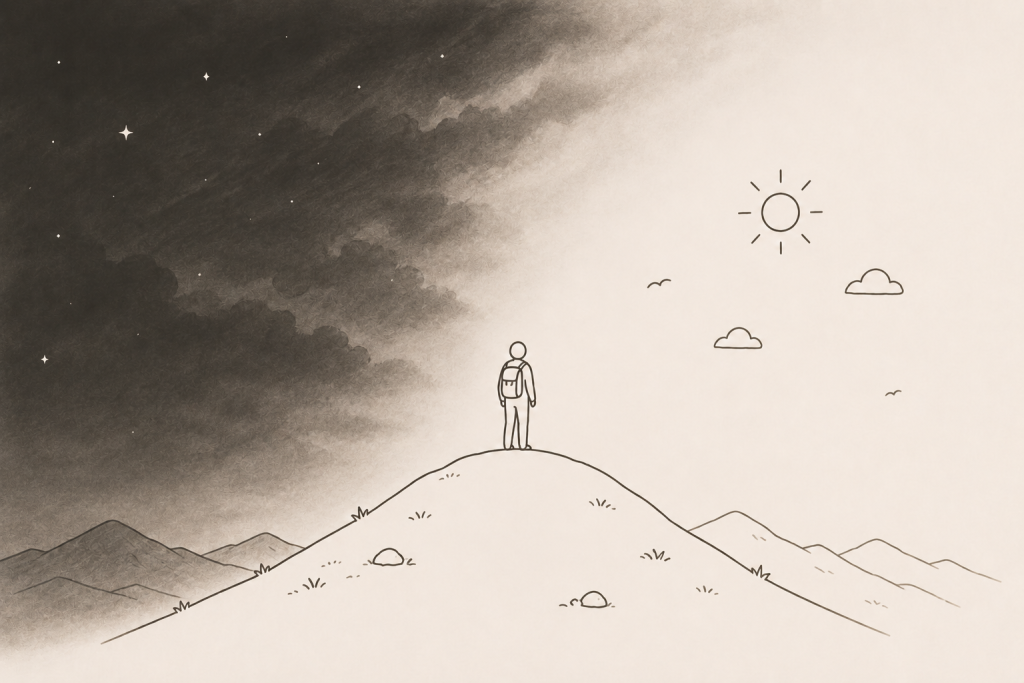
Why you may feel like you don’t fit in anywhere
It is normal to feel insecure at stages in our life and not have a full understanding your self-image and identity. We will now explore some reasons why you may feel like ‘I don’t fit in anywhere,’ and once you begin to understand this further you will then have deeper foundations to explore ways to create the life you desire.
Why you may feel like you don’t fit in anywhere
Feeling that you do not belong rarely has one simple cause. It can be shaped by past experiences, the people around you, how you relate to yourself, and the stage of life you are moving through.
You may recognise yourself in one reason, several of them, or none exactly. Use these as possibilities to reflect on rather than explanations you have to fit yourself into.
01 Rejection, hurt & self-protection When previous experiences make belonging feel less safe.
Past rejection can make belonging feel risky
Rejection is a normal part of human life, but when you are already questioning where you belong, even a small experience of exclusion can feel especially painful. Past rejection may also make you more alert to signs that someone does not accept you, even when their behaviour may have little to do with you.
Sometimes the first step is not trying harder to be accepted, but noticing what previous experiences have taught you to expect from other people.
You may protect yourself by staying closed off
When connection has previously brought pain, disappointment or misunderstanding, keeping parts of yourself hidden can become a form of protection. The difficulty is that the same protection that reduces the risk of being hurt can also make deeper connection harder to experience.
Opening up does not have to mean sharing everything. It may begin with allowing safe people to know one genuine part of your experience.
You may be trying very hard to avoid rejection
When belonging feels uncertain, it is easy to monitor how you speak, behave or appear in the hope of getting things “right”. Paradoxically, constantly trying to secure approval can make social situations feel more effortful and less natural.
Belonging tends to feel different when there is enough safety to participate without continually checking whether you are being accepted.
02 Identity, authenticity & self-consciousness When fitting in begins to compete with being yourself.
You may be overly concerned with other people’s opinions
When approval becomes very important, other people’s reactions can start determining how you see yourself. You may hold back an opinion, change how you present yourself or avoid something you value because you are imagining how it will be judged.
Authentic belonging is different from universal approval. It leaves room for disagreement while allowing you to remain connected with your own values.
You may feel self-conscious around other people
Self-consciousness can draw attention inward: how you look, what you just said, whether you sounded awkward, or what someone might be thinking about you. The more attention goes into monitoring yourself, the harder it can be to become absorbed in the interaction itself.
You may still be learning to accept your individuality
Style, sexuality, culture, temperament, interests, beliefs and life choices can all make us feel different from the people around us. At certain stages of life, those differences can feel like evidence that we do not belong.
A stronger relationship with your own individuality can gradually shift the question from “How do I become more like them?” toward “Where can I participate without abandoning who I am?”
03 Temperament, shyness & social anxiety Not everyone experiences connection in the same way.
You may simply be more introverted
Introversion does not mean that you dislike people or are incapable of belonging. You may simply prefer smaller groups, quieter settings, more time alone or relationships that develop through deeper one-to-one conversation.
Feeling uncomfortable in highly social environments may sometimes reflect a mismatch between the setting and the kind of connection that suits you.
Shyness may make it harder to show others who you are
When you feel shy, you may have thoughts, humour, warmth or curiosity that remain largely internal. Other people then have fewer opportunities to discover those parts of you, which can reinforce the impression that meaningful connection is difficult.
Connection does not require becoming extroverted. Small, manageable moments of participation can gradually create more room for your personality to be known.
Social anxiety can make ordinary interactions feel high stakes
Busy rooms, unfamiliar people and situations where you feel observed can create intense self-awareness. You may worry about saying the wrong thing, appearing awkward or being judged before there is any real evidence that this is happening.
When much of your energy is being used to manage anxiety, it can be difficult to experience the ease and spontaneity that often help connection develop.
04 Your social world may be changing Sometimes the environment changes before our sense of belonging catches up.
Friends and relationships change over time
Friends move, start relationships, change jobs, become parents or develop new interests. A relationship can still matter while becoming less central to everyday life.
This transition can leave you feeling displaced or “second best”, even when nobody has deliberately rejected you. Sometimes belonging needs to expand rather than be restored to exactly what it was before.
You may simply be in the wrong social group
Workplaces, universities, neighbourhoods and social circles can bring us into contact with people we did not personally choose. You can be kind, interested and respectful without necessarily feeling deeply at home in every group.
Not fitting one environment does not automatically mean that you struggle to belong everywhere.
Your background or beliefs may differ from those around you
Cultural background, religion, political or philosophical beliefs, family expectations and ways of living can all shape how easily you recognise yourself in a group.
Difference can feel uncomfortable, but meaningful relationships do not require identical beliefs. Curiosity, boundaries and mutual respect can allow connection to exist alongside difference.
05 Communication & emotional presence Connection becomes easier when there is room to notice and be noticed.
You may not be fully present in interactions
Everyone’s attention wanders. But when your mind is occupied with worries, your phone, what you should say next or how you are being perceived, it becomes harder to notice another person’s tone, expression and meaning.
Presence is not about performing perfectly in conversation. It is about repeatedly bringing your attention back to the person and moment in front of you.
You may find it difficult to listen deeply
Connection often strengthens when another person experiences that we are genuinely interested in their world. If we are preparing our response, making quick assumptions or trying to impress, we can unintentionally miss what they are actually communicating.
Curiosity can create connection without requiring you to be the most confident or entertaining person in the room.
You may hold back your true feelings
If your words and behaviour rarely reveal what genuinely matters to you, relationships can remain pleasant but feel strangely distant. Emotional honesty does not require revealing everything; it means allowing appropriate parts of your real experience to enter the relationship.
06 Meaning, participation & the life you are building Belonging can grow indirectly when life feels more genuinely yours.
You may be trying too hard to make connection happen
When we desperately want to belong, social interactions can become projects to succeed at. We may try to make somebody laugh, win approval or quickly create closeness before enough trust has had time to develop.
Relationships often grow more naturally when there is room for curiosity, reciprocity and time rather than pressure to create an immediate bond.
You may not be spending enough time around what genuinely matters to you
Interests, values and meaningful activities create natural points of contact with other people. When most of your time is spent in environments that do not reflect what matters to you, it can become harder to meet people with whom connection feels natural.
Moving toward what genuinely interests you can sometimes create belonging as a by-product rather than something you have to chase directly.
You may be participating less than you realise
Belonging involves both being welcomed and gradually contributing something of yourself. If fear, exhaustion or uncertainty has led you to withdraw, wait for others to initiate, or remain on the edge of groups, there may be fewer opportunities for familiarity and mutual connection to develop.
This is not about forcing yourself socially. It may simply mean noticing where one small act of participation feels possible.
Feeling that you don’t fit in does not necessarily mean that you need to change yourself. Sometimes the more useful question is what your experience is revealing about your relationships, environment, values and relationship with yourself.
Finding Belonging Through Authenticity
Continue Your Journey
Receive insights from our founders
Join David Chorlton and Therapist Sandy ElChaar for occasional thoughtful reflections, practical guidance and Meaningful Paths updates grounded in the Mountain Framework.
When the thought “I don’t fit in anywhere” arises, Existential Analysis encourages us to pause and ask: Am I living in line with my values? Am I showing up authentically? Do I have spaces where I can truly breathe and grow? These questions help us shift from focusing solely on external acceptance to reflecting on whether we are being true to ourselves.
Authenticity is at the heart of belonging. To be authentic means to acknowledge your feelings, needs, and values without suppressing them just to be liked or accepted. It requires honesty with yourself and courage in your interactions with others. Rather than trying to mould yourself to every group, authenticity invites you to stand in your own truth and allow the right relationships to emerge around you.
From an Existential Analysis perspective, authenticity connects directly to the third fundamental motivation (FM3): the need to live in genuine relationship with oneself and others. This means taking responsibility for your inner voice, respecting your boundaries, and engaging with others in ways that reflect who you really are. While this can feel vulnerable, it is also liberating. When we are authentic, belonging is no longer about fitting a mold—it becomes about discovering communities and connections where our true selves are seen, valued, and supported.
Using the Mountain Framework to Pause & Reflect
When you feel like you do not fit in, it can be tempting to focus only on what may be wrong with you or what you need to change.
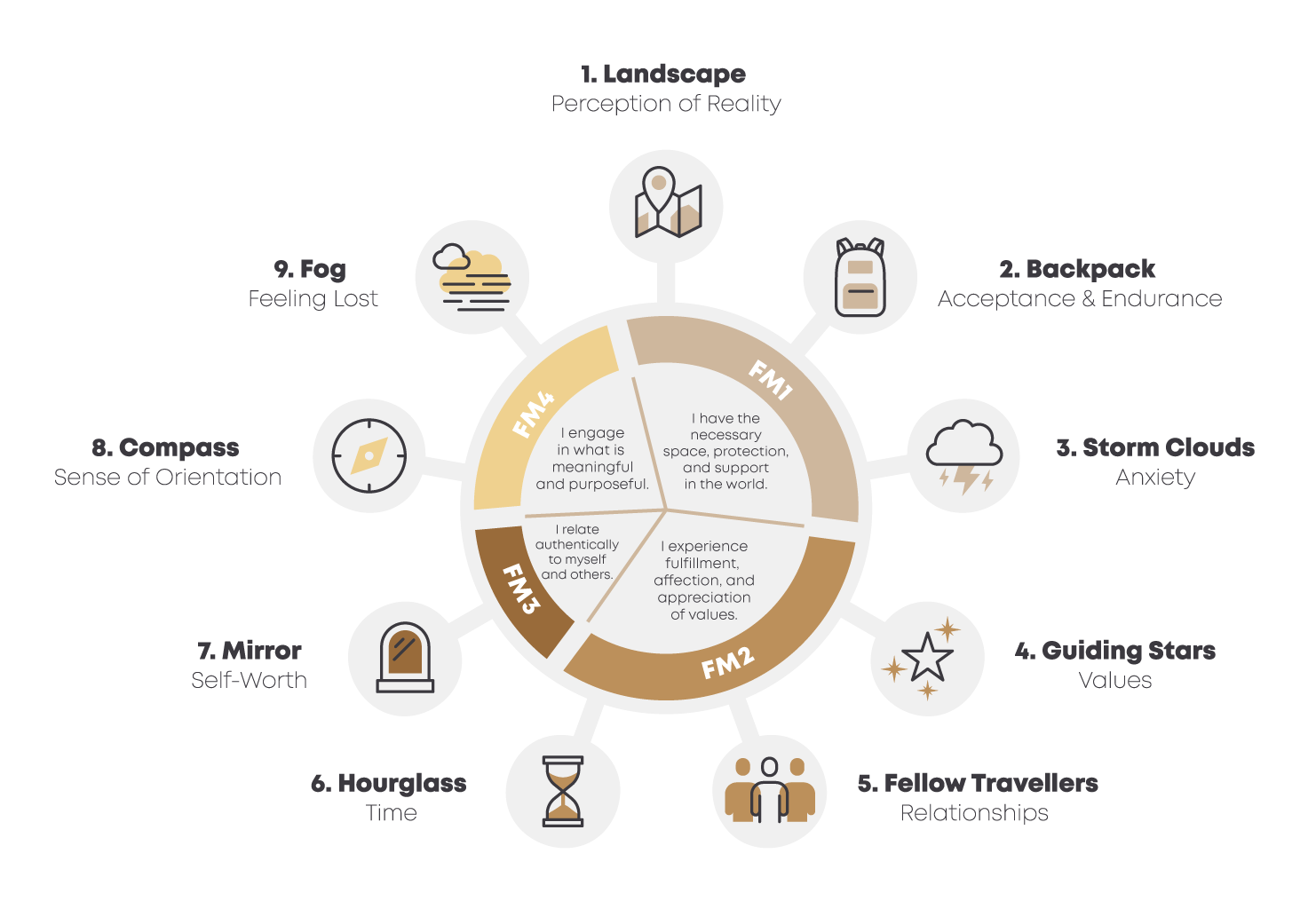
The Mountain Framework offers another way to pause and look at the wider picture. Your sense of belonging can be shaped by what matters to you, how you see the world, the people travelling alongside you, and the way you relate to yourself.
What matters to you?
Your values can act like guiding stars. If the people or places around you continually pull you away from what feels important, the experience of not fitting in may be pointing toward a mismatch rather than a personal failure.
Which values do you most want your relationships and communities to make room for?How are you seeing the world around you?
Our landscape includes the way we interpret the world, the people around us, and the situations we move through. When we already feel excluded or uncertain, the landscape can begin to look more rejecting than it actually is.
What are you noticing around you — and what might your current perspective be adding to the picture?Who are you travelling with?
Belonging is relational. Some fellow travellers may offer warmth, curiosity and space for you to be yourself, while others may leave you feeling unseen or as though you need to perform.
Where in your life do you already experience even a small sense of ease, recognition or mutual understanding?What happens in your relationship with yourself?
When you repeatedly feel that you do not belong, it can gradually shape the way you see yourself. The Mirror invites you to notice whether you are relating to yourself with curiosity and respect, or mainly through the imagined judgement of others.
If you stopped viewing yourself through other people’s eyes for a moment, what would you notice?Choose the part of the mountain that feels most relevant today. Sometimes clarity begins by noticing one area more carefully rather than trying to solve the whole experience of belonging.
How to feel like you belong?
Pursue interests that reflect who you are
One of the most effective ways to build meaningful connections is by engaging in activities that genuinely resonate with you. Rather than focusing on fitting in, choose hobbies or interests that align with your values and curiosity. Consistency matters more than performance — showing up regularly, learning, and developing new skills naturally strengthens confidence and identity over time. As your sense of self becomes clearer, connection with others tends to follow more organically.
Within the Meaningful Paths Mountain Framework, this reflects the relationship between My Motivation and My Journey — understanding what draws you forward and allowing growth to unfold without comparison.
Communicate with presence and authenticity
Connection deepens when communication is grounded in presence rather than performance. Being engaged in conversation — noticing tone, meaning, and what feels important to the other person — creates space for mutual understanding. Relationships strengthen not through saying the “right” thing, but through showing up as yourself and allowing real dialogue to unfold. Over time, this kind of communication supports trust and emotional safety.
This aligns with My Decisions in the Mountain Framework — choosing how you relate to others with awareness and intention.
Build self-awareness before chasing connection
Many people try to solve loneliness by pushing themselves outward, without first understanding what is happening inwardly. Taking time to notice your thoughts, emotions, and patterns — without judgement — helps clarify what feels meaningful and what doesn’t. This self-awareness forms the foundation of authentic connection, because it allows you to relate to others without abandoning yourself.
In the Mountain Framework, this is the process of strengthening your internal ground before extending outward toward others.
Move toward what feels meaningful, not impressive
Living with purpose does not require dramatic goals or external validation. Meaning grows when your actions align with what matters to you — even in small, quiet ways. When you pursue a life shaped by meaning rather than approval, your energy becomes more grounded and authentic. This kind of presence is often what draws people in, because it feels real and unforced.
Meaningful Paths views purpose as something that emerges through alignment, not pressure or productivity.
Embrace who you are becoming
Belonging is not created by reshaping yourself to fit every space. It comes from knowing who you are, accepting your pace, and allowing your identity to evolve naturally. When you are more at ease with yourself, relationships tend to feel less effortful and more reciprocal. Authenticity creates a sense of aliveness — and that is often what others respond to most.
Know your worth and set healthy boundaries
Knowing your worth is not about confidence displays or social dominance. It is about respecting your limits, your energy, and your needs. This includes allowing yourself to say no without guilt, to choose some invitations and decline others, and to prioritise rest when needed. Healthy boundaries support sustainable connection — you do not need to chase every opportunity or person to belong.
Within the Meaningful Paths Mountain Framework, this reflects living in alignment with yourself while remaining open to connection, rather than driven by fear of exclusion.
What is loneliness?
Are loneliness and social isolation the same thing? Loneliness can lead to social isolation and social isolation can lead to loneliness.
It is possible to see people regularly but feel lonely as they may not have meaningful connections with the people they interact with. For example someone may say hello to their colleagues but rarely go any deeper into the conversation.
It is possible to be a very social person, but long working hours, moving location or a global challenge such as COVID-19 can result in social isolation. Over many weeks and months, such isolation can result in that person feeling lonely.
It is important to distinguish between loneliness and social isolation as it may help us to understand why we feel like we don’t fit in anywhere. Learning how to combat loneliness can be a vital first step in helping us to fit in and connect with others.
Loneliness Through the Lens of Existential Analysis
Loneliness Through the Lens of Existential Analysis
Loneliness is not always simply about being physically alone. It can also reflect a deeper sense that something important is missing in the way we experience ourselves, our relationships, or our place in the world.
Existential Analysis offers a useful way of exploring this through the Four Fundamental Motivations. Rather than asking only “How do I stop feeling lonely?”, we can begin to ask which area of life may feel unsupported, disconnected or lacking in meaning.
Space, protection & support
Do I have the necessary space, protection, and support in the world?
Loneliness may become more intense when life feels unsafe, unstable or lacking in reliable support.Fulfilment, affection & values
Do I experience fulfillment, affection, and appreciation of values?
We can be surrounded by people and still feel lonely when there is little warmth, emotional closeness or connection with what we value.Authenticity & relationship
Do I relate authentically to myself and others?
A sense of belonging can become difficult when we feel unable to show who we really are, or when our relationships do not feel mutual or genuine.Meaning & purposeful engagement
Do I engage in what is meaningful and purposeful?
Sometimes loneliness is connected not only to relationships, but to feeling disconnected from contribution, direction or a sense that life is moving toward something meaningful.Which of these four areas feels most connected to your experience of loneliness right now?
How To Deal With Loneliness – Things To Remember
Pause & Reflect: Finding Your Place on the Mountain
Feeling lonely can sometimes narrow our attention towards what is missing. These questions invite you to widen the view—not to force an answer, but to notice what matters, what you long for, and where connection may already exist.
Landscape — How you experience your world
Where do you feel most able to relax and simply be yourself? What is different about that place or situation?
Mirror — Your relationship with yourself
What is one part of you that you wish other people could see, understand or appreciate more?
Guiding Stars — What matters to you
If you no longer had to work or prove anything to anyone, how would you want to spend more of your time?
Fellow Travellers — Relationships
Who makes you feel most like yourself? What is it about being with them that creates that feeling?
Backpack — What you carry
Is there an experience from your past that still influences how easily you trust, connect with or open up to people today?
Hourglass — Time
Who or what would you like to give a little more of your time to?
Appreciation
What is one person, experience or small part of your life that you regularly appreciate—but perhaps rarely stop to acknowledge?
Compass — Direction
If your life felt a little more connected six months from now, what might be different?
You don’t need to answer every question. Notice which one makes you pause. That may be the part of your mountain asking for your attention.

Belonging is not always about learning how to fit into more places. Sometimes it begins with understanding where you can be more fully yourself.
Explore Sandy’s reflections and resources on meaning, identity, relationships and finding direction through life’s questions.
Explore Sandy’s ResourcesConclusion: Navigating Your Own Mountain
Feeling like you don’t fit in anywhere can stir a deep sense of disorientation—but within this struggle lies the potential for profound personal growth. The Mountain Framework offers a gentle, structured path forward.
- My Motivation reminds you to reconnect with what grounds you—your values, strengths, and guiding lights—especially when belonging feels elusive.
- My Journey helps you map your inner and outer terrain—acknowledging the storm clouds of isolation while also recognizing the passing moments of clarity, connection, and self-compassion.
- My Decisions invites you to choose actions aligned with your purpose—for instance, small gestures of self-kindness, reaching out in simple ways, or pausing to reflect under your guiding stars.
When the thought “I don’t fit in anywhere” arises, Existential Analysis encourages us to pause and ask: Am I living in line with my values? Am I showing up authentically? Do I have spaces where I can truly breathe and grow? Instead of chasing acceptance in every environment, it guides us to choose communities and relationships that resonate with our true selves. Belonging, in this view, is not about conforming—it is about engaging meaningfully with the world while staying grounded in who we are.
Existential Analysis teaches that we don’t need to fit everywhere; we need to choose where we belong—and that begins with self-awareness, resilience, and intentional living. By using the Mountain Framework, you gain both a compass and a map to navigate loneliness toward connection and meaning.
You may also enjoy our overthinking quotes section of our platform, which can help you with self-reflection, inspiration and self-compassion.
Still wondering why you don’t feel like you fit in?
Sometimes the answer isn’t about changing who you are. It’s about understanding the experiences, values, relationships and direction that have shaped your journey.
Mountain Reflections is a therapist-designed digital guide based on the Mountain Framework, helping you better understand yourself and the people around you through nine thought-provoking reflections.
Instant digital download • Save to your phone • Return whenever you need a fresh perspective.
Explore Mountain ReflectionsAdditional resources
- Why Do I Feel So Disconnected From Everyone?
https://www.meaningfulpaths.com/why-do-i-feel-so-disconnected-from-everyone/
Explores emotional disconnection, feeling out of sync with others, and why belonging can feel difficult even when you’re not alone. - Loneliness in the UK (2025): Listening to the Nation’s Search for Connection
https://www.meaningfulpaths.com/loneliness-in-the-uk-2025-listening-to-the-nations-search-for-connection/
A data-led exploration of how people across the UK describe loneliness, belonging, and the search for connection in their own words. - How to Find Peace in Yourself
How to Find Peace in Yourself: Meaning, Harmony & Inner Calm
An article on how to help your mind to stop racing, be more present and at peace with yourself. - Self-Discover Journaling
Self-Discovery Journaling: Meaning, Identity & Personal Growth
Tips and prompts for processing your emotions via writing.
If this feeling keeps returning
Feeling like you don’t fit in anywhere can be deeply unsettling. Reading can help put language to the experience, but some people also find it helpful to have gentle structure or support as they reflect on identity, belonging, and connection.
You can explore our self-guided tools if you want quiet prompts and reflective exercises to help you understand yourself more clearly and reconnect with what feels meaningful to you, at your own pace:
Learn More >
If this sense of not belonging feels long-standing or overwhelming, our coaching options offer guided conversations to help you explore where this feeling comes from and how to relate to it with more self-understanding and compassion.
Thanks for listening.
David Chorlton
Continue Your Journey
Explore your question further with 🧭 Path Search, our free guided reflection tool for meaning, purpose, self-worth, relationships, and life direction.
You can also use the Mountain Journal, designed to accompany Path Search and help you record insights, reflections, and next steps.
Frequently Asked Questions
Why do I feel like I don’t fit in anywhere?
Many people experience periods where they feel disconnected, different, or uncertain about where they belong. This can happen during life transitions, personal growth, changes in relationships, or when your values no longer align with the people or environments around you. Feeling like you don’t fit in does not necessarily mean there is something wrong with you.
Is it normal to feel like you don’t belong?
Yes. Most people experience feelings of not belonging at some point in their lives. These experiences can be uncomfortable, but they are often a natural part of self-discovery, identity development, and finding communities that align with who you truly are.
What if I don’t fit in with my friends or family?
Not fitting in with certain people does not mean you are destined to be alone. Sometimes it may indicate differences in values, interests, priorities, or life direction. Healthy relationships often allow space for individuality rather than requiring complete similarity.
Why do I always feel different from everyone else?
Feeling different can stem from personality, life experiences, beliefs, cultural background, values, or the way you perceive the world. Many people who feel different later discover that their uniqueness is one of their strengths rather than a flaw that needs fixing.
Does everyone need to fit in?
Human beings naturally seek belonging and connection, but fitting in and belonging are not always the same thing. Fitting in may involve changing yourself to gain acceptance, whereas belonging often involves being accepted for who you genuinely are.
Can feeling like an outsider be a good thing?
Although it can be painful, feeling like an outsider can sometimes encourage deeper self-awareness, authenticity, creativity, and personal growth. Many people discover that their sense of difference helps them better understand themselves and what truly matters to them.
How can I find where I belong?
Belonging often develops when we connect with people, communities, and activities that reflect our values and interests. Rather than asking “Where can I fit in?”, it can be helpful to ask “Where can I be myself?” Authentic belonging usually grows from that place.
What does existential psychology say about belonging?
Existential psychology suggests that questions about belonging, identity, authenticity, and meaning are a natural part of being human. Rather than trying to eliminate these questions, it encourages people to explore them with curiosity and use them as opportunities for self-discovery and personal growth.
Can not fitting in affect mental health?
Persistent loneliness and disconnection can affect wellbeing. However, feeling different or questioning where you belong is not necessarily a sign of poor mental health. These experiences can also be part of personal development and the search for meaning, purpose, and authentic relationships.
How do I stop worrying about fitting in?
Instead of focusing solely on fitting in, it can be helpful to focus on understanding your values, strengths, interests, and authentic self. As self-acceptance grows, many people find that the pressure to fit in decreases and a stronger sense of belonging naturally emerges.
References
Friends Nourish the Body and Soul – Blue Zones
It Is Motivating to Belong to a Group | Psychology Today UK
We All Want to Fit In | Psychology Today
Frankl, V. E. (2006). Man’s Search for Meaning. Beacon Press. (Original work published 1946)
Längle, A. (2011). The search for meaning in life and the existential fundamental motivations. Existential Analysis, 22(1), 25–40.
Längle, A. (2021). The 3rd Fundamental Motivation: The Fundamental Condition for Personhood & the Ability to Be Oneself – Student Manual. GLE-International, Vienna.
Sartre, J.-P. (1993). Being and Nothingness. Washington Square Press. (Original work published 1943)
Kierkegaard, S. (1989). The Sickness Unto Death. Princeton University Press. (Original work published 1849)
Stanford Encyclopedia of Philosophy. (2020). Authenticity. Retrieved from https://plato.stanford.edu/entries/authenticity/
Thoits, P. A. (2011). Social support and health: A review of the literature. In A. Baum, T. A. Revenson, & J. E. Singer (Eds.), Handbook of Health Psychology (2nd ed., pp. 145–171). Psychology Press.
Continue Your Journey
Receive insights from our founders
Join David Chorlton and Therapist Sandy ElChaar for occasional thoughtful reflections, practical guidance and Meaningful Paths updates grounded in the Mountain Framework.