

Feeling lost in life can be unsettling. You may feel disconnected from yourself, uncertain about the future, or unsure which direction to take next. Sometimes this follows a major life transition such as a career change, relationship ending, loss, relocation, or period of burnout. At other times, the feeling seems to arrive without any obvious reason.
When life feels uncertain, many people search for answers outside themselves. While guidance from others can be valuable, journaling offers something different. It creates space to slow down, listen inwardly, and reconnect with what matters most to you.
The journaling prompts in this article are designed to help you explore your thoughts, emotions, values, and sense of direction. Rather than providing quick fixes, they invite reflection, helping you understand where you are, what may be missing, and what your next steps could be.
This article focuses specifically on journaling during periods of uncertainty, transition, and feeling lost in life. If you are looking for a broader introduction to reflective writing, identity, and personal growth, explore our guide to Self-Discovery Journaling. For a wider collection of reflective questions, see our Journaling Prompts for Self-Discovery article.
Feeling lost is not always a sign that something is wrong. Sometimes it is an invitation to pause, reflect, and rediscover what is meaningful before continuing the journey.
Looking for a Deeper Exploration of Meaning and Purpose?
🧭 If these journaling prompts have resonated with you, you may also enjoy our article, From Lost Hope to Found Purpose.
Written by existential therapist Sandy ElChaar, the book combines a short reflective story with practical insights from Existential Analysis. Rather than offering journaling prompts, it provides a deeper exploration of meaning, purpose, values, authenticity, and how we can respond to life’s challenges in a more meaningful way.
Whether you are feeling lost, questioning your direction, or simply seeking a richer understanding of what gives life meaning, the book offers a gentle companion for reflection and personal growth.
Why Journaling Can Help When You Feel Lost
When we feel lost, our minds often become consumed with finding immediate answers. We may repeatedly ask ourselves, “What should I do?” or “How do I fix this?” Yet the pressure to find certainty can sometimes make us feel even more stuck.
Journaling offers an alternative. Rather than forcing solutions, it creates space for exploration. Writing slows our thinking down, helps us notice patterns, and allows us to engage with questions that may otherwise remain hidden beneath the surface of everyday life.
From the perspective of Existential Analysis, feeling lost is often connected to one or more of our fundamental human needs being challenged. We may feel disconnected from support and stability, uncertain about what truly matters, disconnected from ourselves, or unsure about the meaning and direction of our lives.
The Four Fundamental Motivations provide one way of understanding these experiences:
- FM1 – Space, Protection, and Support: Do I feel safe, supported, and able to exist in the world as I am?
- FM2 – Fulfilment and Values: Do I experience value, enjoyment, and connection in my life?
- FM3 – Authenticity and Self-Worth: Am I living in a way that feels true to myself?
- FM4 – Meaning and Purpose: Do I experience a sense of direction and meaningful engagement with life?
Often, feeling lost is not simply about lacking a goal. It may reflect a deeper invitation to reconnect with one or more of these areas.
The prompts below are designed to help you explore your experience through reflection rather than self-judgment. You do not need to answer every question. Choose the prompts that resonate with you and allow yourself to write honestly, with curiosity and compassion.
Journaling Prompts to Understand Where You Are Right Now
When we feel lost, our first instinct is often to rush towards answers. Yet before we can decide where we want to go, it can be helpful to understand where we currently stand.
These prompts are designed to help you take stock of your present experience with honesty and curiosity.
- In what areas of my life do I feel most lost right now?
- When did I first start noticing this feeling of being lost or disconnected?
- What recent changes, transitions, or challenges may be contributing to how I feel?
- What aspects of my life currently feel uncertain or unclear?
- What am I hoping will change?
- What am I afraid might happen if nothing changes?
- What thoughts do I find myself returning to repeatedly?
- What questions do I keep asking myself?
- Which parts of my life feel stable and supportive, even if other areas feel uncertain?
- If I described my current situation to a trusted friend, what would I say?
- What am I avoiding thinking about, feeling, or facing?
- What would it mean to accept where I am right now, even if I do not yet know the next step?
You may notice that some of these questions do not immediately produce answers. That is okay. Journaling is not always about solving problems. Sometimes it is about creating enough space for deeper understanding to emerge.
If you are completely new to journaling or unsure how to begin writing about these questions, our guide on What to Write in a Writing Journal offers additional ideas and starting points for meaningful reflection.

Journaling Prompts to Reconnect with What Matters Most
When we feel lost, it is often tempting to focus entirely on what is missing. Yet even during difficult periods, there may still be people, experiences, values, and moments that hold meaning for us. Reconnecting with what matters can provide a sense of grounding before we begin searching for direction.
These prompts are designed to help you explore what still feels valuable in your life.
- What moments have brought me a sense of fulfilment in the past year?
- When do I feel most alive, engaged, or present?
- What activities tend to leave me feeling energised rather than drained?
- Who are the people I feel most connected to, and why?
- What qualities do I appreciate most in others?
- What values have guided me throughout my life?
- Which values feel neglected or overlooked at the moment?
- What would I miss most if it were suddenly no longer part of my life?
- What experiences make me lose track of time?
- What small moments of beauty, joy, or appreciation have I noticed recently?
- What am I grateful for, even during this difficult period?
- What aspects of my life still feel meaningful, even if other areas feel uncertain?
When we feel lost, gratitude can sometimes feel difficult or even inappropriate. However, gratitude is not about ignoring pain or pretending everything is fine. It is about recognising that alongside uncertainty, there may still be sources of value, connection, and support.
If you would like to explore this further, our articles on Gratitude Prompt and Prompts for a Gratitude Journal offer additional reflections to help cultivate presence, appreciation, and emotional grounding.
Journaling Prompts to Reconnect with Yourself
Sometimes feeling lost is not only about uncertainty regarding the future. It can also reflect a growing distance between who we are and how we are living. We may find ourselves following expectations, routines, or responsibilities while losing touch with our own needs, preferences, strengths, and values.
These prompts are designed to help you reconnect with yourself and explore what feels authentically yours.
- When do I feel most like myself?
- What parts of my personality have I been neglecting or hiding?
- What expectations am I currently trying to meet?
- Which of those expectations genuinely matter to me, and which belong to someone else?
- What strengths have helped me navigate difficult times in the past?
- What do I admire most about myself?
- What am I often critical of myself for?
- If I spoke to myself as I would a close friend, what would I say right now?
- What choices in my life feel aligned with who I truly am?
- What choices feel disconnected from my values or authentic self?
- What am I pretending not to know?
- What would I do differently if I trusted myself a little more?
- What am I longing for at this stage of my life?
- What parts of myself would I like to develop further?
- If I could reconnect with one forgotten part of myself, what would it be?
Many people assume that finding direction requires discovering something entirely new. Often, however, clarity emerges when we reconnect with aspects of ourselves that have been overlooked, neglected, or silenced.
If you would like to explore identity, values, and self-understanding more deeply, our guide to Self-Discovery Journaling offers a broader introduction to reflective writing for personal growth, while Journaling Prompts for Self-Discovery provides an extended collection of questions focused on understanding yourself and your life direction.
What would you like to explore today?
Search meaning, purpose, self-worth, relationships, or life direction…Free guided reflections with 🧭 Path Search.
Journaling Prompts to Discover Meaning and Direction
Feeling lost often creates pressure to find the “right” answer immediately. We may believe we need a complete life plan before we can move forward. In reality, meaning and direction often emerge gradually through reflection, experience, and small steps rather than sudden revelations.
From an existential perspective, purpose is not simply something we find. It is something we build through our choices, relationships, values, and engagement with life.
These prompts are designed to help you explore what may be calling for your attention at this stage of your journey.
- What feels most important to me right now?
- What areas of my life am I being drawn towards?
- What areas of my life am I being drawn away from?
- What gives me a sense of meaning, even during difficult times?
- When have I felt that my life had direction or purpose?
- What was present during those periods that may be missing today?
- What am I curious about exploring further?
- What dreams, interests, or aspirations have I put aside?
- If fear was less influential in my decisions, what might I choose differently?
- What opportunities am I currently overlooking?
- What contribution would I like to make to others, my community, or the world around me?
- What do I want my life to stand for?
- What would a meaningful year ahead look like?
- What would a meaningful month ahead look like?
- What would a meaningful week ahead look like?
- What is one small step I could take today that would move me closer to the life I want to build?
- What is life asking of me at this moment?
- If I trusted that clarity develops through action rather than certainty, what would I do next?
Many people discover that they do not need a perfect destination before taking the next step. Often, direction becomes clearer as we engage with life rather than waiting for complete certainty to arrive.
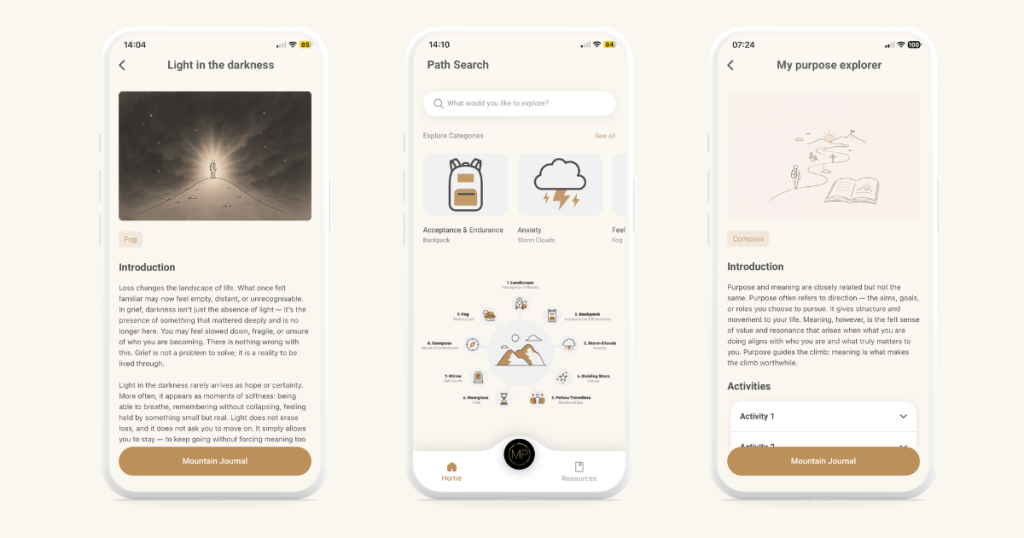
At Meaningful Paths, we explore these questions through the Mountain Framework, a reflective model inspired by Existential Analysis. The framework uses symbols such as the compass, guiding stars, backpack, and landscape to help individuals understand meaning, values, self-worth, challenges, and direction throughout life’s journey.
If you would like support exploring questions about meaning, purpose, relationships, self-worth, and personal growth, try 🧭 Path Search. Path Search provides guided reflections inspired by the Four Fundamental Motivations and can help you identify meaningful questions to explore further in your journaling practice.
Using the Four Fundamental Motivations When You Feel Lost
Sometimes journaling helps us uncover a deeper question beneath the feeling of being lost. While our circumstances may differ, many experiences of uncertainty can be explored through four fundamental areas of human life known as the Four Fundamental Motivations.
As you reflect on the prompts above, you may find it helpful to consider which of these areas feels most relevant to your current situation.
FM1: Space, Protection, and Support
When life feels uncertain, we may need to reconnect with a sense of stability and support.
Reflective questions:
- Do I feel supported by the people around me?
- What helps me feel safe and grounded?
- Where do I need more support or protection in my life?
- What is helping me cope right now?
FM2: Fulfilment and Values
Feeling lost can sometimes arise when we become disconnected from what we value most.
Reflective questions:
- What still brings me joy, fulfilment, or appreciation?
- What values feel most important to me today?
- Where do I experience genuine connection?
- What feels meaningful even during difficult periods?
FM3: Authenticity and Self-Worth
At times, we lose direction because we have lost touch with ourselves.
Reflective questions:
- Am I living in a way that feels true to who I am?
- What expectations am I carrying that do not belong to me?
- What strengths have I forgotten?
- What would self-trust look like right now?
FM4: Meaning and Purpose
Feeling lost often leads us to questions about direction, contribution, and purpose.
Reflective questions:
- What is life asking of me at this stage?
- What would make the coming months feel meaningful?
- What contribution would I like to make?
- What small step could move me forward?
The goal is not to score yourself or find perfect answers. Rather, these reflections can help identify which area of life may need the most attention right now.
If you would like a dedicated space to explore these questions, the Mountain Journal was designed to accompany Path Search and the Four Fundamental Motivations. It provides a simple structure for recording insights, reflections, actions, and discoveries as you continue your journey.
When You Don’t Know What to Write
One of the most common challenges people encounter when journaling is staring at a blank page and wondering where to begin. This can be especially difficult when you are already feeling uncertain, overwhelmed, or lost.
If this happens, try not to focus on writing something insightful or profound. Instead, start with what is true in this moment.
You might begin by completing simple sentences such as:
- Right now, I am feeling…
- What is occupying most of my attention today is…
- Something I wish I understood better is…
- One thing I know for certain is…
- One question I keep returning to is…
- If I was completely honest with myself, I would admit that…
Remember that journaling is not a test. There are no right or wrong answers. The purpose is not to write perfectly, but to create space for reflection and self-understanding.
Often, the most meaningful insights emerge after several minutes of writing, once we move beyond our first thoughts and begin exploring what lies beneath them.
If you are new to journaling or regularly find yourself unsure what to write about, our guide to What to Write in a Writing Journal provides additional prompts and practical ideas to help you get started. Sometimes the hardest part of journaling is simply beginning, and a single question can be enough to open the door to deeper reflection.
Feeling Lost Can Be Part of Finding Your Way
Many people assume that feeling lost means they have failed, made the wrong choices, or fallen behind in life. Yet periods of uncertainty are often a natural part of growth. They invite us to pause, reflect, and reconsider what truly matters before continuing our journey.
You do not need to have all the answers today. You do not need a complete plan for the future. Often, the next meaningful step becomes visible long before the entire path reveals itself.
Journaling can help create the space needed for that process. By exploring your thoughts, emotions, values, relationships, and aspirations, you may begin to notice patterns, insights, and possibilities that were previously hidden beneath the pressure to “figure everything out.”
If you would like additional support in exploring questions about meaning, purpose, self-worth, relationships, and personal growth, consider using Path Search (look for the compass icon). Path Search provides guided reflections inspired by the Four Fundamental Motivations and the Meaningful Paths framework.
To deepen your reflections, you can also download the Mountain Journal, which was specifically designed to accompany Path Search. The journal provides space to record insights, explore the Four Fundamental Motivations, and capture meaningful discoveries as you continue your journey.
Feeling lost does not mean you have stopped moving forward. Sometimes it is simply the point on the mountain where the path disappears briefly from view, inviting you to slow down, look around, and reconnect with what matters before taking the next step.
Featured Image: https://pixabay.com/users/qiye
Frequently Asked Questions
Is it normal to feel lost in life?
Yes. Most people experience periods of uncertainty, confusion, or lack of direction at various points in their lives. Major life transitions, loss, relationship changes, career challenges, burnout, and personal growth can all contribute to feeling lost. While uncomfortable, these periods often create opportunities for reflection, learning, and change.
Can journaling help you find direction in life?
Journaling cannot provide instant answers, but it can help you understand your thoughts, emotions, values, and priorities more clearly. By creating space for reflection, journaling often helps people recognise patterns, identify what matters most, and discover meaningful next steps.
What should I write when I feel lost?
Start with simple questions such as:
- What feels uncertain right now?
- What am I struggling with most?
- What do I need at this moment?
- What matters most to me?
- What is one small step I could take today?
You do not need to write perfectly. Honest reflection is often more valuable than finding the “right” answer.
How often should I journal when feeling lost?
There is no perfect schedule. Some people benefit from daily journaling, while others prefer a few times each week. Consistency is usually more important than frequency. Even ten minutes of reflective writing can help create greater clarity over time.
What if journaling makes me feel emotional?
This is a common experience. Journaling often brings thoughts and feelings into awareness that may have been pushed aside or overlooked. If difficult emotions arise, try to approach them with curiosity rather than judgment. You may also wish to pause, take a break, or seek support if needed.
What is the difference between journaling and therapy?
Journaling is a self-reflective practice that helps you explore your experiences through writing. Therapy involves working with a trained professional who can provide guidance, support, and a deeper exploration of emotional difficulties. Many people find that journaling and therapy complement one another.
Can journaling help me discover my purpose?
Journaling can help you explore the values, interests, relationships, strengths, and experiences that contribute to a sense of purpose. Rather than revealing a single life mission, reflective writing often helps people build greater clarity about what feels meaningful and worth pursuing.
What if I still feel lost after journaling?
Feeling lost is not always something that disappears immediately. Journaling is less about finding quick answers and more about developing greater awareness and understanding over time. Clarity often emerges gradually through reflection, action, relationships, and lived experience.
How can Path Search and the Mountain Journal help?
Path Search provides guided reflections inspired by Existential Analysis, the Four Fundamental Motivations, and the Meaningful Paths framework. The Mountain Journal was designed to accompany Path Search, offering a dedicated space to record insights, explore meaningful questions, and reflect on your personal journey over time.
Related Resources for Reflection and Personal Growth
If you found these journaling prompts helpful, you may also enjoy exploring the following resources:
Self-Discovery Journaling: A Reflective Guide to Meaning, Identity, and Personal Growth
This guide explores the practice of self-discovery journaling in greater depth, including how reflective writing can help you understand your identity, values, relationships, and life direction. It is ideal if you would like a broader introduction to journaling as a tool for personal growth and meaning.
Self-Discovery Journaling: Meaning, Identity & Personal Growth
Journaling Prompts for Self-Discovery
Looking for additional questions? This collection contains reflective prompts focused on understanding yourself, exploring your values, identifying patterns, and gaining greater clarity about your life direction.
Journaling Prompts for Self Discovery: 40 Questions for Personal Growth
What to Write in a Writing Journal
If you often find yourself staring at a blank page, this guide offers practical ideas and prompts to help you begin writing, even when you are unsure what to say.
What to Write in a Writing Journal: 50 Prompts for Self-Discovery
Gratitude Prompt: Meaningful Reflections for Presence, Peace, and Emotional Grounding
When feeling lost, it can be difficult to notice what is still supportive, valuable, or meaningful in your life. These gratitude reflections are designed to help cultivate presence, appreciation, and emotional grounding.
Gratitude Prompt: Meaningful Reflections for Peace & Presence
Prompts for a Gratitude Journal
This collection of gratitude-focused questions can help you develop a regular journaling practice centred on appreciation, connection, and purpose.
Prompts for Gratitude Journal: Meaning, Peace & Purpose
Living a Purposeful Life
If feeling lost has led you to question your direction or sense of meaning, this guide explores practical ways to cultivate a more purposeful and fulfilling life through your values, relationships, choices, and daily actions.
Living a Purposeful Life: Meaning, Values and Fulfillment
The Purpose Driven Life: Meaning, Values, and Direction
This article explores how purpose can provide direction and orientation during times of uncertainty, helping you move forward with greater intention and clarity.
The Purpose Driven Life: Meaning, Values, and Direction
Continue Your Journey with Path Search and the Mountain Journal
If you would like support exploring questions about meaning, self-worth, values, relationships, and purpose, try Path Search (look for the compass icon). Path Search offers guided reflections inspired by Existential Analysis, the Four Fundamental Motivations, and the Meaningful Paths framework.
To deepen your reflections, download the Mountain Journal, which was specifically designed to accompany Path Search. Together, they provide a practical way to capture insights, track personal growth, and explore meaningful questions as your journey unfolds.
Continue Your Journey
Explore your question further with 🧭 Path Search, our free guided reflection tool for meaning, purpose, self-worth, relationships, and life direction.
You can also use the Mountain Journal, designed to accompany Path Search and help you record insights, reflections, and next steps.