

You have a stable job. Your relationships are mostly okay. You have achieved goals that once felt important. From the outside, your life may even appear successful.
Yet something feels missing.
You move through your days completing tasks, meeting responsibilities, and doing what is expected of you, but beneath the surface there is a lingering sense of emptiness. You may struggle to explain it to others because there is no obvious reason for feeling this way. Nothing is necessarily wrong, yet something doesn’t feel right.
Many people experience periods of life where they begin to wonder:
- Why do I feel empty inside?
- Why am I not happy when everything seems fine?
- Why don’t my achievements feel satisfying?
- What am I missing?
- What is the point of all this?
These questions can feel confusing, particularly when compared to people facing obvious hardships. You may even feel guilty for struggling when you have much to be grateful for.
However, feeling empty does not mean you are ungrateful, broken, or failing. In many cases, emptiness can be understood as a signal that an important part of your life is asking for attention.
Why Do I Feel Empty Even When Life Looks Good?
Many people assume that feeling empty only happens when life is going badly.
Yet some of the most confusing periods of life occur when things appear fine on the surface. You may have a career, a home, relationships, financial stability, or achievements that once seemed important, yet still experience a persistent feeling that something is missing.
People often describe this experience as:
- Feeling numb despite success
- Going through the motions
- Feeling disconnected from life
- Losing excitement for things they once enjoyed
- Wondering why achievements don’t feel satisfying
- Questioning what the point of everything is
According to existential psychologist and therapist Sandy ElChaar, this feeling is often less about having too little and more about becoming disconnected from what gives life meaning, value, authenticity, and purpose.
From an existential perspective, emptiness is not necessarily a sign that something is wrong with you. It may be a sign that an important part of your life is asking for attention.
Rather than trying to eliminate the feeling immediately, it can be helpful to become curious about it.
What is this emptiness trying to tell you?
What needs, values, relationships, or aspirations may have been neglected?
What parts of yourself have been left behind while pursuing responsibilities, expectations, or external measures of success?
Sometimes emptiness is not the end of the story.
Sometimes it is the beginning of a deeper search for meaning.
Life Looks Fine… So Why Do I Still Feel Empty?
Feeling empty isn’t always about what’s happening around you. Sometimes it’s a sign that something deeper is asking for your attention—your values, relationships, purpose, or direction in life.
“Why do I feel empty?”
“Why do I feel lost in life?”
“How can I find meaning again?”
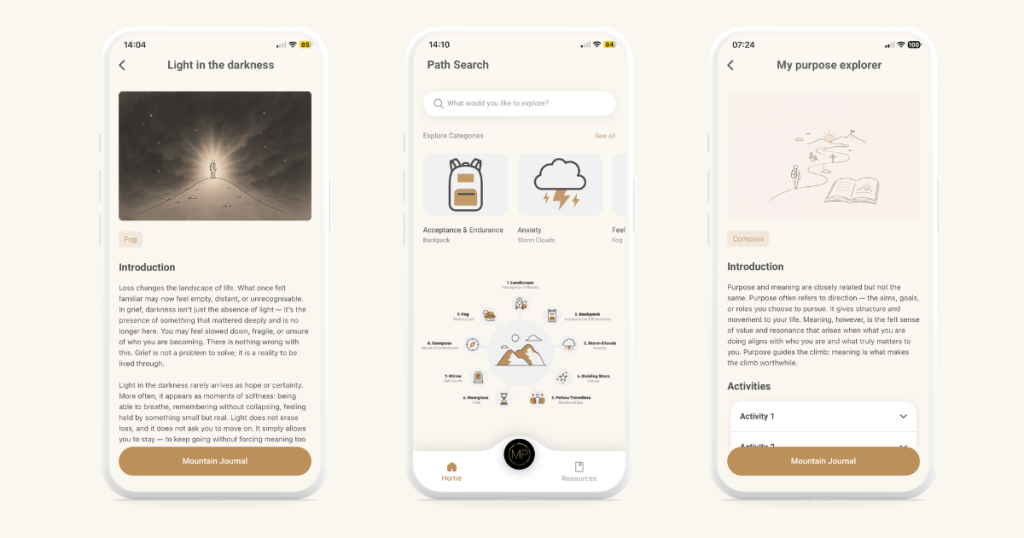
Path Search is our free guided reflection app, built around the Meaningful Paths Mountain Framework, helping you explore life’s deeper questions through thoughtful, therapist-designed reflections.
🧭 Explore Your Question with Path SearchLooking to explore meaning and purpose in greater depth? Discover Mountain Maps
The Strange Experience of Having Everything Yet Feeling Nothing
One of the most confusing aspects of emptiness is that it often appears during periods of apparent success rather than obvious struggle.
Many people expect happiness to arrive once they achieve a particular goal.
Perhaps it is finding the right partner, buying a home, building a successful career, raising a family, earning more money, or reaching a long-awaited milestone.
For years, these goals can provide a sense of direction and motivation. They offer something to strive towards and create the belief that fulfilment lies just beyond the next achievement.
Then the goal is reached.
For a brief period there may be excitement, relief, or satisfaction. Yet after a while, life begins to feel strangely familiar again. The anticipated sense of lasting fulfilment fails to appear, and a difficult question emerges:
“Is this all there is?”
This question can feel unsettling because it challenges assumptions that may have guided us for years.
Many people respond by pursuing another goal.
A promotion becomes another promotion.
A larger house becomes a larger house.
A new relationship becomes another relationship.
The search continues, yet the feeling of emptiness remains.
From an existential perspective, this often occurs because achievements and possessions can provide comfort, security, and temporary satisfaction, but they cannot fully answer deeper human questions.
Questions such as:
- Am I living in a way that feels meaningful?
- Do I feel connected to what truly matters?
- Am I being myself?
- What gives my life purpose beyond achievement?
- What am I ultimately working towards?
These questions are not signs of weakness or dissatisfaction. They are deeply human questions.
In modern society, we are often encouraged to focus on productivity, performance, status, and measurable success. While these things can be valuable, they do not necessarily create fulfilment.
A person can be highly successful and still feel disconnected.
A person can be admired and still feel lonely.
A person can achieve everything they planned and still wonder why they feel empty inside.
This is why emptiness can feel so confusing. There is often no obvious problem to solve.
The challenge is not necessarily that something is missing from your life. Sometimes the deeper issue is that you have become disconnected from yourself, your values, your relationships, or your sense of meaning.
The feeling of emptiness may therefore be less of a failure and more of an invitation.
An invitation to pause.
An invitation to reflect.
An invitation to look beyond external achievements and ask what truly makes life feel alive.
Before exploring how to respond to this feeling, it is important to understand that emptiness is often misunderstood. Many people immediately assume they are depressed, ungrateful, or broken when something much more complex may be taking place.

Why Emptiness Is Often Misunderstood
When people begin feeling empty, they often assume something must be seriously wrong.
They may wonder whether they are depressed, burned out, ungrateful, or simply expecting too much from life.
While emptiness can sometimes occur alongside mental health difficulties, it is important to recognise that not all emptiness is the same.
Emptiness Is Not Always Depression
Depression often involves persistent low mood, hopelessness, loss of interest, exhaustion, and difficulty functioning in everyday life.
Existential emptiness can look different.
A person may continue going to work, meeting responsibilities, maintaining relationships, and appearing successful on the surface. They may not feel particularly sad. Instead, they often describe a sense of disconnection, numbness, or questioning.
It can feel as though life has lost some of its colour or significance.
Rather than asking:
“How do I get through today?”
The question often becomes:
“Why does none of this feel meaningful anymore?”
Of course, depression and existential emptiness can overlap, and if symptoms are severe or persistent it is important to seek professional support.
However, many people experiencing emptiness are not necessarily depressed. They are searching for something deeper than symptom relief.
Emptiness Is Not the Same as Sadness
Sadness usually has a clear object.
You may feel sad because of a loss, disappointment, conflict, or difficult life event.
Emptiness is often harder to explain.
People frequently say things such as:
- “Nothing is wrong, but something feels off.”
- “I should be happy, but I’m not.”
- “I don’t know what is missing.”
- “I feel disconnected from my own life.”
The lack of a clear explanation can make emptiness particularly confusing.
Emptiness Is Not Always Burnout
Burnout is typically linked to prolonged stress, overwork, emotional exhaustion, and feeling overwhelmed.
Many people experiencing burnout feel depleted because they have been giving too much for too long.
Existential emptiness can certainly accompany burnout, but it often remains even after rest.
You may take a holiday, reduce your workload, or create more balance, yet still find yourself wondering:
“What am I doing all of this for?”
When this question persists, the issue may extend beyond exhaustion alone.
Emptiness Is Not a Sign of Ingratitude
Perhaps one of the most damaging misunderstandings is the belief that feeling empty means you are ungrateful.
People often tell themselves:
- “I have a good life.”
- “Other people have it much worse.”
- “I should be happy.”
- “I have no right to complain.”
These thoughts can create guilt and prevent honest reflection.
Yet acknowledging emptiness does not mean you are ungrateful for what you have.
A person can appreciate their family and still feel disconnected.
A person can value their career and still question its meaning.
A person can be grateful for their life and still long for something more.
Gratitude and existential questioning can exist side by side.
Sometimes Emptiness Is a Message
From an existential perspective, emptiness is often less a symptom to eliminate and more a message to understand.
It may be signalling that:
- Your values have changed.
- Important needs are being neglected.
- You have become disconnected from yourself.
- You are living according to expectations rather than personal meaning.
- A new chapter of life is trying to emerge.
Rather than asking only:
“How do I get rid of this feeling?”
It can be helpful to ask:
“What might this feeling be trying to show me?”
This question formed the basis of Viktor Frankl’s work and remains central to existential approaches today. Instead of seeing emptiness as a failure, we can begin to view it as an invitation to explore what gives life meaning, purpose, and genuine fulfilment.

Understanding Emptiness Through the Four Fundamental Motivations
When people experience emptiness, they often assume that something is wrong with them.
Existential Analysis takes a different view.
Instead of asking, “What is wrong with me?”, it asks:
“What might be missing from my experience of life?”
Professor Alfried Längle developed the Four Fundamental Motivations as a way of understanding the conditions that help human beings live fulfilling and meaningful lives.
When these conditions are present, we are more likely to experience engagement, connection, authenticity, and purpose.
When they are neglected or blocked, feelings of emptiness, dissatisfaction, and disconnection can begin to emerge.
Exploring these four motivations can provide valuable clues about what may be seeking attention in your own life.
FM1 – Security and Support: Do I Feel Able to Be Here?
The first fundamental motivation asks:
Can I be here?
At its core, FM1 relates to safety, security, protection, and support.
Many people assume that if they have a home, income, or stable circumstances, this need has been met. Yet FM1 goes deeper than external security.
It also asks:
- Do I feel emotionally safe?
- Can I trust life?
- Do I feel supported?
- Am I constantly carrying anxiety beneath the surface?
Sometimes emptiness develops because so much energy is being used simply to cope.
You may appear successful, but internally you feel exhausted from navigating uncertainty, pressure, or fear.
In these situations, emptiness can become a protective response. Rather than fully engaging with life, you may find yourself disconnected from it.
Reflective question:
Where in my life do I feel unsupported, unsafe, or overwhelmed right now?
FM2 – Value and Fulfilment: Do I Feel Alive?
The second fundamental motivation asks:
Do I like living?
This motivation concerns value, enjoyment, connection, and emotional fulfilment.
For many people experiencing emptiness, this is where the greatest disconnect occurs.
Life becomes efficient but not meaningful.
Productive but not fulfilling.
Busy but not alive.
You may spend your days completing tasks, meeting obligations, and pursuing goals, yet rarely pause to ask:
- What genuinely brings me joy?
- What makes me feel alive?
- What experiences nourish me?
- What relationships matter most?
Over time, it is possible to become disconnected from the very things that once brought colour and vitality to life.
This often explains why people can have successful careers and still feel empty.
Achievement provides accomplishment.
It does not automatically provide fulfilment.
Reflective question:
When was the last time I felt genuinely alive, engaged, or deeply moved by something?
FM3 – Authenticity and Self-Worth: Am I Being Myself?
The third fundamental motivation asks:
Am I allowed to be myself?
This motivation relates to authenticity, identity, self-worth, and the ability to live in alignment with who we truly are.
Many people reach adulthood having become highly skilled at meeting expectations.
They learn how to succeed.
How to please others.
How to gain approval.
How to fit in.
Yet somewhere along the way, they lose contact with themselves.
This can create a particularly painful form of emptiness because outward success may be built upon a life that no longer feels authentic.
Questions often emerge such as:
- Is this what I really want?
- Am I living according to my own values?
- Have I become the person others expected me to be?
- Do I know who I am beyond my roles and responsibilities?
Sometimes emptiness is not the absence of achievement.
It is the absence of authenticity.
Reflective question:
Where in my life am I acting according to expectations rather than what feels genuinely true for me?
FM4 – Meaning and Purpose: What Is My Life Serving?
The fourth fundamental motivation asks:
What is life asking of me?
This motivation concerns purpose, direction, contribution, and meaning.
It is often the area people think of first when discussing existential emptiness.
Human beings naturally seek a sense that their lives matter.
Not necessarily in grand or extraordinary ways, but in ways that feel personally meaningful.
Purpose may be found through:
- Relationships
- Creativity
- Service
- Personal growth
- Parenting
- Learning
- Helping others
- Living according to values
When purpose becomes unclear, life can begin to feel repetitive and directionless.
You may continue functioning effectively, yet still find yourself wondering:
- Why am I doing all of this?
- What am I working towards?
- What truly matters?
- What gives my life meaning?
These questions often emerge during transitions, achievements, losses, and periods of change.
Rather than viewing them as a problem, existential psychology invites us to see them as part of being human.
Reflective question:
What feels meaningful enough to deserve my time, energy, and attention right now?
Emptiness as an Invitation
Viewed through the Four Fundamental Motivations, emptiness is not simply a symptom to eliminate.
It can become a valuable source of information.
It may be showing you that:
- You need more support (FM1)
- You need more fulfilment (FM2)
- You need greater authenticity (FM3)
- You need renewed purpose (FM4)
The feeling itself is often uncomfortable.
Yet it may also be pointing towards the very areas of life that are asking for your attention.
Sometimes emptiness is not evidence that life has lost its meaning.
Sometimes it is the beginning of discovering where meaning needs to be rebuilt.
Questions to Ask Yourself If Life Feels Empty
When we feel empty, our first instinct is often to search for a quick solution.
We may assume we need a new job, a new relationship, a new goal, a holiday, or a major life change. Sometimes these changes are necessary. However, acting too quickly can cause us to miss the deeper message beneath the feeling.
Existential psychology encourages a different approach.
Before trying to fix the emptiness, it can be helpful to become curious about it.
The following questions are not designed to provide instant answers. Instead, they are invitations to reflect more deeply on your current experience and identify what may be seeking attention.
Questions About Security and Support (FM1)
- Where in my life do I currently feel overwhelmed?
- What worries occupy most of my mental energy?
- Do I feel supported by the people around me?
- What would help me feel more secure right now?
- Am I carrying responsibilities that feel too heavy to carry alone?
Sometimes emptiness develops because so much energy is being spent simply coping that there is little left for living.
Questions About Value and Fulfilment (FM2)
- What activities make me feel genuinely alive?
- What experiences bring me joy, peace, or connection?
- What have I stopped doing that used to matter to me?
- Which relationships feel nourishing and meaningful?
- When was the last time I felt deeply engaged with life?
Emptiness often grows when life becomes dominated by obligations while fulfilment gradually disappears.
Questions About Authenticity and Self-Worth (FM3)
- Am I living according to my own values or someone else’s expectations?
- What parts of myself have I been neglecting?
- Where do I feel most able to be myself?
- What am I pretending not to know?
- If I stopped seeking approval, what might I do differently?
Sometimes emptiness emerges when we become disconnected from who we truly are.
Questions About Meaning and Purpose (FM4)
- What feels meaningful to me right now?
- What gives me a sense of purpose?
- What contribution do I want to make?
- What feels worth investing my time and energy in?
- What might life be asking of me at this stage of my journey?
Purpose does not always arrive as a clear answer. More often, it emerges gradually through reflection, action, and engagement with what matters.
You Don’t Need All the Answers Today
Many people become frustrated because they cannot immediately identify what is missing.
That is completely normal.
The goal is not to solve your entire life in one afternoon.
The goal is to begin listening.
To notice what resonates.
To pay attention to the questions that evoke emotion, curiosity, resistance, or longing.
These reactions often provide valuable clues.
Sometimes the first step out of emptiness is not finding an answer.
Sometimes it is simply asking a better question.
And often, the questions that stay with us are the ones most worth exploring.
Small Signs That Meaning Is Trying to Return
When people feel empty, they often assume they have completely lost their sense of meaning.
Yet meaning rarely disappears overnight.
More often, it becomes buried beneath routine, responsibility, stress, disappointment, or years of living on autopilot.
Even during periods of emptiness, small signs of meaning often remain present.
The challenge is that they can be easy to overlook.
Many people expect meaning to arrive as a dramatic revelation—a sudden moment of clarity that explains exactly what they should do with their life.
In reality, meaning often returns much more quietly.
It appears through moments of curiosity.
A conversation that stays with you.
A book that sparks something inside you.
A feeling of excitement about a new possibility.
A desire to create, learn, help, explore, or contribute.
These moments may seem small, but they often provide important clues.
Pay Attention to What Moves You
One of the simplest ways to identify meaning is to notice what captures your attention.
Ask yourself:
- What topics do I keep returning to?
- What conversations energise me?
- What problems do I care about?
- What experiences leave a lasting impression?
Meaning often reveals itself through attraction rather than obligation.
You may find yourself repeatedly drawn towards certain people, ideas, activities, or causes without fully understanding why.
Rather than dismissing these experiences, consider them invitations to explore.
Pay Attention to What You Envy
Envy is rarely a comfortable emotion.
However, it can sometimes reveal hidden desires.
For example, you may find yourself envying someone who:
- Changed careers
- Started a business
- Travels regularly
- Creates art
- Prioritises family life
- Lives more authentically
Often, what we envy points towards parts of ourselves that have been neglected.
The goal is not to become the other person.
The goal is to understand what their life might be reflecting back to you.
Pay Attention to Moments of Aliveness
Many people experiencing emptiness can still identify brief moments where life feels different.
Moments where they feel:
- Curious
- Present
- Connected
- Inspired
- Peaceful
- Energised
These experiences may occur while:
- Walking in nature
- Having a meaningful conversation
- Reading
- Creating something
- Helping someone
- Learning a new skill
- Spending time with loved ones
Such moments often reveal where value and meaning are already present.
Pay Attention to Restlessness
Restlessness is frequently viewed as a problem.
Yet from an existential perspective, restlessness can sometimes be a sign that growth is trying to occur.
It may indicate that your current way of living no longer fully reflects who you are becoming.
The discomfort itself may be pointing towards an important change, conversation, decision, or opportunity.
Meaning Often Returns Gradually
One of the most reassuring things to remember is that meaning rarely arrives all at once.
It tends to emerge through small choices, repeated experiences, and a willingness to engage with life again.
A conversation becomes a friendship.
A hobby becomes a passion.
A question becomes a new direction.
A small act of courage becomes a meaningful change.
When viewed this way, emptiness does not have to be feared.
It may simply be the space from which something new is beginning to emerge.
And the first signs of that emergence are often already present, waiting to be noticed.
What To Do When You Feel Empty
When life feels empty, it is natural to want a quick solution.
You may find yourself searching for a major change, a new goal, a different job, a relationship, or a dramatic breakthrough that will suddenly make everything feel meaningful again.
Sometimes significant changes are necessary. However, many people discover that emptiness is not resolved by changing their circumstances alone.
Instead, it often begins to shift when they reconnect with themselves.
Stop Trying to Fill the Void Immediately
Modern culture often encourages us to escape uncomfortable feelings as quickly as possible.
When we feel empty, we may respond by:
- Staying constantly busy
- Scrolling endlessly
- Working more
- Pursuing another achievement
- Seeking distraction
While these strategies can provide temporary relief, they rarely address the underlying experience.
Before rushing to fill the emptiness, try creating some space to understand it.
Ask yourself:
What is this feeling asking of me?
The answer may not appear immediately, but the question itself can be powerful.
Reconnect With What You Value
One of the most common causes of emptiness is becoming disconnected from the things that genuinely matter.
Over time, responsibilities can begin to dominate our lives.
Work needs doing.
Bills need paying.
Tasks need completing.
In the process, we can lose contact with activities, relationships, and experiences that make life feel worthwhile.
Consider asking:
- What matters most to me?
- What do I care about deeply?
- What have I neglected that once felt important?
You do not need to transform your life overnight.
Even small steps towards your values can begin restoring a sense of connection.
Spend More Time With What Makes You Feel Alive
Meaning is often discovered through experience rather than thinking alone.
Many people attempt to solve emptiness entirely through analysis.
While reflection is valuable, it is equally important to engage with life.
Think about moments when you feel:
- Curious
- Present
- Inspired
- Connected
- Energised
Then ask:
How can I create more space for these experiences?
This might involve:
- Walking in nature
- Learning something new
- Spending time with loved ones
- Creative activities
- Volunteering
- Pursuing forgotten interests
The goal is not to maximise pleasure.
The goal is to reconnect with aliveness.
Allow Yourself to Change
Sometimes emptiness appears because an old version of life no longer fits.
The goals that motivated you at twenty-five may not motivate you at forty-five.
The priorities that once felt meaningful may evolve.
This does not mean you have failed.
It means you are changing.
Instead of asking:
“How do I get back to who I was?”
It may be more helpful to ask:
“Who am I becoming?”
Growth often requires letting go of old expectations.
Focus on Small Meaningful Actions
One of the biggest mistakes people make is believing they need to discover their entire purpose before taking action.
Meaning rarely works that way.
More often, meaning emerges through action.
You help someone.
You start a conversation.
You learn a skill.
You explore an interest.
You take one small step.
Then another.
Purpose is often discovered by walking rather than waiting.
Talk About It
Existential questions can feel isolating.
Many people assume they are the only ones wondering:
- What am I doing with my life?
- Why don’t I feel fulfilled?
- What is missing?
In reality, these questions are deeply human.
Talking with a trusted friend, therapist, coach, mentor, or reflective community can help bring clarity to experiences that are difficult to navigate alone.
Life Looks Fine… So Why Do I Still Feel Empty?
Feeling empty isn’t always about what’s happening around you. Sometimes it’s a sign that something deeper is asking for your attention—your values, relationships, purpose, or direction in life.
“Why do I feel empty?”
“Why do I feel lost in life?”
“How can I find meaning again?”
Path Search is our free guided reflection app, built around the Meaningful Paths Mountain Framework, helping you explore life’s deeper questions through thoughtful, therapist-designed reflections.
🧭 Explore Your Question with Path SearchLooking to explore meaning and purpose in greater depth? Discover Mountain Maps
Remember That Emptiness Is Not Permanent
Perhaps most importantly, remember that emptiness is a feeling, not a life sentence.
Many people who later describe their lives as meaningful, purposeful, and fulfilling have experienced periods of confusion, uncertainty, and existential questioning.
The feeling of emptiness often emerges during transitions.
It can signal that something old is ending, something important is missing, or something new is trying to emerge.
Rather than viewing emptiness as evidence that your life lacks meaning, consider the possibility that it may be inviting you to discover a deeper relationship with meaning than you have known before.
Sometimes the most meaningful chapters of life begin with a question.
And sometimes the feeling of emptiness is what prompts us to start asking it.
Explore What’s Missing With Path Search
When life feels empty, it can be difficult to know where to begin.
You may find yourself asking questions such as:
- Why do I feel disconnected from my life?
- What is missing?
- Why doesn’t success feel satisfying?
- What gives life meaning?
- Why do I feel lost even when things seem okay?
- How do I find purpose again?
- Am I living according to my values?
- What is life asking of me right now?
These are not always easy questions to answer alone.
This is why we created Path Search.
Path Search is a free reflective tool designed to help you explore questions about meaning, purpose, values, self-worth, relationships, and personal growth through the lens of Existential Analysis and Logotherapy.
Rather than offering quick fixes or generic advice, Path Search invites you to engage more deeply with the challenges, questions, and experiences that are shaping your life.
Simply type your question in your own words and discover personalised reflections, practical exercises, articles, and resources that can help you explore what may be seeking attention.
For example, you might explore questions such as:
- Why do I feel empty?
- How do I find meaning?
- What should I do with my life?
- Why do I feel disconnected?
- How do I trust myself again?
- What really matters to me?
Many people discover that emptiness is not a dead end.
It is often the beginning of a deeper conversation about who they are, what they value, and how they want to live.
You can also download the free Mountain Journal, designed to accompany Path Search and provide space for recording reflections, insights, observations, and emerging questions as you continue your journey.
Sometimes the answers we are searching for do not arrive immediately.
Sometimes they emerge through reflection, curiosity, and a willingness to explore the path ahead one step at a time.
Conclusion: Perhaps Emptiness Is Asking a Question
Feeling empty does not necessarily mean that something is wrong with you.
Nor does it mean that your life lacks value.
In many cases, emptiness emerges not because life has failed, but because an important part of you is asking for attention.
Perhaps you have become disconnected from what makes you feel alive.
Perhaps you have been meeting expectations while neglecting your own needs.
Perhaps your values have changed.
Perhaps life is inviting you to explore a new direction.
From an existential perspective, emptiness is often less about what you lack and more about what is waiting to be rediscovered.
The Four Fundamental Motivations remind us that a fulfilling life requires more than achievement alone.
We need:
- Security and support
- Value and fulfilment
- Authenticity and self-worth
- Meaning and purpose
When one or more of these areas becomes neglected, feelings of emptiness can emerge as a signal that something important deserves our attention.
Rather than asking only:
“How do I get rid of this feeling?”
You might instead ask:
“What is this feeling trying to show me?”
The answer may not arrive immediately.
But the willingness to ask the question is often where meaningful change begins.
As Viktor Frankl observed, human beings are not simply searching for happiness. We are searching for meaning.
And sometimes the feeling of emptiness is what first invites us onto that path.
The journey may begin with uncertainty.
But it can also become the beginning of a deeper, more authentic, and more meaningful relationship with life.
Further Reflections on Meaning, Peace, and Emotional Grounding
You may also find these reflections helpful:
Frequently Asked Questions
Why do I feel empty even when my life looks good?
Feeling empty despite having a successful career, stable relationships, or external achievements is more common than many people realise. Sometimes emptiness reflects a disconnect from meaning, values, authenticity, emotional fulfilment, or purpose rather than a lack of success.
Is it normal to feel empty sometimes?
Yes. Most people experience periods of emptiness at different stages of life. These feelings often emerge during transitions, after major achievements, during periods of routine, or when important needs are no longer being met.
Is feeling empty a sign of depression?
Not necessarily. While depression can involve feelings of emptiness, existential emptiness is often different. Many people experiencing existential emptiness continue functioning well in daily life while feeling disconnected, directionless, or unfulfilled.
What is existential emptiness?
Existential emptiness refers to a feeling that something important is missing, even when life appears fine on the surface. It often involves questions about meaning, purpose, identity, fulfilment, and what truly matters.
Why don’t my achievements make me happy anymore?
Achievements often provide temporary satisfaction, but lasting fulfilment usually comes from deeper sources such as meaningful relationships, values, authenticity, personal growth, contribution, and purpose.
Can you feel empty even if you have a good relationship?
Yes. A healthy relationship can be deeply valuable, but no relationship can fully replace the need for personal meaning, self-understanding, purpose, and authentic engagement with life.
What does Viktor Frankl say about emptiness?
Viktor Frankl described the “existential vacuum” as a feeling of inner emptiness that can emerge when people lose touch with meaning and purpose. He believed that meaning can be discovered through relationships, experiences, creativity, responsibility, and the way we respond to life’s challenges.
How do the Four Fundamental Motivations relate to feeling empty?
According to Existential Analysis, emptiness may emerge when one or more essential life conditions are not being met:
- FM1: Security and Support
- FM2: Value and Fulfilment
- FM3: Authenticity and Self-Worth
- FM4: Meaning and Purpose
Exploring these four areas can often provide clues about what may be missing or seeking attention.
Why do I feel empty after reaching a goal?
Many people spend months or years working towards an important goal. Once it has been achieved, they may discover that the goal provided direction but not lasting fulfilment. This can trigger deeper questions about meaning, values, and purpose.
Can feeling empty be a positive sign?
Surprisingly, yes. While uncomfortable, emptiness can sometimes signal that an old way of living no longer fits and that a deeper search for meaning, authenticity, fulfilment, or purpose is beginning.
What can I do when I feel empty inside?
Helpful starting points include slowing down, reflecting on your values, reconnecting with meaningful relationships, spending time in nature, engaging in creative activities, journaling, seeking support, and exploring what genuinely matters to you.
How can I find meaning again?
Meaning is rarely found all at once. It often emerges gradually through relationships, contribution, personal growth, values-based action, creativity, and responding to what life is asking of you in the present moment.
What if I don’t know what is missing?
Many people begin by knowing only that something feels absent. Reflection tools such as journaling, therapy, meaningful conversations, Path Search, or exploring the Four Fundamental Motivations can help uncover what may be seeking attention.
Why do I feel disconnected from my life?
Feeling disconnected often occurs when there is a gap between how you are living and what genuinely matters to you. This can involve neglected values, lack of fulfilment, emotional exhaustion, relationship difficulties, or a loss of direction and purpose.
Can Path Search help me explore these questions?
Yes. Path Search was designed to help people explore questions about meaning, purpose, values, self-worth, relationships, and personal growth. By guiding reflection and providing practical activities, it can help uncover what may be contributing to feelings of emptiness and disconnection.