

Many people searching for advice on making a good choice are hoping for certainty.
They want to know which option is right, how to avoid mistakes, and how to guarantee a positive outcome.
Unfortunately, life rarely offers that kind of certainty.
Whether you are making a good choice about a relationship, career, major life decision, or personal challenge, there are often factors beyond your control.
This is why meaningful decision-making is not simply about predicting the future.
Instead, it involves understanding yourself, clarifying your values, considering the realities of the situation, and choosing a path that you can genuinely stand behind.
According to existential psychologist and therapist Sandy ElChaar, good decisions are rarely about finding the perfect answer. More often, they emerge through reflection, authenticity, and a willingness to engage with what matters most.
The frameworks below can help you develop a deeper understanding of the process of making a good choice, even when uncertainty remains.
This is where the Four Fundamental Motivations, the Mountain Framework, and Personal Existential Analysis can help.
The Four Fundamental Motivations
Within Existential Analysis, four fundamental questions help us understand our relationship with life and can provide a valuable foundation for decision-making:
FM1. Do I have the necessary space, protection, and support in the world?
FM2. Do I experience fulfilment, affection, and appreciation of values?
FM3. Do I relate authentically to myself and others?
FM4. Do I engage in what is meaningful and purposeful?
When facing a difficult decision, these questions can help reveal whether a choice supports your wellbeing, values, authenticity, and sense of purpose.
For example, a job opportunity might offer financial security (FM1), but if it conflicts with your values (FM2), requires you to hide who you are (FM3), or feels disconnected from what matters most (FM4), it may not ultimately feel like a good choice.
Personal Existential Analysis (PEA): A Structured Way to Make Decisions
Personal Existential Analysis provides a practical process for working through important decisions.
1. Thoughts/Cognition
Perception of the reality and the facts.
Before making a decision, it is important to understand the situation clearly.
Ask yourself:
- What are the facts?
- What assumptions am I making?
- What do I know with certainty?
- What information am I missing?
2. Emotions
Listing the values, weighing all possibilities.
Emotions are not obstacles to good decisions.
They often reveal what matters to us.
Consider:
- What emotions arise when I think about each option?
- What values are reflected in those emotions?
- What possibilities am I considering?
3. Value-based Decisions
Choosing the most valuable thing to do.
Once we understand the facts and our emotional response, we can ask:
- Which option aligns most closely with my values?
- Which choice feels most meaningful?
- Which decision can I genuinely stand behind?
4. Activity
Acting the chosen situation – Motivation.
Eventually, every decision requires action.
A choice remains theoretical until we engage with it.
This final step involves committing to the decision and taking responsibility for the direction we choose.
The Mountain Framework and Decision-Making
The Meaningful Paths Mountain Framework provides another way of understanding the human experience when making choices.
Rather than focusing solely on the decision itself, it encourages us to reflect on the wider context of our lives.
The framework explores nine interconnected aspects of the human journey, including our perception of reality, past experiences, values, relationships, self-worth, sense of direction, relationship with time, experiences of uncertainty, and feelings of being lost.
When making an important decision, it can be helpful to reflect on:
Landscape – Perception of Reality
How am I seeing this situation?
Backpack – Acceptance & Endurance
What past experiences am I carrying into this decision?
Guiding Stars – Values
What values are helping guide me?
Fellow Travellers – Relationships
Who is affected by this choice?
Hourglass – Time
How might I view this decision in one year? Five years?
Mirror – Self-Worth
Does this decision reflect how I value myself?
Compass – Sense of Orientation
Does this choice move me towards the life I want to create?
Fog – Feeling Lost
Am I avoiding a decision because I feel uncertain?
The Mountain Framework reminds us that good decisions are rarely made in isolation. They emerge from our relationship with ourselves, our values, our circumstances, and our direction in life.
10 Reflection Questions for Difficult Decisions
When we are faced with an important decision, our instinct is often to search for certainty.
We want reassurance that we are making the right choice.
Unfortunately, life rarely provides absolute certainty.
Many of the most important decisions we make involve risk, ambiguity, and the possibility of regret.
This does not mean we are making the wrong choice.
It simply means we are making a human choice.
Rather than searching endlessly for certainty, it can be more helpful to develop a deeper understanding of ourselves, our values, and the situation we are facing.
The following reflection questions can help.
1. What are the facts of the situation?
Before making a decision, separate facts from assumptions.
Ask yourself:
- What do I know for certain?
- What am I assuming?
- What information am I missing?
Good decisions begin with an honest understanding of reality.
2. What emotions arise when I consider each option?
Emotions often contain valuable information.
Notice:
- Excitement
- Anxiety
- Relief
- Resistance
- Curiosity
- Fear
Rather than dismissing emotions, ask what they might be trying to tell you.
3. Which values are most relevant here?
Many difficult decisions involve competing values.
For example:
- Security versus freedom
- Stability versus growth
- Loyalty versus authenticity
- Comfort versus courage
Clarifying your values often brings greater clarity to your choices.
4. Which option feels most authentic?
Imagine explaining your decision to someone you deeply respect.
Which option feels most aligned with who you truly are?
Which choice allows you to remain genuine rather than acting from fear, pressure, or expectation?
5. What am I afraid of?
Fear often influences decision-making.
Sometimes appropriately.
Sometimes unnecessarily.
Ask:
- What am I afraid might happen?
- How realistic is that fear?
- What would I do if I trusted myself more?
6. Am I moving towards something or simply away from something?
Many people make decisions primarily to escape discomfort.
While this can occasionally be necessary, meaningful decisions are often guided by what we wish to move towards rather than what we are trying to avoid.
7. How might I view this decision in five years?
Imagine looking back on this moment from the future.
What perspective might you have gained?
Which choice would you be proud to have made?
8. What would I advise a close friend to do?
Sometimes we can see another person’s situation more clearly than our own.
Imagine someone you care about was facing the same dilemma.
What would you encourage them to consider?
9. What is life asking of me right now?
According to existential thinking, purpose is not always something we invent.
Sometimes it emerges from the situation itself.
Ask:
- What responsibility is being placed before me?
- What opportunity is being offered?
- What response feels most meaningful?
10. Which choice can I genuinely stand behind?
No decision comes with guarantees.
Instead of asking:
“Which choice is perfect?”
Consider asking:
“Which choice can I genuinely stand behind?”
A good choice is not always the easiest choice, the safest choice, or the most popular choice.
Often, it is the choice that remains most consistent with our values, authenticity, and sense of purpose.
These questions will not eliminate uncertainty.
However, they can help transform a confusing decision into a meaningful process of reflection and self-understanding.
Values: The Foundation of Good Choices
Many difficult decisions become easier when we are clear about our values.
Values act like guiding stars.
They do not tell us exactly where to go, but they help us determine whether we are moving in the right direction.
If you are unsure what values are or how to identify them, explore our guide:
What Are Values? A Reflective Guide to Meaning, Direction and Living Authentically
When faced with a difficult choice, ask:
- Which option best reflects my values?
- What matters most to me here?
- Which choice would I respect myself for making?
Often, the best decision is not the easiest option, but the one that remains most consistent with what matters.
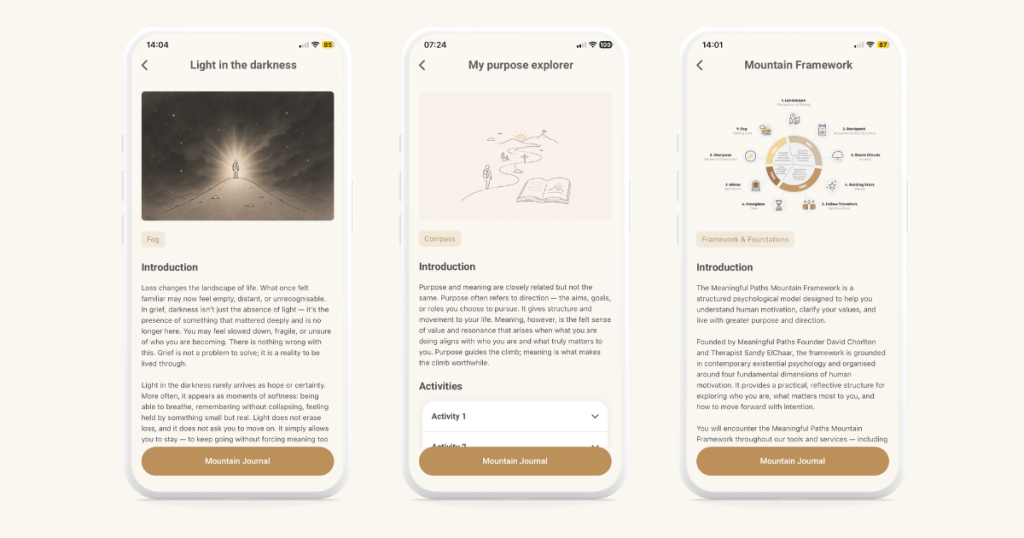
🧭 Explore Difficult Decisions with Path Search
Making a good choice is not always about finding the perfect answer.
Sometimes it involves understanding yourself more deeply.
Your values.
Your relationships.
Your fears.
Your hopes.
Your sense of purpose.
Path Search is a free reflective companion app designed to help you explore life’s questions through the lens of Existential Analysis and the Mountain Framework.
Whether you are facing a difficult decision, feeling uncertain about your direction, or simply looking for greater clarity, Path Search offers guided reflections and practical activities to support your thinking.
Popular decision-making searches include:
- How do I make the right decision?
- How do I trust myself?
- What matters most to me?
- How do I stop overthinking?
- Why do I feel stuck?
- How do I find my purpose?
- How do I know what to do next?
Each search provides reflections and activities designed to help you move from uncertainty towards greater clarity, self-understanding, and meaningful action.
Download Path Search and continue exploring the questions that matter most.
Further Reading
To explore meaning, purpose, values, and direction more deeply:
- From Lost Hope to Found Purpose
- How to Find Your Purpose: A Reflective Guide to Meaning, Direction and Feeling Lost
- Living a Purposeful Life
FAQs
How do I know if I am making a good choice?
A good choice is not always the option that guarantees the best outcome. Often, making a good choice involves understanding the facts, considering your values, reflecting on your emotions, and choosing an option that feels authentic and meaningful.
What if I make the wrong decision?
No decision comes with complete certainty. Even thoughtful decisions can lead to unexpected outcomes. Rather than aiming for perfection, focus on making the most informed and value-based choice possible.
How do I stop overthinking decisions?
Overthinking often happens when we seek certainty that does not exist. Clarifying your values, understanding the facts, and accepting some degree of uncertainty can help you move forward with greater confidence.
Why are values important when making decisions?
Values act like guiding stars. They help us determine which options align most closely with what matters to us. Decisions based on values often feel more meaningful and easier to stand behind over time.
How can I trust myself when making decisions?
Self-trust develops through experience. By reflecting on reality, listening to your emotions, considering your values, and acting with authenticity, you strengthen your ability to make decisions and learn from the outcomes.