
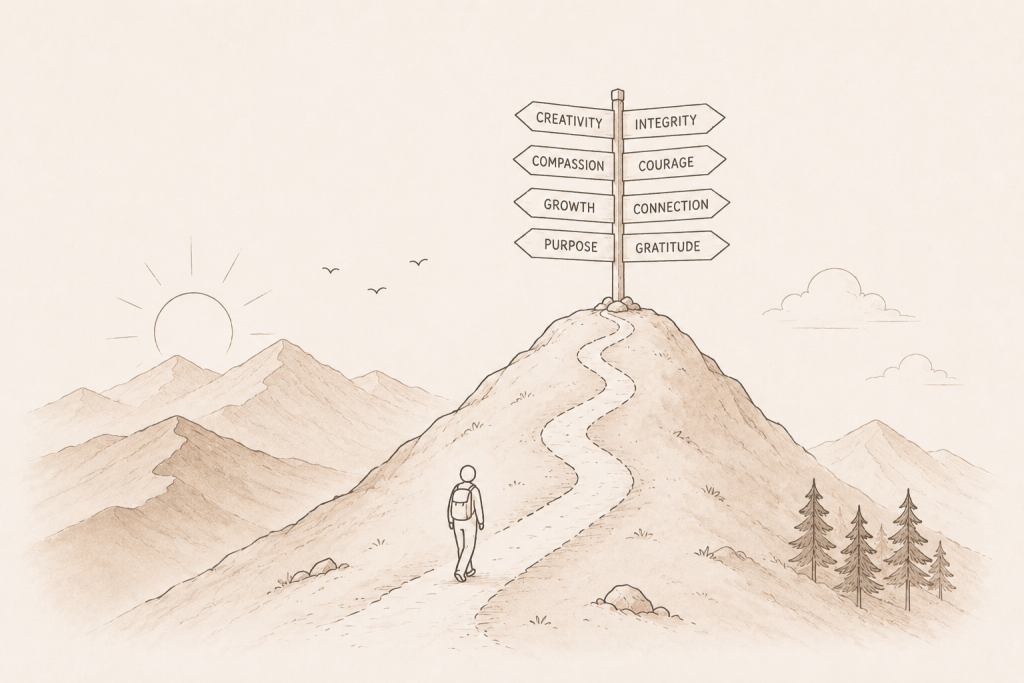
Many people search questions like:
- What are values in life?
- How do I know my values?
- Why do my values matter?
- How do values shape purpose and meaning?
- Why do I feel disconnected from myself?
According to existential psychologist and therapist Sandy ElChaar, values are not simply ideas we choose from a list. They are often revealed gradually through lived experience — through what moves us, hurts us, energises us, and feels deeply meaningful.
Rather than being abstract concepts, values act like inner guiding stars. They help orient us when life feels uncertain, overwhelming, or directionless.
At Meaningful Paths, values are explored through the Guiding Stars dimension of the Meaningful Paths Mountain Framework — a reflective model designed to help people understand meaning, purpose, relationships, anxiety, identity, and emotional wellbeing through human-centred reflection.
Values Are Often Discovered — Not Invented
Many people try to “find their values” intellectually.
But values are rarely discovered through logic alone.
According to Sandy El Chaar, values often emerge through:
- moments of emotional resonance
- meaningful relationships
- suffering and adversity
- experiences of fulfilment
- creativity and contribution
- awe, connection, and reflection
This means values are less about:
“What sounds good?”
And more about:
“What feels deeply alive, important, and meaningful to me?”
The Meaningful Paths Perspective on Values
Within the Meaningful Paths Mountain Framework, values are represented through the idea of Guiding Stars.
Guiding stars help orient the journey up the mountain.
You may still face:
- uncertainty
- anxiety
- loneliness
- setbacks
- emotional storms
But values help prevent you from becoming completely lost.
They provide:
- direction
- orientation
- inner coherence
- meaning
- intentionality
Without values, people often drift toward:
- emotional numbness
- chronic distraction
- external validation
- people pleasing
- emptiness despite success
Values Often Reveal Themselves Through Experience
As explored within the Path Search reflective exercises:
“Values are often revealed through lived experience. They show themselves in moments of engagement, appreciation, and response — in what you create, what you receive, and how you respond when life is difficult.”
This existential perspective sees values as deeply connected to real life experience rather than abstract self-improvement ideals.
For example:
- someone may discover they value connection after periods of loneliness
- someone may discover they value creativity after feeling emotionally deadened in routine work
- someone may discover they value courage after surviving adversity
- someone may realise they value authenticity after years of masking or people pleasing
The Three Categories of Values
Drawing from existential analysis and logotherapy traditions, Meaningful Paths explores three broad dimensions of values.
1. Creative Values (Productive)
These involve:
- creating
- contributing
- building
- expressing
- working toward something meaningful
This may include:
- art
- parenting
- meaningful work
- writing
- teaching
- caring for others
- creating community
Questions to reflect on:
- When do I feel engaged or purposeful?
- What activities leave me feeling fulfilled?
- What do I naturally give energy toward?
2. Experiential Values (Receptive)
These relate to:
- receiving meaning from life
- beauty
- love
- awe
- relationships
- nature
- presence
Experiential values remind us that meaning is not only created through achievement.
Sometimes meaning is received through:
- connection
- silence
- intimacy
- art
- music
- wonder
- being deeply present
Questions to reflect on:
- What moments make me feel emotionally alive?
- When do I feel connected to life?
- What experiences nourish me deeply?
3. Attitudinal Values (Positioning)
These emerge especially during:
- suffering
- loss
- illness
- uncertainty
- limitation
- hardship
Existential psychology recognises that while we cannot always control circumstances, we can still shape our relationship toward them.
Questions include:
- Who do I want to be during difficulty?
- What values do I want to embody?
- How do I position myself toward suffering?
These values often reveal:
- courage
- dignity
- compassion
- resilience
- integrity
- acceptance
What would you like to explore today?
Search meaning, purpose, self-worth, relationships, or life direction…Free guided reflections with 🧭 Path Search.
Why Values Matter So Much
Many people feel anxious, disconnected, or directionless not because something is “wrong” with them — but because they have lost connection with what genuinely matters to them.
When life becomes dominated by:
- pressure
- comparison
- productivity
- external expectations
- social media
- performance
People often drift away from their values.
This creates an internal sense of fragmentation.
According to Sandy ElChaar, reconnecting with values often helps restore:
- coherence
- self-trust
- emotional grounding
- direction
- purpose
Values and Purpose Are Deeply Connected
Purpose is often misunderstood as:
- one perfect career
- a single calling
- a dramatic life mission
But existential psychology views purpose differently.
Purpose often emerges where:
- values
- meaning
- action
- relationships
- intentional living
begin to align.
This is explored further in:
- “How to Find Your Purpose: A Reflective Guide to Meaning, Direction, and Feeling Lost”
- “Living A Purposeful Life”
- “From Lost Hope to Found Purpose”
Purpose becomes clearer not through forcing certainty, but through gradually living closer to what matters.
Signs You May Be Disconnected From Your Values
You may feel:
- emotionally numb
- constantly restless
- successful but empty
- directionless
- disconnected from yourself
- burnt out
- trapped in external expectations
- unsure what truly matters anymore
Often this is not a lack of ambition.
It is a lack of alignment.
How to Begin Reconnecting With Your Values
You do not need to perfectly define your entire identity overnight.
Instead, begin gently noticing:
- what gives you energy
- what feels meaningful
- what feels emotionally alive
- what creates resentment when ignored
- what kind of person you want to become
Simple reflective questions:
- What currently feels worth giving my time and energy to?
- What experiences leave me feeling deeply fulfilled?
- What do I admire most in others?
- What feels quietly meaningful, even if nobody sees it?
- What kind of life would feel authentic to me?
Using Path Search to Explore Your Values
Path Search was created to help people explore existential and emotional questions through reflective guidance grounded in the Meaningful Paths Mountain Framework.
Users can explore searches such as:
- “Help me explore my values”
- “Why do I feel disconnected from myself?”
- “How do I find purpose?”
- “I feel emotionally lost”
- “What truly matters to me?”
- “Why do I feel empty despite success?”
Rather than giving rigid answers, Path Search encourages meaningful reflection, self-understanding, and emotional orientation.
Final Reflection
Values are not simply goals or achievements.
They are the deeper qualities, meanings, and directions that shape how we live.
In existential psychology, values are not imposed from outside. They are gradually uncovered through life itself.
Sometimes quietly.
Sometimes painfully.
Sometimes beautifully.
But often, reconnecting with your values becomes the beginning of reconnecting with yourself.
Continue Your Journey
Explore your question further with 🧭 Path Search, our free guided reflection tool for meaning, purpose, self-worth, relationships, and life direction.
You can also use the Mountain Journal, designed to accompany Path Search and help you record insights, reflections, and next steps.
Frequently Asked Questions
What are personal values?
Personal values are the principles, qualities, and beliefs that matter most to you. They influence how you make decisions, relate to others, spend your time, and evaluate what feels meaningful or worthwhile in life.
What are the three types of values in existential psychology?
Drawing from existential analysis and logotherapy traditions, values are often understood through three broad dimensions:
Creative values involve contributing, creating, building, expressing yourself, and working toward something meaningful. These may be found through activities such as meaningful work, parenting, teaching, writing, caring for others, or creating community.
Experiential values involve receiving meaning from life through experiences such as love, beauty, nature, relationships, art, music, awe, and moments of deep presence.
Attitudinal values emerge most clearly during periods of suffering, uncertainty, loss, illness, or limitation. They reflect how we choose to respond to difficult circumstances and may include courage, dignity, compassion, resilience, integrity, and acceptance.
Together, these three dimensions remind us that meaning can be created through what we contribute, received through what we experience, and discovered through the attitudes we adopt toward life’s challenges.
Why are values important?
Values provide guidance when making decisions and facing challenges. They can help create a greater sense of authenticity, consistency, and direction, particularly during periods of uncertainty or change.
How do I identify my core values?
You can identify your values by reflecting on experiences that felt meaningful, fulfilling, inspiring, or deeply important. Often, our strongest values become visible through the choices we make, the people we admire, and the situations that affect us most deeply.
Are values the same as purpose?
No. Values and purpose are closely connected but not identical. Values act as a compass, helping guide everyday decisions and behaviour. Purpose provides a broader sense of direction, helping answer what you want your life to contribute to or stand for over time.
Are values the same as meaning?
Not exactly. Values help guide how we live, while meaning refers to the sense of significance, fulfilment, and connection we experience in life. Living according to our values often contributes to a greater sense of meaning.
Can my values change over time?
Yes. While some values remain relatively stable, others may evolve as people move through different life stages, relationships, careers, experiences, and challenges.
What are examples of personal values?
Examples include honesty, compassion, creativity, family, growth, freedom, courage, learning, responsibility, authenticity, contribution, connection, and respect. Each person may prioritise values differently.
How do values help with decision-making?
Values provide a framework for evaluating choices. When faced with difficult decisions, reflecting on what matters most can help identify options that feel more authentic and aligned with who you are.
What does it mean to live according to your values?
Living according to your values means making choices and taking actions that reflect what you genuinely believe is important. It involves aligning behaviour, priorities, and commitments with your deepest principles rather than simply responding to external expectations.
What does existential psychology say about values?
Existential psychology views values as an important part of living authentically. Rather than blindly adopting values from others, individuals are encouraged to reflect on what genuinely matters to them and take responsibility for living in accordance with those values.