
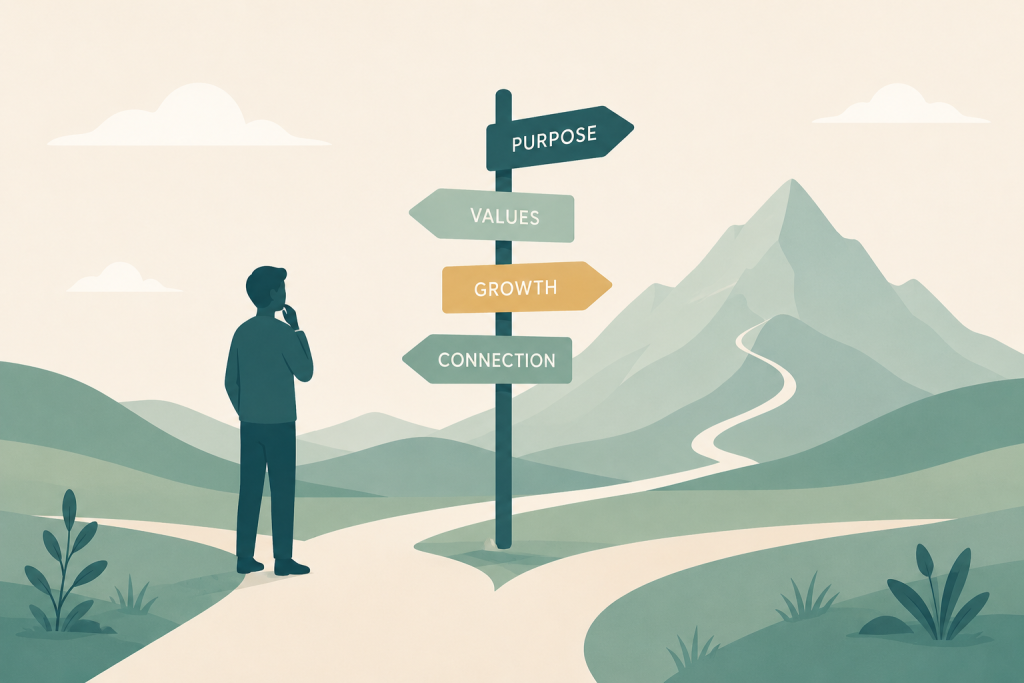
If you don’t know what you want, it does not necessarily mean something is wrong with you. Many people experience periods of uncertainty, especially during life transitions, after achieving major goals, or when living according to expectations that do not fully reflect their own values. From an existential perspective, uncertainty can be an invitation to reconnect with yourself, your values, your relationships, and what gives your life meaning.
Have you ever found yourself thinking:
“I don’t know what I want anymore.”
Perhaps you feel stuck between different options. Perhaps everyone around you seems certain about their future while you feel confused about your next step. Maybe you have achieved goals that once felt important, only to discover that they did not bring the sense of fulfilment you expected.
If this resonates with you, you are not alone.
Many people experience periods of uncertainty about what they want from life, relationships, work, or their future. This can happen during major life transitions, after reaching significant milestones, or when the path that once seemed clear no longer feels meaningful.
From an existential perspective, not knowing what you want is not necessarily a problem to solve. Sometimes it is a signal that something deeper is asking for your attention.
You may be questioning old assumptions. You may be outgrowing previous goals. You may be discovering that what others expect from you is different from what genuinely matters to you.
In these moments, the question is often not simply:
“What do I want?”
But rather:
“What truly matters to me?”
“What kind of life feels meaningful?”
“What direction feels authentic?”
Exploring these questions takes courage. It also takes patience. Meaningful direction rarely emerges through pressure, certainty, or forcing ourselves to have all the answers. More often, it develops through reflection, experience, and a gradual reconnection with ourselves.
In this article, we will explore some common reasons why people struggle to know what they want, how Existential Analysis understands uncertainty, and how the Meaningful Paths Framework can help you find greater clarity, direction and purpose.
Continue Your Journey
Receive insights from our founders
Join David Chorlton and Therapist Sandy ElChaar for occasional thoughtful reflections, practical guidance and Meaningful Paths updates grounded in the Mountain Framework.
Why Do So Many People Feel Unsure About What They Want?
Not knowing what you want can feel frustrating, especially when it seems as though everyone else has life figured out. Yet uncertainty is a common part of the human experience.
There are many reasons why people struggle to identify what they truly want.
Too Many Possibilities
Modern life offers more choices than ever before. While freedom can be exciting, it can also become overwhelming.
Should you focus on your career, relationships, travel, personal growth, financial security, or something else entirely?
When every path appears possible, making a choice can feel difficult. Instead of moving forward, many people become stuck trying to find the “perfect” answer.
Living According to Expectations
Sometimes we spend years pursuing goals that were never fully our own.
Perhaps you followed a career path because it seemed practical. Perhaps you adopted values from family, culture, or society without questioning whether they genuinely reflected who you are.
Over time, this can create a quiet sense of disconnection. You may achieve what you thought you wanted, only to discover that it does not feel as meaningful as expected.
Fear of Making the Wrong Choice
Many people believe they must identify the right answer before taking action.
But life rarely works this way.
The fear of making a mistake can lead to endless analysis, second-guessing, and hesitation. Instead of learning through experience, we wait for certainty that may never come.
Life Transitions and Change
Periods of uncertainty often emerge during significant life changes.
You may be:
- graduating from education
- changing careers
- ending a relationship
- becoming a parent
- moving to a new country
- experiencing loss or grief
- questioning long-held assumptions
When one chapter ends, the next is not always immediately clear. Feeling uncertain during these transitions is often a natural response rather than a sign that something is wrong.
Disconnection From Yourself
Sometimes the problem is not that you have no desires or aspirations.
The problem is that you have become disconnected from them.
When life becomes busy, stressful, or focused on meeting external demands, it can be difficult to hear your own voice. You may know what others expect from you, but struggle to identify what genuinely matters to you.
This can create a feeling of being lost, confused, or directionless.
Comparing Yourself to Others
In a world filled with social media and constant comparison, it is easy to believe that everyone else knows exactly where they are going.
In reality, many people are navigating uncertainty behind the scenes.
Comparing your internal struggles to someone else’s external appearance often increases self-doubt and makes it harder to recognise your own path.
Rather than asking, “Why don’t I know what I want?” it can sometimes be more helpful to ask:
“Have I given myself the space to discover what truly matters to me?”
This shift takes us beyond finding the perfect goal and towards a deeper exploration of meaning, values, and authenticity.
What would you like to explore today?
Search meaning, purpose, self-worth, relationships, or life direction…Free guided reflections with 🧭 Path Search.
Signs You May Be Disconnected From What You Truly Want
When people think about not knowing what they want, they often imagine a complete absence of direction. In reality, the signs are usually more subtle.
You may be moving forward in life, achieving goals, and fulfilling responsibilities, yet still feel uncertain about where you are heading or why.
Some common signs include:
You Keep Changing Your Goals
A new job, relationship, qualification, project, or life plan may seem exciting at first. Yet once you move towards it, the enthusiasm quickly fades and another goal takes its place.
This does not necessarily mean you are indecisive. It may suggest that you are searching for something deeper than achievement alone.
You Feel Stuck Between Different Options
Sometimes every choice feels equally right—or equally wrong.
You might spend months weighing different possibilities without making a decision because no option feels completely certain.
This can create the exhausting feeling of being trapped between paths.
You Often Wonder If There Is Something More
Even when life appears to be going reasonably well, a persistent question remains:
“Is this really it?”
You may find yourself longing for greater meaning, purpose, authenticity, or connection without being able to clearly define what is missing.
You Make Decisions Based Primarily on Expectations
Many people become disconnected from what they want because they are focused on what they believe they should want.
You may find yourself asking:
- What would make my family proud?
- What is the sensible choice?
- What do successful people do?
- What will other people think?
These questions are understandable, but if they become the primary guide for your decisions, your own voice can become difficult to hear.
You Feel Envious of Other People’s Lives
Envy is often uncomfortable, but it can also provide useful information.
Sometimes envy reveals a neglected value, desire, or possibility.
Rather than judging yourself for feeling envious, it may be worth asking:
“What does this reaction tell me about what matters to me?”
You Struggle to Make Even Small Decisions
When we lose touch with our values and priorities, even ordinary decisions can feel overwhelming.
Questions that once seemed simple may become difficult:
- What do I want to do next?
- What kind of work suits me?
- What relationships do I want to invest in?
- What direction feels right?
Without an internal compass, every choice can feel uncertain.
You Feel Lost Despite Being Busy
One of the most common experiences is being constantly occupied yet feeling directionless.
You may spend your days working, studying, caring for others, or completing endless tasks, while quietly wondering whether your life is moving towards something that truly matters.
This is often the moment when people begin asking deeper existential questions.
Not because they are failing.
Not because something is wrong with them.
But because they are seeking a more authentic relationship with themselves, their values, and the life they are living.
From an existential perspective, these experiences are not simply problems to eliminate. They may be invitations to pause, reflect, and reconnect with what genuinely matters.
An Existential Perspective: Perhaps the Question Is Not “What Do I Want?” But “What Matters?”
When people feel uncertain about what they want, they often assume they need to think harder, analyse more, or discover the perfect goal.
Yet from an existential perspective, the challenge may not be a lack of options. It may be a lack of connection.
The question is often not:
“What do I want?”
but rather:
“What truly matters to me?”
“What kind of life feels worth living?”
“What direction reflects who I am?”
Existential Analysis, developed by Alfried Längle and influenced by the work of Viktor Frankl, suggests that human beings flourish when four fundamental conditions of existence are sufficiently met.
These are known as the Four Fundamental Motivations.
Rather than focusing solely on goals, achievements, or happiness, they invite us to reflect on our relationship with life itself.
When one or more of these foundations feels neglected, it can become difficult to know what we want because we have lost touch with important aspects of ourselves and our existence.
The First Fundamental Motivation: Can I Be Here?
Before we can pursue meaningful goals, we need a sense of security and support.
Do I have enough stability in my life?
Do I feel safe enough to explore possibilities?
Do I have the space to exist as I am?
When life feels overwhelming, uncertain, or threatening, our energy is often focused on coping rather than discovering what we want.
Sometimes clarity emerges not through finding a purpose, but through first creating the conditions that allow us to breathe, rest, and feel grounded.
The Second Fundamental Motivation: Do I Like Living?
This motivation relates to our relationship with value.
Do I experience joy, connection, appreciation, or fulfilment?
What genuinely enriches my life?
What activities, people, or experiences feel valuable to me?
Many people struggle to know what they want because they have become disconnected from the things that bring life colour and meaning.
When we lose contact with what we value, direction becomes difficult because we no longer know what we are moving towards.
The Third Fundamental Motivation: May I Be Myself?
This motivation concerns authenticity and self-worth.
Can I be myself in this situation?
Do I respect my own feelings and perspectives?
Am I living according to my values or someone else’s expectations?
Many people who feel lost discover that they have spent years trying to become who they thought they should be rather than who they genuinely are.
In these situations, uncertainty can be an invitation to rediscover one’s own voice.
The Fourth Fundamental Motivation: What Am I Living For?
This motivation relates to meaning and purpose.
What calls me forward?
What contribution do I want to make?
What gives my life a sense of significance?
Meaning does not always arrive as a sudden revelation. More often, it emerges gradually through our relationships, values, responsibilities, and choices.
When we ask what we want, we are often searching for meaning, even if we do not realise it.
From this perspective, uncertainty is not necessarily a failure to figure life out.
It may be a sign that something important is asking to be explored more deeply.
Rather than rushing towards an answer, we can begin by asking a different question:
“Which of these foundations might need my attention right now?”
This shift moves us away from pressure and towards curiosity—a much more fertile ground for discovering direction and purpose.

Using the Meaningful Paths Mountain Framework to Find Clarity
At Meaningful Paths, we often describe personal growth as a journey through a mountain landscape.
When people say, “I don’t know what I want,” they are often searching for a destination. Yet before we can identify where we want to go, it can be helpful to better understand where we are.
The Meaningful Paths Mountain Framework offers a way to reflect on different aspects of our experience and uncover a clearer sense of direction.
Landscape: Understanding Your Current Situation
When we feel lost, our attention is often pulled towards the future.
We focus on questions such as:
- What should I do next?
- Which decision is right?
- What if I make a mistake?
Yet clarity often begins by understanding our current reality.
The Landscape represents the terrain of your life as it is today.
You might ask yourself:
- What is currently happening in my life?
- What challenges am I facing?
- What opportunities are available to me?
- What strengths can I draw upon?
Before deciding where to go, it helps to understand the ground beneath your feet.
Fog: Accepting Uncertainty
Many people believe they need complete certainty before moving forward.
In reality, uncertainty is a natural part of life.
The Fog represents those moments when the path ahead is unclear.
You may not know:
- which career to pursue
- whether a relationship is right for you
- where you want to live
- what your future will look like
The goal is not always to eliminate uncertainty.
Sometimes the task is to learn how to move forward despite it.
A small step taken in uncertainty often teaches us more than endless reflection without action.
Mirror: Listening to Your Own Voice
One reason people struggle to know what they want is that they have become surrounded by the voices of others.
Family expectations.
Social expectations.
Cultural expectations.
Advice from friends.
Opinions from social media.
The Mirror invites us to pause and ask:
- What do I genuinely think?
- What do I genuinely feel?
- Which desires belong to me?
- Which expectations have I adopted from others?
This is not about becoming selfish. It is about developing an honest relationship with yourself.
Guiding Stars: Clarifying Your Values
When people do not know what they want, they often benefit from exploring what they value.
Values act like guiding stars.
They do not provide a detailed map, but they help us orient ourselves.
Examples might include:
- connection
- creativity
- learning
- contribution
- compassion
- adventure
- authenticity
- growth
When choices feel confusing, values can provide direction even when the destination remains uncertain.
You may not know exactly what you want, but you may know what matters.
Compass: Choosing a Direction
The Compass represents intentional movement.
Many people wait until they feel completely certain before taking action.
Unfortunately, certainty often arrives after movement rather than before it.
You do not need to know your entire future.
You only need to identify a direction that feels meaningful enough to explore.
Sometimes the most helpful question is not:
“What do I want to do for the rest of my life?”
but:
“What feels like the next meaningful step?”
Small actions create experience.
Experience creates insight.
Insight creates clarity.
And clarity often reveals itself gradually through the journey rather than appearing all at once.
If you do not know what you want, perhaps the task is not to force an answer.
Perhaps the task is to better understand your landscape, accept the fog, listen to your own voice, reconnect with your values, and take one meaningful step forward.
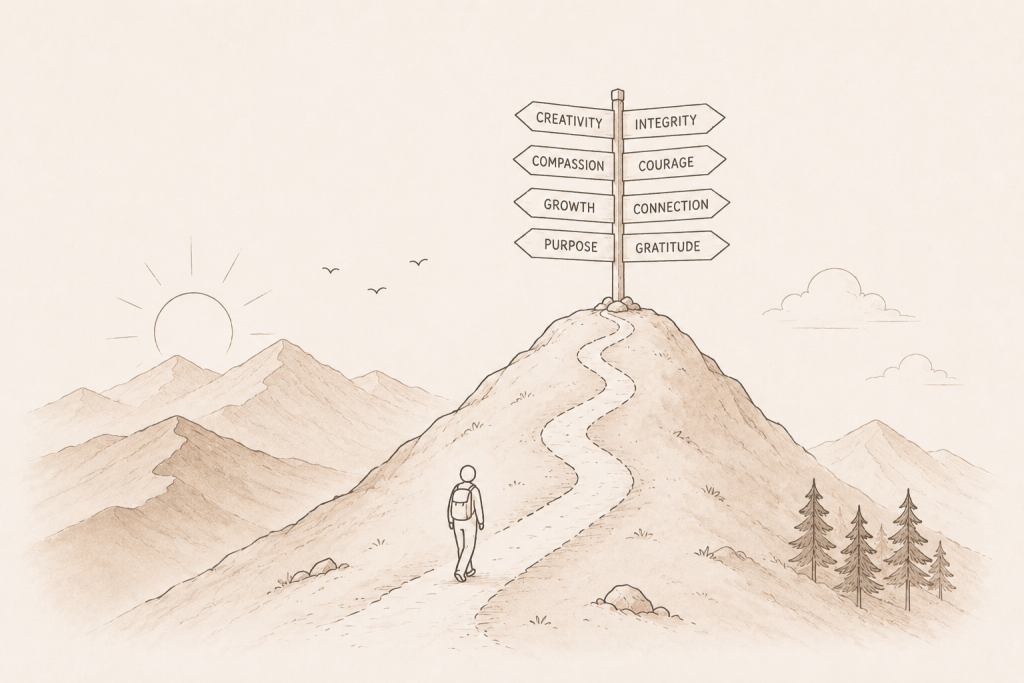
What If I Still Don’t Know What I Want?
One of the most difficult aspects of uncertainty is the belief that we should have the answer by now.
You may look around and assume that other people have a clear plan, a strong sense of purpose, or complete confidence in their direction. Yet many people are navigating similar questions beneath the surface.
Not knowing what you want does not mean you are failing.
It does not mean you are behind.
And it does not mean there is something wrong with you.
In fact, some of life’s most important discoveries emerge during periods of uncertainty.
Clarity Often Comes Through Experience
Many people approach life as though they must first discover the perfect answer and then take action.
In reality, the opposite is often true.
Action creates information.
Experience creates understanding.
Reflection creates clarity.
You may not know whether a particular path is right until you begin exploring it.
A conversation, a course, a new hobby, a volunteering opportunity, a creative project, or a small career change can reveal insights that endless thinking cannot.
Stop Looking for the Perfect Choice
The desire to make the “right” decision can become a source of paralysis.
Life rarely presents us with one perfect path.
Most meaningful lives are built through a series of imperfect choices, adjustments, discoveries, and course corrections.
Instead of asking:
“What is the perfect decision?”
you might ask:
“Which option feels most aligned with my values right now?”
This shift often reduces pressure and makes movement possible.
Give Yourself Permission Not to Know
There can be a surprising amount of freedom in admitting:
“I don’t know yet.”
Not every question needs an immediate answer.
Sometimes uncertainty is not a problem to solve but a stage to move through.
Just as a seed requires time beneath the soil before it grows, periods of confusion can precede important personal growth and transformation.
Focus on the Next Step, Not the Entire Journey
One reason people feel overwhelmed is that they try to solve their entire future at once.
Questions such as:
- What should I do with my life?
- What career should I pursue?
- What is my purpose?
- Where will I be in ten years?
can feel enormous.
Instead, consider a smaller question:
“What is one meaningful step I can take this week?”
Small steps often reveal more than grand plans.
Trust That Meaning Can Be Discovered
From an existential perspective, meaning is not always something we invent through careful planning.
Often, it is something we discover through engagement with life.
Meaning may emerge through:
- relationships
- acts of service
- creativity
- learning
- personal growth
- overcoming challenges
- contributing to something larger than ourselves
Rather than trying to force certainty, it can be helpful to remain open and attentive to what life is asking of you in this moment.
A Different Question
If you are struggling with not knowing what you want, consider replacing the question:
“What do I want?”
with:
“What matters enough for me to explore further?”
You do not need all the answers today.
You do not need complete certainty.
You do not need a perfectly mapped future.
You only need enough courage to take the next meaningful step and enough curiosity to keep listening as your path unfolds.
Reflective Questions: Exploring What Matters to You
If you are struggling to know what you want, it can be helpful to slow down and reflect rather than immediately searching for answers.
The following questions are designed to help you reconnect with your values, experiences, and sense of direction.
You may wish to journal about them or simply sit with them for a few moments.
Landscape
- What is happening in my life right now?
- What challenges or opportunities are most present for me at this moment?
- What aspects of my current situation am I accepting, and which might need to change?
Mirror
- Which goals in my life genuinely feel like my own?
- Which goals have been shaped primarily by other people’s expectations?
- When do I feel most like myself?
Guiding Stars
- What values matter most to me at this stage of my life?
- What qualities do I admire in others?
- What experiences leave me feeling fulfilled, alive, or connected?
Compass
- What is one direction I feel curious about exploring?
- What small step could I take this week to learn more about myself?
- What decision would feel more aligned with my values?
Meaning
- When have I felt that my life was meaningful?
- What activities make me lose track of time?
- What kind of contribution would I like to make to others, my community, or the world around me?
Looking Ahead
- If fear were not holding me back, what might I be willing to explore?
- What would I like to learn about myself over the next year?
- What matters enough for me to take one small step towards it today?
You do not need perfect answers to these questions.
Sometimes the goal of reflection is not to arrive at certainty, but to develop a deeper understanding of yourself and the direction that feels most authentic and meaningful.
Clarity often emerges gradually through reflection, experience, and action. The more we listen to ourselves with curiosity and honesty, the easier it becomes to recognise the paths that genuinely matter to us.
Frequently Asked Questions
Why don’t I know what I want in life?
There are many possible reasons. You may be experiencing a life transition, feeling overwhelmed by choices, living according to other people’s expectations, or becoming disconnected from your values. Sometimes uncertainty is not a sign that something is wrong, but an invitation to reflect more deeply on what truly matters to you.
Is it normal not to know what I want?
Yes. Most people experience periods of uncertainty at different stages of life. Major changes, personal growth, loss, achievement, and shifting priorities can all lead us to question our direction. Not knowing what you want is a common human experience rather than a personal failure.
Why do I feel lost and confused?
Feeling lost often occurs when familiar goals, roles, or assumptions no longer provide the same sense of meaning or direction. This can happen after significant life events or during periods of personal change. While uncomfortable, these experiences can also create opportunities for growth, reflection, and self-discovery.
How can I figure out what I really want?
Rather than searching for a perfect answer, it can be helpful to explore your values, interests, experiences, and relationships. Reflection, journaling, trying new experiences, and paying attention to what feels meaningful can gradually reveal what matters most to you.
Can anxiety make it difficult to know what I want?
Yes. Anxiety often focuses our attention on potential risks, mistakes, and uncertainties. When we are anxious, it can be difficult to hear our own preferences or trust our decisions. Creating space for reflection and self-understanding can help reduce this confusion.
Why do I keep changing my mind?
Changing your mind is not always a sign of indecisiveness. Sometimes it reflects growth, new experiences, or a deeper understanding of yourself. However, if you frequently abandon goals, it may be worth exploring whether fear, perfectionism, or external expectations are influencing your decisions.
What if I am afraid of making the wrong choice?
Many people delay decisions because they fear regret or failure. Yet life rarely provides complete certainty. Often, clarity develops through action rather than endless analysis. Instead of seeking the perfect choice, it may be more helpful to identify the option that feels most aligned with your values right now.
How do values help me find direction?
Values act like guiding stars. They do not tell you exactly what to do, but they help you orient yourself when decisions feel difficult. Understanding what matters most to you can make it easier to choose paths that feel authentic, meaningful, and fulfilling.
Will I always feel this uncertain?
Probably not. While uncertainty is a natural part of life, most people experience periods of greater clarity as they continue reflecting, learning, and engaging with life. Meaning and direction often emerge gradually rather than appearing all at once. The goal is not to eliminate uncertainty completely, but to learn how to move forward despite it.
Continue Your Journey
Explore your question further with 🧭 Path Search, our free guided reflection tool for meaning, purpose, self-worth, relationships, and life direction.
You can also use the Mountain Journal, designed to accompany Path Search and help you record insights, reflections, and next steps.
Conclusion
If you have been asking yourself, “Why don’t I know what I want?”, it can be tempting to assume that something is wrong with you.
Yet uncertainty is often a natural part of being human.
Many people experience periods where old goals no longer feel meaningful, familiar paths become unclear, or important life questions begin to emerge. These moments can feel uncomfortable, but they can also become opportunities for reflection, growth, and self-discovery.
From an existential perspective, the challenge is not always finding the perfect answer. Often, it is about developing a deeper relationship with yourself, your values, your experiences, and what gives your life meaning.
The Four Fundamental Motivations remind us that direction is connected to more than goals alone. It is influenced by our sense of security, our experience of value and fulfilment, our authenticity, and our relationship with meaning and purpose.
Similarly, the Meaningful Paths Mountain Framework reminds us that clarity rarely appears all at once.
We begin by understanding our Landscape.
We learn to navigate the Fog.
We look honestly into the Mirror.
We reconnect with our Guiding Stars.
And we use our Compass to take the next meaningful step forward.
You do not need to have your entire future figured out.
You do not need complete certainty.
You do not need a perfectly mapped path.
Perhaps the most important question is not:
“What do I want for the rest of my life?”
but:
“What matters enough for me to explore next?”
Sometimes direction is not found through having all the answers.
Sometimes it is discovered by taking one meaningful step at a time.
Further Resources
→ From Lost Hope to Found Purpose
A short story and reflective lessons about finding meaning during difficult times.
→ Why Do I Feel Empty Even When Life Looks Good?
Explore why achievement and success do not always lead to fulfilment.
→ What Are Values? A Reflective Guide to Meaning, Direction and Living Authentically
Discover how values can act as guiding stars when life feels uncertain.
→ What Is Wrong With Me?
A compassionate exploration of self-doubt, comparison, and feeling disconnected from yourself.
→ Finding Happiness Within Yourself: An Existential Perspective
Reflect on fulfilment, self-acceptance, and living in alignment with what matters.
→ Prompts for a Gratitude Journal: Meaningful Reflections for Presence, Peace and Purpose
A collection of reflective prompts to help reconnect with meaning in everyday life.
→ Living a Purposeful Life
Reflective article with advice on how to live a Purposeful Life.
Explore Your Path
If you’re unsure what you want, you may not need more advice—you may need better questions.
Path Search is a free reflective tool based on Existential Analysis and the Meaningful Paths Mountain Framework. Through guided questions and activities, it can help you explore your values, relationships, direction, and sense of purpose.
Continue Your Journey
Receive insights from our founders
Join David Chorlton and Therapist Sandy ElChaar for occasional thoughtful reflections, practical guidance and Meaningful Paths updates grounded in the Mountain Framework.