
Introduction
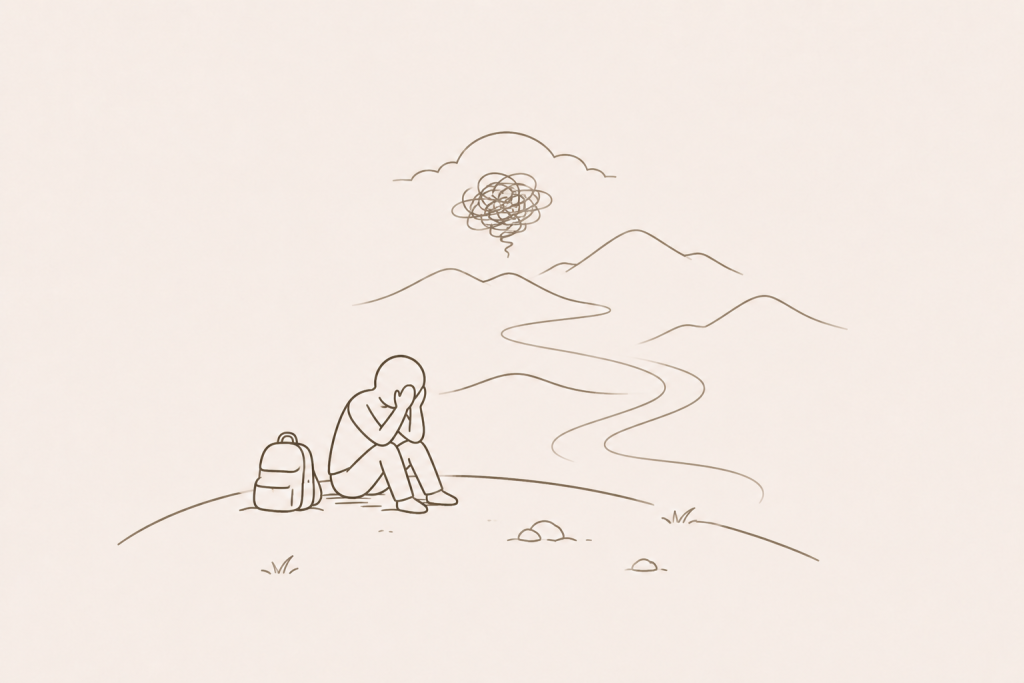
Anxiety can make it feel as though your mind is constantly moving. Thoughts race ahead to future possibilities, replay past events, or become caught in endless cycles of worry and uncertainty. Even when there is no immediate danger, anxiety can leave you feeling overwhelmed, restless, exhausted, or disconnected from the present moment.
During these periods, many people search for certainty. They try to think their way out of anxiety, solve every possible problem, or prepare for every potential outcome. Yet anxiety often grows stronger the more we struggle against it.
Journaling offers a different approach. Rather than trying to eliminate anxious thoughts, reflective writing creates space to observe them with curiosity and compassion. Writing can help organise overwhelming thoughts, identify patterns, reconnect with what is within your control, and return your attention to the present moment.
This article focuses specifically on journaling during periods of anxiety, mental overwhelm, and racing thoughts. If you are looking for broader questions about uncertainty, purpose, and life direction, explore our guide to Journaling Prompts for When You Feel Lost in Life. If anxiety is affecting your confidence, self-acceptance, or relationship with yourself, you may also find Journaling Prompts for Self-Worth helpful.
The prompts below are not intended to provide quick fixes or eliminate anxiety completely. Instead, they are designed to help you understand your experience more clearly, create moments of grounding, and reconnect with the support, values, and inner resources that can help you navigate difficult periods with greater steadiness.
Anxiety often pulls us away from the present moment. Journaling can help us gently return.
Why Journaling Can Help with Anxiety
When we experience anxiety, our attention is often pulled away from the present moment and into the future. Our minds begin scanning for potential threats, problems, uncertainties, or situations that might go wrong. While this process is intended to protect us, it can sometimes leave us feeling trapped in cycles of worry and overthinking.
The more anxious we become, the narrower our focus can become. We may struggle to recognise what is going well, overlook available sources of support, or lose sight of what is actually happening in the present moment.
Journaling can help interrupt this cycle. Writing slows the mind down, creates distance from overwhelming thoughts, and provides an opportunity to explore our concerns more clearly. Rather than being swept along by anxiety, we can begin to observe it, understand it, and respond to it more intentionally.
From the perspective of Existential Analysis, anxiety is often closely connected to the First Fundamental Motivation (FM1): Space, Protection, and Support.
FM1 asks a simple but important question:
Can I be here?
When FM1 feels secure, we experience a sense of stability, support, and grounding. When it is challenged, we may feel unsafe, overwhelmed, uncertain, or unable to find solid ground beneath our feet.
This does not mean anxiety is always caused by a lack of support. However, anxiety often invites us to consider questions such as:
- What feels threatening or uncertain right now?
- What support do I need?
- What is within my control?
- What helps me feel safe and grounded?
- How can I create more space for myself during difficult periods?
The journaling prompts below are designed to help you explore these questions with curiosity rather than judgment. You do not need to answer every prompt. Choose the ones that resonate with your current experience and allow yourself to write honestly, without pressure to solve everything immediately.
Sometimes the goal is not to eliminate anxiety. Sometimes the goal is simply to understand it well enough that it no longer has to carry the entire conversation.
Journaling Prompts to Understand Your Anxiety
Before we can respond to anxiety, it can be helpful to understand it. Many anxious thoughts operate quickly and automatically, making it difficult to distinguish between what is actually happening and what we fear might happen.
Journaling creates an opportunity to slow these thoughts down and explore them more carefully. Often, simply putting worries into words can reduce some of their intensity and help us see them more clearly.
These prompts are designed to help you understand what may be contributing to your anxiety and how it is affecting your experience.
- What am I most anxious about right now?
- What specific outcome am I worried might happen?
- What thoughts keep repeating in my mind?
- What uncertainty feels hardest for me to tolerate?
- What am I trying to predict, prevent, or control?
- What evidence supports my fears?
- What evidence may suggest a different possibility?
- What is the worst-case scenario I am imagining?
- If that scenario happened, how might I cope?
- What am I assuming about the future that I cannot actually know?
- What aspects of this situation are within my control?
- What aspects are outside of my control?
- What physical sensations do I notice when I feel anxious?
- When did these feelings first begin?
- Are there particular situations, people, or events that tend to trigger my anxiety?
- What need, concern, or value might be sitting beneath my anxiety?
- What is my anxiety trying to protect me from?
- What might my anxiety be asking me to pay attention to?
- What would change if I approached this situation with curiosity rather than fear?
- What do I need most right now?
Many people discover that anxiety is not simply about fear. Beneath anxious thoughts, there may be important concerns about safety, belonging, relationships, responsibility, uncertainty, or things that genuinely matter to us.
Understanding anxiety does not make it disappear. However, it can help transform anxiety from something that feels overwhelming and mysterious into something that can be explored, understood, and responded to with greater awareness.
If you are new to journaling or unsure how to begin exploring these questions, our guide to What to Write in a Writing Journal offers additional ideas and starting points for reflective writing.
Journaling Prompts for Self-Compassion During Anxiety
Many people experience a second layer of suffering on top of anxiety itself. Not only do they feel worried, overwhelmed, or uncertain, but they also become frustrated with themselves for feeling that way.
Thoughts such as:
- “I shouldn’t feel like this.”
- “Why can’t I just get over it?”
- “Everyone else seems to cope better than me.”
can add self-criticism to an already difficult experience.
Self-compassion offers a different approach. Rather than fighting anxiety or judging ourselves for experiencing it, self-compassion invites us to respond with understanding, patience, and kindness. This does not mean we enjoy anxiety or want it to remain. It simply means we stop treating ourselves as the enemy.
The following prompts are designed to help you develop a more compassionate relationship with yourself during anxious periods.
- How am I speaking to myself about my anxiety right now?
- Would I speak to a friend in the same way?
- What am I judging myself for at the moment?
- What would a kinder response sound like?
- What am I finding difficult that deserves understanding rather than criticism?
- What would I say to someone I care about if they were experiencing exactly what I am experiencing?
- What expectations am I placing on myself during this period?
- Are those expectations realistic?
- What am I doing well, despite my anxiety?
- What strengths have helped me cope with previous challenges?
- What would it mean to be gentle with myself today?
- What part of me needs reassurance right now?
- What am I learning about myself through this experience?
- What would self-compassion look like over the next 24 hours?
- What small act of care can I offer myself today?
- What would happen if I stopped trying to be perfect?
- How might I support myself rather than fight myself?
- What do I need to hear most right now?
Many people discover that anxiety becomes easier to navigate when they stop treating it as a personal failure. Anxiety is a human experience, not a character flaw. Responding to yourself with compassion does not make you weak; it creates the emotional safety needed to cope more effectively.
If self-criticism, self-doubt, or feelings of not being enough are contributing to your anxiety, you may also find our article Journaling Prompts for Self-Worth helpful. Building self-compassion and self-worth often goes hand in hand, creating a stronger foundation for resilience and wellbeing.
Journaling Prompts for Finding Stability, Support, and What You Can Control
Anxiety often thrives in uncertainty. The more unpredictable a situation feels, the stronger our urge may become to seek certainty, reassurance, or control. Yet many of the things we worry about are ultimately beyond our influence.
One of the most helpful shifts we can make is learning to distinguish between what we can control and what we cannot. This does not eliminate anxiety, but it can help us direct our energy towards actions, resources, and sources of support that are actually available to us.
The following prompts are designed to help you identify areas of stability, strengthen your support system, and reconnect with what is within your influence.
- What aspects of my current situation are within my control?
- What aspects are outside of my control?
- Where am I spending energy trying to control things I cannot change?
- What practical actions are available to me right now?
- What is one small step I can take today?
- What support do I need at this moment?
- Who are the people I can turn to when I am struggling?
- What makes me feel safe, grounded, or supported?
- What routines help me feel more stable?
- What boundaries would reduce unnecessary stress in my life?
- What commitments or responsibilities feel manageable right now?
- What am I expecting of myself that may be unrealistic?
- What resources, strengths, or coping skills have helped me before?
- What would it mean to ask for help rather than carrying everything alone?
- What environment helps me feel calm and focused?
- What can I simplify, postpone, or let go of for now?
- What would it look like to focus on the next step rather than the entire journey?
- What evidence do I have that I have survived uncertainty before?
- What strengths have carried me through difficult periods in the past?
- What helps me feel more connected to life when anxiety is high?
When anxiety is intense, it is easy to forget the support, resilience, and resources that already exist around us. These reflections are not about pretending everything is fine. They are about recognising that alongside uncertainty, there may also be stability, strength, and support available to help us move forward.
Sometimes we do not need complete certainty. Sometimes we simply need enough support to take the next step.
Using the Four Fundamental Motivations During Anxiety
Anxiety is often treated as something we must eliminate as quickly as possible. While reducing distress is important, anxiety can also be viewed as a signal that invites us to pay attention to deeper questions about our lives, relationships, values, and sense of direction.
The Four Fundamental Motivations provide one way of exploring these deeper layers.
Rather than asking only:
“How do I stop feeling anxious?”
we might also ask:
“What is my anxiety asking me to pay attention to?”
FM1: Space, Protection, and Support
FM1 asks:
Can I be here?
Anxiety is often closely connected to this motivation. When we feel unsafe, unsupported, overwhelmed, or uncertain, our minds naturally become more alert to potential threats.
Reflective questions:
- What support do I need right now?
- Where do I need more stability or protection?
- What helps me feel grounded?
- What is helping me cope during this period?
FM2: Fulfilment and Values
FM2 asks:
Do I like living?
Sometimes anxiety can become stronger when life feels disconnected from the people, activities, and experiences that bring value and fulfilment.
Reflective questions:
- What still brings me a sense of appreciation or joy?
- What values feel important to me right now?
- Where do I feel connected and engaged?
- What small moments of fulfilment am I overlooking?
FM3: Authenticity and Self-Worth
FM3 asks:
Can I be myself?
Anxiety is sometimes linked to self-criticism, perfectionism, people-pleasing, or fear of judgment. We may feel pressure to meet impossible standards or seek constant reassurance from others.
Reflective questions:
- What expectations am I placing on myself?
- Where am I seeking approval rather than trusting myself?
- What would self-compassion look like today?
- What strengths have I forgotten?
FM4: Meaning and Purpose
FM4 asks:
What am I living for?
Periods of anxiety can sometimes leave us feeling disconnected from purpose, direction, or a sense of meaning. We may become so focused on avoiding problems that we lose sight of what we are moving towards.
Reflective questions:
- What matters most to me right now?
- What am I trying to protect through my anxiety?
- What would a meaningful next step look like?
- What is life asking of me in this situation?
Exploring anxiety through the Four Fundamental Motivations does not provide instant solutions. However, it can help us move beyond symptom management and towards a deeper understanding of ourselves and our needs.
If you would like support exploring questions about anxiety, self-worth, relationships, meaning, values, and personal growth, consider using Path Search (look for the compass icon). Path Search provides free guided reflections inspired by the Four Fundamental Motivations and the Meaningful Paths framework.
To deepen your reflections, you can also use the Mountain Journal, which was designed to accompany Path Search and provide space to record insights, questions, actions, and discoveries throughout your journey.
When Anxiety Makes You Feel Stuck
One of the most frustrating aspects of anxiety is that it can leave us feeling trapped between wanting to move forward and feeling unable to take action. Decisions feel overwhelming, risks feel larger than they are, and even simple tasks can seem difficult to begin.
In these moments, anxiety often convinces us that we need more certainty before we can act. We tell ourselves that once we feel confident, calm, or completely prepared, we will move forward. Unfortunately, that moment rarely arrives.
Clarity is often created through action rather than waiting for certainty.
This does not mean forcing yourself into situations before you are ready. Rather, it means recognising that small, meaningful steps are often more helpful than endless analysis.
The following prompts are designed to help you explore where anxiety may be keeping you stuck and how you might begin moving forward again.
- What decision or situation am I currently avoiding?
- What feels most difficult about taking the next step?
- What am I waiting for before I allow myself to move forward?
- Is that expectation realistic?
- What would happen if I accepted that uncertainty is part of life?
- What is the smallest possible step I could take today?
- What action feels uncomfortable but meaningful?
- What opportunity might anxiety be preventing me from pursuing?
- What am I afraid could happen if I take action?
- What could I learn even if things do not go perfectly?
- What would I advise a friend in this situation?
- What strengths could help me move forward despite uncertainty?
- What is one thing I know, even if many things remain unclear?
- What would progress look like over the next week rather than the next year?
- What am I capable of doing today?
- What might become possible if I stopped waiting for certainty?
- What meaningful action can I take after I finish writing?
- What would trusting myself look like right now?
Many people discover that anxiety becomes less overwhelming when they stop viewing uncertainty as a problem that must be solved and begin seeing it as a natural part of growth, change, and living.
You do not need to see the entire path before taking the next step.
If anxiety is connected to feeling uncertain about your future, purpose, or direction in life, you may also find our guide to Journaling Prompts for When You Feel Lost in Life helpful. Sometimes what appears to be anxiety is also an invitation to reflect on what matters most and where you want your journey to lead.
Anxiety Does Not Have to Lead the Journey
Anxiety is a natural part of being human. It often emerges when we care about something important, face uncertainty, encounter change, or step beyond what feels familiar. While anxiety can be uncomfortable, it does not have to dictate every decision, dominate every thought, or determine the direction of your life.
One of the challenges of anxiety is that it can narrow our focus. We become preoccupied with what might go wrong, what we cannot control, or what remains uncertain. Over time, this can make the path ahead feel smaller, riskier, and more overwhelming than it truly is.
Journaling offers a way to widen that perspective again.
Through reflection, we can begin to understand our fears, recognise our strengths, reconnect with what matters, and identify the support available to us. We may not eliminate uncertainty, but we can learn to navigate it with greater awareness, self-compassion, and confidence.
As you work through the prompts in this article, remember that the goal is not to find perfect answers. The goal is to create space for understanding, reflection, and meaningful action.
Rather than asking:
“How do I get rid of anxiety?”
you may find it helpful to ask:
“How can I move forward while making space for anxiety?”
This subtle shift often changes everything.
If you would like additional support exploring questions about anxiety, meaning, self-worth, values, relationships, and personal growth, consider using Path Search (look for the compass icon). Path Search provides free guided reflections inspired by Existential Analysis, the Four Fundamental Motivations, and the Meaningful Paths framework.
To deepen your reflections, you can also download the Mountain Journal, which was specifically designed to accompany Path Search. Together, they provide a practical way to explore meaningful questions, capture personal insights, and continue your journey one step at a time.
The path may not always feel clear. But you do not need complete certainty to take the next step.
Related Resources for Anxiety, Reflection, and Personal Growth
If you found these journaling prompts helpful, you may also wish to explore the following resources:
What to Write in a Writing Journal
Not sure what to write about when anxiety feels overwhelming? This guide provides practical prompts and ideas to help you begin writing, even when your thoughts feel scattered or difficult to organise.
What to Write in a Writing Journal: 50 Prompts for Self-Discovery
Self-Discovery Journaling: A Reflective Guide to Meaning, Identity, and Personal Growth
Anxiety often invites deeper questions about who we are, what matters to us, and how we want to live. This guide explores how journaling can support self-understanding, reflection, and personal growth.
Self-Discovery Journaling: Meaning, Identity & Personal Growth
Journaling Prompts for Self-Discovery
Looking for additional reflective questions? This collection provides prompts designed to help you explore your values, emotions, beliefs, relationships, and life direction.
Journaling Prompts for Self Discovery: 40 Questions for Personal Growth
Gratitude Prompt: Meaningful Reflections for Presence, Peace, and Emotional Grounding
Anxiety naturally pulls attention towards uncertainty and potential threats. Gratitude prompts can help broaden your perspective by reconnecting you with appreciation, support, and what is already present in your life.
Gratitude Prompt: Meaningful Reflections for Peace & Presence
Prompts for a Gratitude Journal
If you would like to develop a regular gratitude journaling practice, this collection offers writing prompts specifically designed to cultivate appreciation, emotional grounding, and perspective.
Prompts for Gratitude Journal: Meaning, Peace & Purpose
Journaling Prompts for Self-Worth
Anxiety is often accompanied by self-doubt, perfectionism, and self-criticism. These reflective prompts are designed to help strengthen self-worth, self-compassion, authenticity, and confidence.
Journaling Prompts for Self-Worth: Reflective Questions for Confidence
Journaling Prompts for When You Feel Lost in Life
Sometimes anxiety is connected to uncertainty about the future, purpose, or life direction. This article provides reflective prompts designed to help you reconnect with meaning, values, and a sense of direction.
Journaling Prompts for When You Feel Lost in Life and Need Direction
Living a Purposeful Life
Purpose can provide a sense of orientation during difficult periods. This guide explores practical ways to cultivate meaning, fulfilment, and intentional living through your daily choices and values.
Living a Purposeful Life: Meaning, Values and Fulfillment
Purpose Driven Life: Meaning, Values, and Direction
This article explores how purpose can help guide our decisions, shape our priorities, and provide direction during times of uncertainty and change.
The Purpose Driven Life: Meaning, Values, and Direction
Continue Your Journey with Path Search and the Mountain Journal
If you would like support exploring questions about anxiety, meaning, purpose, relationships, self-worth, and personal growth, try Path Search (look for the compass icon). Path Search provides free guided reflections inspired by Existential Analysis, the Four Fundamental Motivations, and the Meaningful Paths framework.
To deepen your reflections, download the Mountain Journal, which was specifically designed to accompany Path Search. Together, they provide a practical space to record insights, explore meaningful questions, and continue your journey with greater awareness and intention.
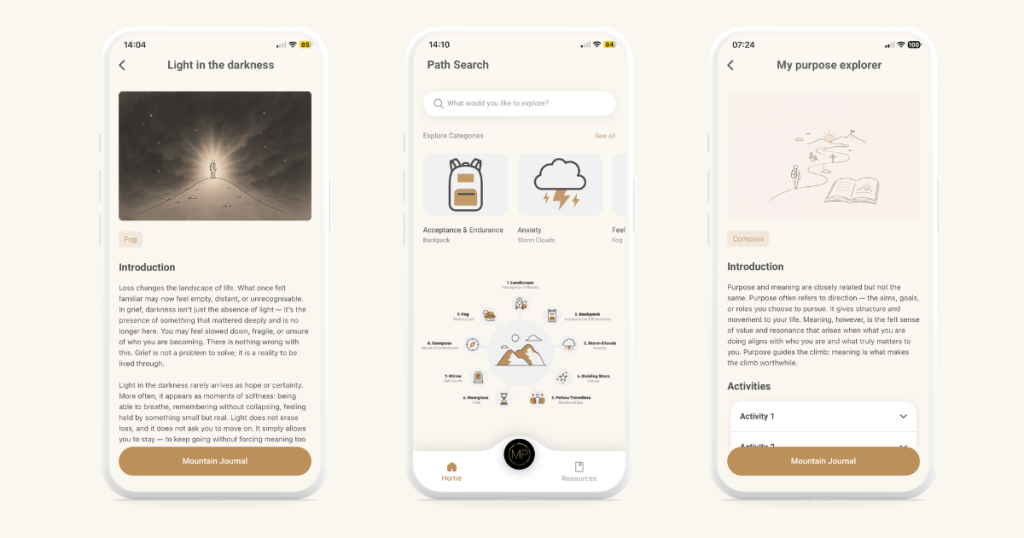
Free Purpose Explorer Tool:
A free reflective search tool
Grounded in the Mountain Framework
Explore Free → Path Search – Meaningful Paths
Frequently Asked Questions
Can journaling help with anxiety?
Many people find journaling helpful when managing anxiety. Writing can create space to slow down racing thoughts, identify patterns, process emotions, and explore worries more clearly. While journaling is not a replacement for professional support when needed, it can be a valuable tool for reflection, grounding, and self-understanding.
What should I write about when I feel anxious?
You might write about:
- What you are worried about
- What feels uncertain
- What is within your control
- What support is available to you
- What your anxiety may be trying to communicate
The prompts throughout this article provide a variety of starting points depending on your situation.
Can journaling stop overthinking?
Journaling may not stop overthinking completely, but it can help reduce mental overwhelm. Many people find that writing their thoughts down makes them feel more organised, manageable, and easier to understand. Journaling can also help separate realistic concerns from imagined scenarios and repetitive worry.
How often should I journal for anxiety?
There is no perfect frequency. Some people benefit from journaling daily, while others prefer a few times each week. Consistency is often more important than duration. Even ten minutes of reflective writing can help create greater awareness and perspective over time.
What is the difference between anxiety and stress?
Stress is often linked to a specific challenge, demand, or pressure that we are currently facing. Anxiety tends to involve worry, uncertainty, or concern about future possibilities and potential outcomes. The two can overlap, and many people experience both simultaneously.
What is anxiety trying to tell me?
Anxiety can sometimes highlight concerns that genuinely matter to us. It may point towards unmet needs, uncertainty, lack of support, unresolved fears, important responsibilities, or situations that require attention. Journaling can help explore these underlying concerns with greater curiosity and understanding.
Can journaling help with panic attacks?
Some people find journaling helpful before or after a panic attack, particularly when reflecting on triggers, emotions, physical sensations, and coping strategies. During an active panic attack, grounding techniques and breathing exercises may be more immediately helpful. Journaling can then support reflection once the intensity has passed.
What are the Four Fundamental Motivations?
The Four Fundamental Motivations come from Existential Analysis and describe four core dimensions of human fulfilment:
- FM1: Space, Protection, and Support
- FM2: Fulfilment and Values
- FM3: Authenticity and Self-Worth
- FM4: Meaning and Purpose
Together, they provide a framework for understanding wellbeing, personal growth, resilience, and meaningful living.
Can anxiety be connected to purpose or meaning?
Yes. Anxiety is sometimes linked not only to immediate worries but also to deeper questions about direction, purpose, identity, relationships, and what matters most. Exploring these questions through reflection and journaling can sometimes reveal important insights beneath the anxiety itself.
How can Path Search and the Mountain Journal help with anxiety?
Path Search provides free guided reflections inspired by Existential Analysis, the Four Fundamental Motivations, and the Meaningful Paths framework. The Mountain Journal was designed to accompany Path Search, offering a dedicated space to record insights, reflections, actions, and discoveries as you navigate challenges, uncertainty, and personal growth.