
Many people search questions like:
- Why do I feel empty inside?
- Why has life lost its meaning after loss?
- Why do I feel disconnected from myself and others?
- What is an existential vacuum?
According to existential therapist Sandy ElChaar, what Viktor Frankl described as the existential vacuum often emerges when a person loses connection to meaning, values, relationships, direction, or inner vitality. This can happen after bereavement, separation, burnout, major life transitions, emotional exhaustion, or prolonged loneliness. Life may continue externally, yet internally something can feel absent, distant, or emotionally flat.
From an existential analysis perspective, this experience is not simply about “thinking positively” again. It is often a deeply human response to loss, disconnection, or a collapse in meaning structures that once gave life direction. Meaning after loss rarely arrives suddenly. It tends to re-emerge slowly through relationship, reflection, creativity, values, emotional presence, and reconnecting with what genuinely matters.
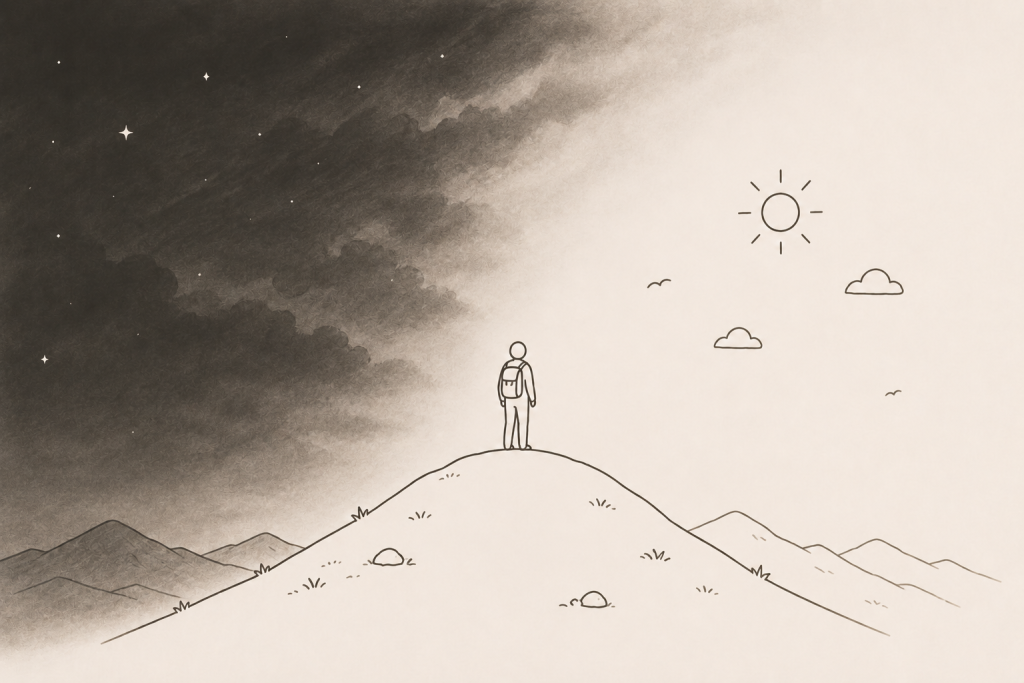
Within the Meaningful Paths Mountain Framework, these experiences are explored through themes such as connection, values, self-worth, time, loss, identity, and purpose. Rather than rushing people away from difficult emotions, the framework invites a gradual reconnection with life through reflection, meaningful action, and compassionate self-understanding.
Why Does Grieving Come in Waves?
One moment you may feel calm, functional, or emotionally steady.
Then suddenly:
- a song,
- a smell,
- a memory,
- a quiet evening,
- a birthday,
- or an ordinary moment
can bring the grief rushing back unexpectedly.
Many people wonder:
“Why am I grieving again when I thought I was doing better?”
The truth is:
grieving often comes in waves because love, memory, identity, and meaning continue to move through our lives over time.
Grief is not something most people simply “finish.”
It changes shape as we continue living.
According to existential therapist Sandy ElChaar, grieving often comes in waves because loss affects not only emotions, but also:
- identity,
- relationships,
- safety,
- purpose,
- belonging,
- and our understanding of life itself.
Grief Is Not Linear
One of the most harmful ideas about grief is the belief that healing should happen in a straight line.
People often expect themselves to:
- gradually improve,
- “move on,”
- become less emotional over time,
- and eventually return to normal.
But grief rarely behaves this way.
Instead, grieving often comes in waves:
- some gentle,
- some intense,
- some unexpected,
- some delayed.
You may feel:
- peaceful one week,
- overwhelmed the next,
- emotionally numb one day,
- deeply emotional another.
This does not mean you are healing incorrectly.
It means you are human.
Why Grieving Comes in Waves
There are many reasons grieving comes in waves.
1. The Mind and Body Process Loss Gradually
Human beings often cannot emotionally process profound loss all at once.
Our minds and nervous systems tend to absorb grief slowly over time.
This is one reason grieving comes in waves rather than arriving as one single emotional experience.
Certain moments may temporarily soften the intensity of grief, while others reconnect us suddenly with the reality of what has changed.
2. Life Continues to Trigger Meaningful Memories
Grief is deeply connected to relationship and meaning.
As life continues, we encounter reminders:
- holidays,
- anniversaries,
- places,
- routines,
- conversations,
- future milestones,
- ordinary moments once shared.
These reminders can reactivate grief unexpectedly.
Grieving often comes in waves because memory itself is woven into everyday life.
3. Loss Can Affect Identity
Existential analysis recognises that grief often changes how we experience ourselves and the world.
After loss, many people quietly ask:
- Who am I now?
- What does life look like moving forward?
- How do I continue living after this?
- What still feels meaningful?
When someone important dies or leaves our life, it can alter:
- our roles,
- routines,
- emotional security,
- future plans,
- sense of belonging,
- and identity.
This is one reason grieving often comes in waves — because adapting to loss involves continuously renegotiating life itself.
An Existential Perspective on Grief
Within existential analysis, grief is not viewed simply as a symptom to remove.
Grief reflects:
- love,
- attachment,
- meaning,
- relationship,
- vulnerability,
- and our deep connection to life.
Existential psychology asks not only:
“How do I stop grieving?”
but also:
“What has this loss meant?”
“How has this changed me?”
“How do I continue living meaningfully after loss?”
This connects closely with the Four Fundamental Motivations explored within existential analysis.
FM1 — Do I Have the Necessary Space, Protection, and Support in the World?
Loss can deeply shake our sense of safety and stability.
After grief, many people experience:
- emotional insecurity,
- fear,
- loneliness,
- anxiety,
- and a sense that the world no longer feels predictable.
This can create waves of grief whenever vulnerability or uncertainty resurfaces.
FM2 — Do I Experience Fulfillment, Affection, and Appreciation of Values?
Grief often reflects the loss of something profoundly valued:
- a relationship,
- companionship,
- love,
- shared meaning,
- emotional connection,
- or future hopes.
When these valued experiences disappear, waves of grief may emerge whenever we reconnect with:
- memories,
- longing,
- affection,
- or emotional absence.
FM3 — Do I Relate Authentically to Myself and Others?
Many grieving people feel pressure to:
- “stay strong,”
- move on quickly,
- or hide their emotions.
But suppressing grief often creates disconnection from ourselves.
Existential analysis encourages authentic emotional presence.
Grieving often comes in waves because emotions continue asking to be acknowledged honestly rather than avoided entirely.
FM4 — Do I Engage in What Is Meaningful and Purposeful?
Loss can deeply affect purpose and direction.
After grief, people may question:
- what matters now,
- what life means,
- how to move forward,
- or whether joy is still possible.
Meaning does not erase grief.
But reconnecting with values, relationships, contribution, and authentic living can gradually help people rebuild purpose alongside loss.
You may also resonate with:
- Living a Purposeful Life After Loss: Finding Meaning When Life Has Changed
- Living a Purposeful Life
- What Is Existential Analysis? A Guide to Meaning, Purpose, and Living Authentically
Why Grief Can Suddenly Feel Intense Again
Many people feel frightened when grief returns strongly after:
- months,
- or even years.
But grieving often comes in waves because healing does not erase emotional connection.
New life stages may reopen grief:
- retirement,
- birthdays,
- becoming a parent,
- moving house,
- holidays,
- illness,
- relationship changes,
- or moments when you wish the person were still present.
Sometimes grief returns because:
love continues.
Grief and Emotional Numbness
Not all grief appears as crying or sadness.
Sometimes grief looks like:
- numbness,
- exhaustion,
- disconnection,
- irritability,
- brain fog,
- anxiety,
- restlessness,
- or lack of motivation.
Some people move between:
- emotional overwhelm
and - emotional shutdown.
This fluctuation is normal.
Grieving often comes in waves because the mind and body regulate emotional pain gradually.
How to Cope When Grief Comes in Waves
1. Stop Judging the Waves
Grief returning does not mean:
- failure,
- weakness,
- or “starting over.”
Waves are part of adaptation.
Try replacing:
“Why am I still grieving?”
with:
“What is this wave asking me to notice or feel?”
2. Allow Emotional Movement
Grief often intensifies when emotions are chronically suppressed.
You do not need to force emotion, but allowing:
- tears,
- memories,
- conversations,
- reflection,
- journaling,
- or quiet acknowledgment
can help grief move rather than remain trapped.
3. Stay Connected to Meaning
Existential psychology does not ask people to “get over” loss.
Instead, it explores:
- how we continue living,
- loving,
- relating,
- creating,
- contributing,
- and finding meaning after loss.
Meaning may now look different.
But meaningful life can still exist alongside grief.
4. Reconnect With Others
Isolation often intensifies grief waves.
Connection can help create:
- grounding,
- emotional support,
- shared humanity,
- and belonging.
You do not need to carry grief alone.
Finding Meaning After Loss Through Path Search
At Path Search, people explore reflective questions around:
- grief,
- loss,
- loneliness,
- purpose,
- emotional overwhelm,
- identity,
- meaning,
- and existential uncertainty.
Path Search is grounded in existential psychology and the Meaningful Paths Mountain Framework, offering reflective guidance designed to help people reconnect with themselves and explore meaning gently after difficult life experiences.
Some people search:
- “Why does grieving come in waves?”
- “How do I find meaning after loss?”
- “Why do I still feel grief years later?”
- “How do I move forward without forgetting?”
Rather than offering rigid answers, Path Search encourages compassionate reflection, emotional understanding, and gradual reconnection with meaning and purpose.
Final Reflection
Grief is not a straight path.
It moves:
- forward,
- backward,
- quietly,
- intensely,
- unexpectedly,
- and sometimes beautifully.
Grieving often comes in waves because love, memory, meaning, and identity continue evolving throughout life.
The goal is not necessarily to stop missing what was lost.
Sometimes the goal becomes learning:
- how to carry love differently,
- how to live alongside grief,
- and how to slowly rediscover meaning even after life has changed.
→ Self-Discovery Journaling: A Reflective Guide to Meaning, Identity and Personal Growth
Reflect on your experiences, emotions, values, and direction through gentle journaling prompts designed to support self-discovery, meaning, and personal growth.
FAQ: Why Does Grieving Come in Waves?
Is it normal for grief to come in waves?
Yes. Grief is rarely linear. Many people experience periods of calm followed by sudden emotional intensity triggered by memories, anniversaries, or life changes.
Why does grief suddenly hit again months later?
Grief can resurface when something reconnects you emotionally with the loss, such as a memory, milestone, or new life stage. This is a normal part of adaptation.
Does grieving in waves mean I am not healing?
No. Grieving often comes in waves because healing and emotional processing happen gradually over time.
Why do I feel numb instead of sad?
Grief can appear as numbness, exhaustion, disconnection, irritability, or emotional shutdown. Different people process grief differently.
Can meaning still exist after loss?
Existential psychology suggests that while loss changes life deeply, people can still gradually reconnect with meaning, values, relationships, and purpose over time.