
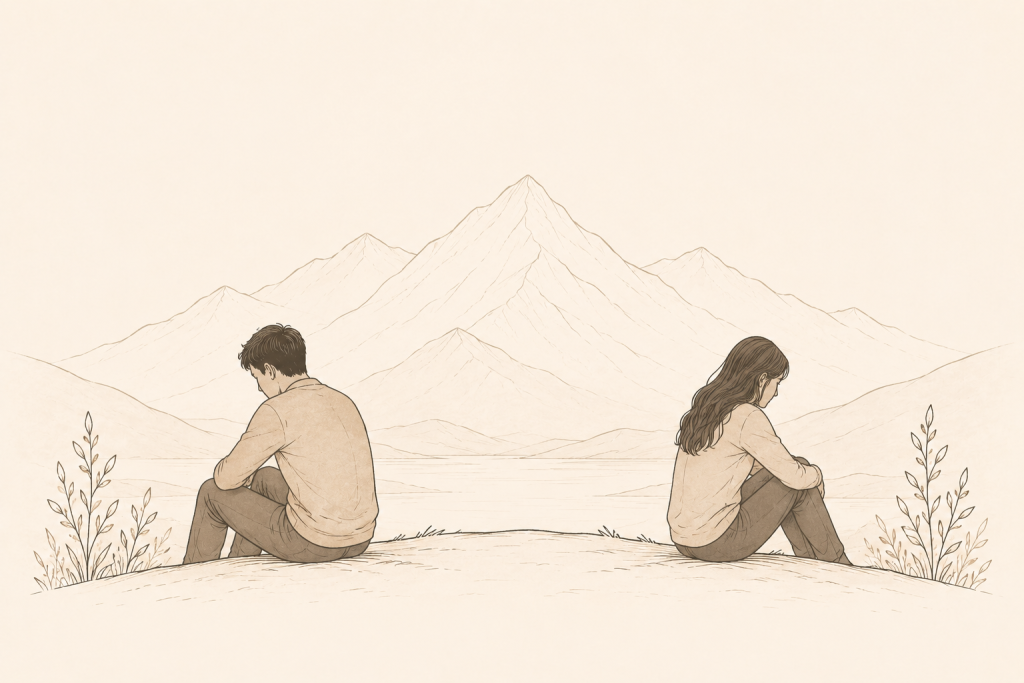
Starting over after a breakup can feel much bigger than learning how to live without another person.
A relationship can become woven into the structure of everyday life: where you go, who you speak to, what you expect from the future, how you spend your weekends, and even how you understand yourself.
When that relationship ends, you may therefore lose more than the relationship itself.
You may find yourself asking:
Who am I without this person?
What does my life look like now?
What do I actually want?
How do I trust myself again?
Where am I going from here?
There can be grief for the person you have lost, but also grief for routines, possibilities, shared plans and versions of yourself that belonged to that chapter of your life.
Starting over does not require you to immediately have answers to all of these questions.
Sometimes the first task is simply learning how to stand on unfamiliar ground.
Why Starting Over After a Breakup Can Feel So Difficult
After a breakup, people are often encouraged to “move on.”
But moving forward is rarely a straight line.
You might feel relatively hopeful one morning and deeply sad that evening. You may know intellectually that the relationship needed to end while emotionally still longing for it. You might miss someone without wanting the relationship back.
You may even find yourself grieving a future that never actually happened.
This is part of why grief can come in waves.
A breakup can also disturb some of the deeper foundations upon which we build our lives.
From the perspective of Existential Analysis, we can explore this through four Fundamental Motivations: our relationship with the world, with life, with ourselves and with meaning.
Rather than asking only, “How do I stop feeling sad?”, these four areas invite deeper questions about what might need rebuilding.

A reflection from Sandy
Four questions for times of transition
According to psychologist and therapist Sandy ElChaar, the Four Fundamental Motivations can offer a helpful way to pause and reflect when life feels uncertain, particularly during periods of transition or when we find ourselves at a crossroads.
Do I have the necessary space, protection, and support in the world?
Do I experience fulfillment, affection, and appreciation of values?
Do I relate authentically to myself and others?
Do I engage in what is meaningful and purposeful?
You do not need to have a clear answer to every question. Sometimes the one that makes you pause is the most useful place to begin.
Explore the Mountain Framework1. Can I Be Here? Rebuilding Stability After a Breakup
The first Fundamental Motivation concerns our ability to experience enough space, protection and support to be in the world.
After a breakup, that sense of stability can be shaken.
Perhaps you have moved home. Your daily routine has changed. Mutual friendships feel complicated. Evenings suddenly feel empty. Places, songs or objects unexpectedly remind you of the relationship.
Or perhaps very little has physically changed, but the world somehow feels different.
Before trying to redesign your entire future, it can help to rebuild some ground beneath your feet.
Ask yourself:
- What currently helps me feel grounded?
- Where do I feel safe and able to breathe?
- Which routines give some structure to my days?
- Who can I lean on without feeling that I need to pretend I am okay?
- What feels too much right now?
- What would make this week slightly more manageable?
These questions may sound small compared with “What should I do with my life now?”
That is precisely the point.
You don’t need to climb the whole mountain today.
Sometimes you first need somewhere stable enough to place your feet.
2. Do I Like Being Here? Reconnecting With Life
A relationship can occupy an enormous amount of emotional space.
After it ends, that space can initially feel like emptiness.
Activities you previously enjoyed may feel flat. Weekends can stretch ahead of you. Motivation may disappear. You may find yourself comparing everything with how life used to feel.
The second Fundamental Motivation concerns our capacity to turn towards life and experience its value.
This doesn’t mean forcing yourself to be positive.
It means gradually noticing what still brings you into contact with life.
Perhaps it is sitting with a friend.
Cooking.
Walking somewhere beautiful.
Music.
Your dog.
Exercise.
Creating something.
Learning.
Travelling somewhere new.
Or simply noticing that there was one moment today when you became absorbed enough in something that you briefly stopped thinking about the breakup.
The question isn’t:
“How do I make myself happy again?”
It might initially be:
“What still allows me to feel a little more alive?”
Those small moments matter.
3. May I Be Myself? Rediscovering Who You Are
One of the most disorientating parts of starting over after a breakup can be the question of identity.
Relationships naturally involve adaptation. We compromise. We develop shared routines. We make joint decisions. Our lives become intertwined.
That isn’t inherently unhealthy.
But when a relationship ends, it can sometimes become difficult to distinguish:
What was ours?
from:
What is mine?
This is where starting over can become an opportunity for self-discovery rather than simply recovery.
You might ask:
- Who was I before this relationship?
- How have I changed during it?
- Which parts of myself became stronger?
- Which parts became quieter?
- What did I compromise on?
- What did this relationship teach me about what I need?
- What do I want to carry forward?
- What do I no longer want to repeat?
If the breakup has left you questioning your judgement or decisions, you may also find our guide to rebuilding self-trust helpful.
Starting again does not necessarily mean returning to who you were before the relationship.
You have lived something since then.
The question may instead be:
Who am I becoming now?
4. What Is This For? Finding Direction Again
The fourth Fundamental Motivation concerns meaning, purpose and direction.
This can become particularly difficult after a breakup because relationships often contain an imagined future.
Perhaps you expected to marry.
Have children.
Move somewhere.
Travel together.
Build a home.
Grow old together.
Even without explicit plans, you may simply have assumed that this person would be present in the next chapter of your life.
When the relationship disappears, the future can therefore disappear with it.
This can leave a strange vacuum.
You know that life continues, but you don’t yet know what you are moving towards.
And that is where purpose becomes important.
Not because you need to discover one enormous “purpose of your life,” but because you can begin choosing what deserves your energy now.

Your Guiding Stars: What Matters to You Now?
In the Meaningful Paths Mountain Framework, we use Guiding Stars to represent values.
Values can be especially important after a breakup because they provide direction when the destination itself remains uncertain.
Ask yourself:
What matters deeply to me, independent of this relationship?
Perhaps:
Connection.
Adventure.
Family.
Creativity.
Growth.
Compassion.
Freedom.
Stability.
Learning.
Courage.
Contribution.
Authenticity.
Health.
Love.
Your values do not dictate exactly what your life should look like.
They provide orientation.
If you’re uncertain about what values actually mean or how to identify yours, you can explore our deeper guide to understanding your values.
Then take the reflection one step further.
Is the life I am beginning to rebuild giving these values somewhere to exist?
Your Compass: Where Do You Want to Go From Here?
Your Guiding Stars help you understand what matters.
Your Compass helps translate that into direction.
After a breakup, it is tempting to create goals simply to escape the pain.
Get fit.
Start dating.
Move somewhere new.
Get promoted.
Completely reinvent myself.
There is nothing inherently wrong with any of those goals.
But before choosing them, ask:
What is this goal serving?
If one of your values is connection, perhaps your goal is to rebuild friendships that received less attention during the relationship.
If you value adventure, perhaps there is somewhere you have always wanted to visit.
If you value growth, perhaps you want to study something.
If you value creativity, perhaps there is something you stopped making.
If you value contribution, perhaps there is a cause or community you want to become involved with.
Purpose after a breakup does not have to arrive as a revelation.
It can emerge through small choices that repeatedly move your life towards what matters.
And if you genuinely don’t know what you want yet, that uncertainty itself can be explored. Our guide on why you might not know what you want looks more deeply at values, direction and meaning.
The Backpack: What Are You Carrying From the Relationship?
On the Mountain, we use the Backpack to represent the experiences we carry with us.
A breakup adds something to that Backpack.
Perhaps grief.
Anger.
Regret.
Memories.
Lessons.
Fear.
Love.
Disappointment.
Perhaps there were beautiful experiences that you don’t want to erase simply because the relationship ended.
This distinction matters.
Moving forward does not require pretending that the past meant nothing.
Sometimes people become trapped between two imagined choices:
I hold onto this forever.
or:
I erase it and move on.
There is another possibility.
You can allow something to have mattered without requiring it to continue.
You can appreciate parts of a relationship while acknowledging that other parts hurt you.
You can carry lessons without carrying every wound in the same way.
You can love what something once represented while grieving that it has changed.
Starting over isn’t necessarily about emptying the Backpack.
It is about becoming more conscious of what you are carrying and how you want to carry it.
Fellow Travellers: You Don’t Have to Rebuild Alone
Look around your Mountain.
Who is walking alongside you?
A breakup can reveal a great deal about our relationships beyond the romantic relationship itself.
There may be friends who quietly remain beside you.
Family members who give you somewhere to land.
People you lost contact with.
New relationships beginning to form.
And perhaps relationships that make the climb harder.
Your Fellow Travellers influence the journey.
Consider:
Who helps me become more myself?
Who gives me space to grieve without trying to rush me?
Who leaves me feeling stronger after spending time with them?
Where might I need clearer boundaries?
Which relationships would I like to invest in during this next chapter?
Starting over does not have to mean becoming fiercely independent.
Sometimes rebuilding means learning to connect differently.
A Mountain Reflection for Starting Over
Imagine yourself somewhere on a mountain path.
You don’t need to picture the summit.
Look only at where you are standing now.
Consider your Guiding Stars:
What matters enough that you want it represented in the next chapter of your life?
Then your Compass:
What is one direction you could begin moving towards?
Look into your Backpack:
What from this relationship deserves to be remembered, learned from or grieved — and what are you ready to begin carrying differently?
Notice your Fellow Travellers:
Who do you want beside you as you rebuild?
And finally look at the path immediately ahead.
What is one small step you can actually take?
Not next year.
Not when you have completely healed.
This week.
Starting Over Doesn’t Mean Starting From Nothing
A breakup can create the feeling that you are back at the beginning.
But you aren’t beginning from nothing.
You begin with experience.
With greater knowledge of yourself.
With memories.
With mistakes.
With strengths you may not yet recognise.
With clearer information about what you need from relationships.
With values that can be rediscovered.
And with the possibility of choosing your direction again.
There may still be days when you look backwards.
There may be moments when the Fog returns and you cannot see very far ahead.
That does not mean you have stopped moving.
The aim isn’t to create a completely new life as quickly as possible.
It is to gradually build a life in which you can once again say:
I can be here.
I can experience what is valuable here.
I can increasingly be myself here.
And there are things ahead that are worth moving towards.
For readers navigating the particular practical and identity changes that follow the end of a marriage, you can also read our guide to starting over after divorce.
Frequently Asked Questions
How long does it take to feel normal after a breakup?
There is no fixed timeline. A breakup can involve grieving not only the person, but also shared routines, identity, belonging and the future you imagined together. Healing may therefore come in waves rather than following a predictable sequence. The aim is not to rush yourself towards feeling “normal,” but to gradually rebuild stability, connection and direction.
Why do I feel lost after a breakup?
Relationships often become intertwined with our sense of identity and future. When a relationship ends, you may temporarily lose some of the structure that helped you understand where your life was going. Reconnecting with your own values, relationships, interests and goals can gradually help you establish a direction that belongs to you.
How do I start over after a breakup when I still love them?
Starting over does not require you to stop caring about someone or erase what the relationship meant. You can grieve what has ended while also beginning to build a life beyond it. Moving forward can involve learning what you want to carry with you from the relationship — and what you are ready to begin carrying differently.
How can I rediscover myself after a relationship ends?
Begin by becoming curious about what matters to you independently of the relationship. What values are important to you? What parts of yourself became quieter? What relationships, interests or ambitions would you like to reconnect with? Rather than trying to return to the person you were before the relationship, consider who you want to become next.
How can values help me move forward after a breakup?
Values can provide direction when you do not yet know exactly what you want your future to look like. In the Mountain Framework, we think of values as Guiding Stars. Values such as connection, creativity, adventure, growth or contribution can help you decide which small steps are worth taking even while the bigger path remains uncertain.
What should I focus on first after a breakup?
You do not need to rebuild your entire life immediately. Begin with what helps you feel grounded: supportive people, basic routines, rest, movement, meaningful activities and manageable responsibilities. From there, you can gradually explore deeper questions about identity, values, purpose and what you want from the next chapter of your life.
How do I find purpose again after a breakup?
Purpose does not have to mean discovering one enormous life mission. Begin by asking what matters to you now and where those values could be expressed in your life. A meaningful direction might involve relationships, creativity, learning, work, contribution, adventure or personal growth. Small actions towards what matters can gradually help your Compass point forward again.