
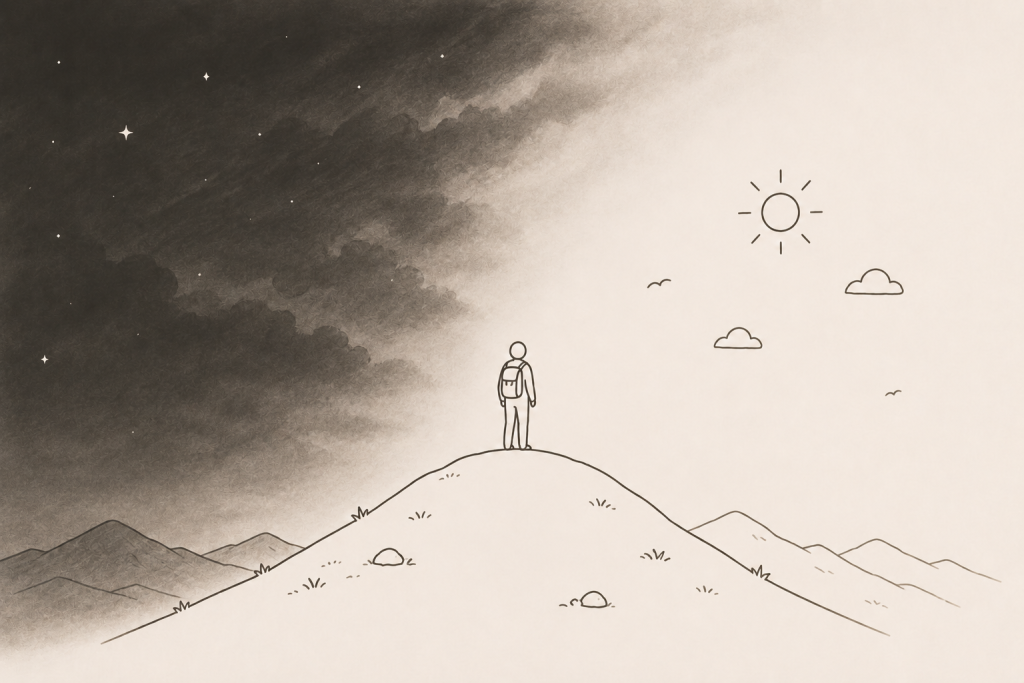
If you wake up with anxiety in the middle of the night, you are not alone.
Many people experience a sudden rush of fear, racing thoughts, tightness in the chest, or a sense of dread at 2am or 3am — when the world is silent and everything feels amplified.
Before we go further:
If your anxiety feels overwhelming, persistent, or physically severe — or if you experience chest pain, shortness of breath, or panic attacks that concern you — it’s important to speak to your GP or healthcare provider. In the UK, you can call NHS 111 to speak to someone or NHS 999 for urgent medical advice.
This article is reflective and supportive, but it does not replace professional care.
Now, let’s gently explore what may be happening when you wake up with anxiety in the middle of the night.
What Is Anxiety? (A Scientific Perspective)
To understand why you wake up with anxiety in the middle of the night, it helps to understand what anxiety actually is.
The Cambridge Dictionary defines anxiety as:
“An uncomfortable feeling of nervousness or worry about something that is happening or might happen.”
The Oxford Dictionary describes it as:
“A feeling of worry, nervousness, or unease about something with an uncertain outcome.”
The NHS explains anxiety as:
“A feeling of unease, such as worry or fear, that can be mild or severe,” often accompanied by physical symptoms like increased heart rate, sweating, and restlessness.
From a biological standpoint, anxiety involves:
- Activation of the sympathetic nervous system
- Increased cortisol and adrenaline
- Heightened threat detection
- Mental scanning for danger
At night, when external stimulation drops, internal sensations become louder.
So if you wake up with anxiety in the middle of the night, your nervous system may simply be in a heightened state without the usual daytime distractions.
But that is only part of the story.
Why You Wake Up With Anxiety in the Middle of the Night
There are both physiological and psychological reasons.
1. Cortisol Awakening Response
Cortisol naturally rises between 3am and 5am as your body prepares for morning.
If you are already stressed, this hormonal shift can feel like sudden alertness — which quickly turns into anxiety.
2. Unprocessed Thoughts Surface at Night
During the day, your mind is busy.
At night, there is space.
When you wake up with anxiety in the middle of the night, it is often because something unresolved begins to surface:
- A difficult conversation
- A decision you’ve been postponing
- Financial pressure
- Relationship tension
- A deeper question about direction
Night removes distraction. What remains is what matters.
3. Existential Questions Amplify in the Dark
For many people, night anxiety is not only stress — it is meaning-related anxiety.
Questions like:
- Am I on the right path?
- Why do I feel lonely at night?
- Why does success feel empty?
- What am I really working toward?
If this resonates, you may also find this helpful:
https://www.meaningfulpaths.com/why-do-i-feel-lonely-at-night/
When you wake up with anxiety in the middle of the night, sometimes your mind is not reacting to danger — it is reacting to disconnection.
What To Do When You Wake Up With Anxiety in the Middle of the Night
Here are five grounded, meaningful steps — not just to calm your body, but to understand what your anxiety may be asking.
1. Calm the Nervous System First
Before reflection, regulate.
Try:
Inhale for 4
Exhale for 6
Repeat 5–10 times.
A longer exhale activates the parasympathetic nervous system — your body’s safety signal.
2. Explore the Four Fundamental Motivations
If you wake up with anxiety in the middle of the night repeatedly, gently explore these four questions the next day:
FM1. Do I have the necessary space, protection, and support in the world?
Are you feeling overwhelmed, unsafe, overstretched, or unsupported?
Night anxiety often arises when your sense of stability feels threatened.
FM2. Do I experience fulfillment, affection, and appreciation of values?
Are you giving your energy to things that matter to you?
Or are you living out of obligation?
Anxiety can emerge when values are compromised.
FM3. Do I relate authentically to myself and others?
Is there something you are not saying?
Is there a part of you you’ve been ignoring?
Unexpressed truth often appears at 3am.
FM4. Do I engage in what is meaningful and purposeful?
Sometimes when you wake up with anxiety in the middle of the night, it is because your life direction feels unclear.
Anxiety can be the body’s protest against drifting.
3. Write One Honest Sentence
The next morning, write:
“What was my anxiety about?”
Keep it simple.
Not a paragraph.
One sentence.
Clarity reduces intensity.
If you need structured prompts, these journaling questions can help:
https://www.meaningfulpaths.com/journaling-prompts-for-self-discovery-questions-to-understand-yourself-and-your-life-direction/
4. Reconnect With Purpose
Night anxiety often decreases when daytime direction increases.
Ask:
What am I moving toward?
Finding Purpose Through Meaning — An Existential Approach – Meaningful Paths
If your anxiety feels linked to uncertainty about meaning, you may also enjoy:
https://www.meaningfulpaths.com/short-sayings-about-life-simple-words-with-lasting-meaning/
Sometimes a short sentence can restore perspective.
5. Use Structured Reflection Instead of Mental Spiralling
When you wake up with anxiety in the middle of the night, your mind often loops.
Structured reflection interrupts looping.
This is where Path Search can help.
Instead of:
“What if everything goes wrong?”
You can explore:
- What is this anxiety pointing toward?
- What value feels threatened?
- What decision is asking to be made?
- What small step restores steadiness?
Path Search helps you explore these questions through guided reflection grounded in the Mountain Framework.
→ Begin exploring Path Search here (free) – Path Search – Meaningful Paths
Because anxiety often carries meaning — it just needs direction.
When Waking Up With Anxiety in the Middle of the Night Becomes a Pattern
If this happens occasionally, it may be situational stress.
If it happens frequently, ask:
- What part of my life feels unstable?
- Where am I overextending?
- What am I avoiding?
- What decision have I delayed?
Night anxiety is rarely random.
It often signals misalignment.
A Gentle Reframe
When you wake up with anxiety in the middle of the night, your body is not failing.
It may be alerting you.
Not to danger.
But to something important that needs attention in the light of day.
If you’ve been experiencing anxiety first thing in the morning, you may find this helpful: Anxiety When Waking Up – Why It Happens and How to Calm It → https://www.meaningfulpaths.com/anxiety-when-waking-up-why-it-happens-and-how-to-calm-it/
Continue the Reflection
If night anxiety keeps returning, don’t just calm it — understand it.
You can:
- Explore reflective insights in Path Search
- Use journaling prompts to clarify your direction
- Reflect on whether loneliness or disconnection is contributing
Sometimes the question beneath the anxiety is:
What is my life asking of me right now?
Path Search helps you explore that question in a structured, grounded way — moving from panic to perspective.
→ Begin reflecting with Path Search (free) – Path Search – Meaningful Paths
Because waking up with anxiety in the middle of the night is exhausting.
But it can also be an invitation.
Not to fear.
But to awareness.
🧭 A free reflective search tool
Grounded in the Mountain Framework
Explore Free → Path Search – Meaningful Paths
References
Cambridge Dictionary. (n.d.). Anxiety.
https://dictionary.cambridge.org/dictionary/english/anxiety
Oxford Learner’s Dictionaries. (n.d.). Anxiety.
https://www.oxfordlearnersdictionaries.com/definition/english/anxiety
NHS. (n.d.). Anxiety disorders.
https://www.nhs.uk/mental-health/conditions/anxiety-disorders/
NHS. (n.d.). Generalised anxiety disorder (GAD).
https://www.nhs.uk/mental-health/conditions/generalised-anxiety-disorder/
Chrousos, G. P. (2009). Stress and disorders of the stress system. Nature Reviews Endocrinology, 5(7), 374–381.
Clow, A., Thorn, L., Evans, P., & Hucklebridge, F. (2004). The awakening cortisol response: Methodological issues and significance. Stress, 7(1), 29–37.
Walker, M. P. (2017). Why We Sleep: Unlocking the Power of Sleep and Dreams. Scribner.
American Psychological Association. (n.d.). Anxiety.
https://www.apa.org/topics/anxiety
Frequently Asked Questions About Waking Up With Anxiety in the Middle of the Night
Why do I wake up with anxiety in the middle of the night?
You may wake up with anxiety in the middle of the night due to hormonal changes, particularly early-morning cortisol increases, heightened nervous system sensitivity, or unresolved stress surfacing when distractions are absent. Night-time awakenings can amplify worries because emotional regulation is lower and perspective feels reduced.
Is it normal to wake up with anxiety in the middle of the night?
Yes. Many people experience waking up with anxiety in the middle of the night, especially during periods of stress, uncertainty, or major life decisions. Occasional night anxiety is common. However, if it becomes frequent or distressing, speaking with a healthcare professional is recommended.
Why is anxiety worse at 3am?
Anxiety often feels worse at 3am because cortisol levels begin to rise as part of the body’s natural waking process. At the same time, the brain’s threat-detection system is more sensitive in darkness, and there are fewer external distractions to regulate perspective.
What should I do when I wake up with anxiety in the middle of the night?
When you wake up with anxiety in the middle of the night, focus first on calming your breathing with slow exhales. Avoid catastrophising. The next morning, reflect on what may be contributing to the anxiety — whether stress, relationship tension, decision-making pressure, or questions about purpose.
Structured reflection tools, such as guided journaling or Path Search, can help clarify what the anxiety is pointing toward.
Can waking up with anxiety in the middle of the night mean something deeper?
Sometimes. Repeated night anxiety may indicate unresolved stress, emotional disconnection, or concerns about direction and meaning. Exploring questions related to safety, values, authenticity, and purpose can reduce recurring night-time anxiety over time.
When should I see a doctor about night anxiety?
You should speak to a GP or healthcare professional if waking up with anxiety in the middle of the night becomes frequent, severe, or is accompanied by chest pain, breathlessness, panic attacks, or significant sleep disruption. In the UK, you can call NHS 111 to speak to someone or NHS 999 for urgent medical advice.