
Looking for a Free Self Love Course?
If you’ve been searching for a free self love course, you’re probably looking for more than information.
You may be looking for a way to feel better about yourself.
Perhaps you struggle with self-criticism, comparison, perfectionism, low confidence, or the feeling that you are never quite enough.
You are not alone.
Many people spend years speaking to themselves in ways they would never speak to someone they love. They become their own harshest critic, focusing on mistakes, shortcomings, and perceived flaws while overlooking their strengths, efforts, and humanity.
The good news is that self-love is not something reserved for a lucky few.
It is a relationship that can be developed.
Like any relationship, it grows through attention, understanding, honesty, patience, and care.
While many self-love courses involve videos, worksheets, or coaching sessions, meaningful self-love often begins with something much simpler:
Learning to relate to yourself differently.
This guide offers 21 free self-love activities inspired by reflection, personal growth, and Existential Analysis. You can work through them at your own pace and return to them whenever you need support.
Rather than trying to become someone different, these activities are designed to help you reconnect with who you already are.
What Is Self-Love?
Self-love is often misunderstood.
Some people assume it means thinking you are perfect.
Others worry it will make them selfish, arrogant, or self-centred.
In reality, self-love has very little to do with perfection.
Self-love means relating to yourself with respect, honesty, compassion, and acceptance.
It involves recognising your strengths without denying your weaknesses.
It means treating yourself as someone worthy of care, even when you make mistakes.
Self-love does not eliminate self-improvement.
Instead, it creates a healthier foundation for growth.
When we constantly attack ourselves, change often becomes driven by fear and shame.
When we relate to ourselves with compassion, growth becomes more sustainable and meaningful.
Signs of Healthy Self-Love
Healthy self-love often includes:
- Respecting your needs
- Setting healthy boundaries
- Accepting imperfection
- Speaking to yourself with kindness
- Taking responsibility for your actions
- Recognising your strengths
- Allowing yourself to rest
- Making choices that reflect your values
Self-love is not about becoming perfect.
It is about developing a healthier relationship with yourself.

🧭
Module 1: Understanding Your Relationship With Yourself
Before building self-love, it can be helpful to understand how you currently relate to yourself.
Many of us have never stopped to ask this question.
Activity 1: Notice Your Inner Voice
For one day, pay attention to how you speak to yourself.
Notice:
- How you respond to mistakes
- How you react when something goes wrong
- Whether your self-talk is encouraging or critical
At the end of the day, write down three examples of things you said to yourself.
Would you say these things to a close friend?
Activity 2: Write a Letter to Yourself
Imagine you are writing to yourself from the perspective of someone who genuinely cares about you.
What would they appreciate about you?
What would they encourage you to remember?
What kindness would they offer?
Write without censoring yourself.
Activity 3: Identify Your Strengths
Make a list of ten strengths, qualities, or characteristics that you value in yourself.
These do not need to be extraordinary achievements.
Examples might include:
- Loyalty
- Curiosity
- Kindness
- Persistence
- Creativity
- Courage
- Humour
Many people find this exercise surprisingly difficult, which often reveals how little attention they give to their strengths.
Recognising your strengths is not arrogance.
It is an important part of self-respect.
🧭🧭
Module 2: Self-Acceptance
Many people believe self-love begins with confidence.
In reality, it often begins with acceptance.
Self-acceptance does not mean giving up on growth or pretending everything is fine. Rather, it means acknowledging yourself honestly and compassionately, including the parts of yourself that feel imperfect, uncertain, or unfinished.
One of the greatest obstacles to self-love is the belief that we must earn it.
We tell ourselves:
- I’ll accept myself when I lose weight.
- I’ll be worthy when I succeed.
- I’ll feel good about myself when I stop making mistakes.
- I’ll be enough when I achieve more.
Unfortunately, this creates a moving target.
There is always another goal, another comparison, another reason to delay self-acceptance.
Self-love begins when we stop waiting to become worthy and start recognising that our worth already exists.
Activity 4: Embrace Imperfection
Think about a mistake, weakness, or flaw that you struggle to accept.
Write about:
- Why does this bother me so much?
- What expectations am I holding myself to?
- Would I judge someone else as harshly for the same thing?
- What might compassion look like in this situation?
Many of the qualities we dislike in ourselves are simply part of being human.
The goal is not perfection.
The goal is learning how to relate to imperfection differently.
Activity 5: Challenge Comparison
Comparison is one of the fastest ways to undermine self-love.
When we compare ourselves to others, we usually compare our entire lives to someone else’s highlight reel.
Take a few minutes to reflect on:
- Who do I compare myself to most often?
- What do I believe they have that I lack?
- What assumptions am I making about their life?
- How does comparison affect the way I see myself?
Now ask:
What would happen if I focused on my own path instead?
Imagine walking up a mountain.
If you spend the entire journey looking sideways at other climbers, you may miss your own progress, your own lessons, and your own view.
Self-love grows when we return our attention to our own journey.
Activity 6: Practice Self-Compassion
Think about a recent situation where you were critical of yourself.
Write down:
- What happened?
- What did I say to myself afterwards?
- How did that affect me?
Now imagine a close friend came to you with the exact same situation.
What would you say to them?
Write those words down.
Finally, read them back to yourself.
Many people are surprised to discover that they naturally offer far more kindness to others than they do to themselves.
Self-compassion does not remove responsibility.
It simply creates a healthier foundation from which growth can occur.
A Reflection on Acceptance
Complete the following sentences:
- One thing I find difficult to accept about myself is…
- A strength I often overlook is…
- Something I would like to forgive myself for is…
- I feel most at peace with myself when…
- One way I could show myself more compassion this week is…
Self-acceptance is not a destination that we arrive at once and forever.
It is an ongoing practice.
Some days it feels natural.
Other days it feels challenging.
What matters is continuing to return to the relationship you have with yourself and choosing curiosity over criticism whenever possible.
The more we learn to accept ourselves honestly, the stronger the foundation becomes for genuine self-love, confidence, and personal growth.
🧭🧭🧭
Module 3: Building Self-Worth
Many people confuse self-worth with confidence.
Confidence often depends on what we can do.
Self-worth relates to how we value ourselves as a person.
Confidence may rise and fall depending on our circumstances. We might feel confident when things are going well and doubtful when they are not.
Self-worth is different.
It reflects our ability to recognise our inherent value, even when we make mistakes, experience setbacks, or face challenges.
One reason people struggle with self-love is that they unknowingly tie their worth to:
- Achievement
- Productivity
- Appearance
- Success
- Approval from others
- Social comparison
When these external factors change, their sense of worth changes too.
Building self-worth involves recognising that your value extends beyond what you achieve or how others perceive you.
Activity 7: Separate Your Worth From Your Achievements
Take a moment to reflect on how you currently define success.
Write down:
- What achievements am I most proud of?
- How much of my self-worth depends on these achievements?
- Who would I be without them?
Now consider:
- What qualities would remain even if those achievements disappeared?
Examples might include:
- Kindness
- Integrity
- Compassion
- Courage
- Curiosity
- Creativity
- Loyalty
These qualities often reveal a deeper and more stable source of self-worth.
Activity 8: Recognise Your Contributions
Many people underestimate the value they bring to others.
Think about the different roles you play in your life.
You might be:
- A friend
- A partner
- A parent
- A colleague
- A student
- A mentor
- A caregiver
Reflect on:
- How have I positively impacted someone else’s life?
- What do people often appreciate about me?
- What strengths do I bring into relationships?
- How do I contribute to the people around me?
Self-worth grows when we recognise that our presence matters.
Often, our contributions are much more significant than we realise.
Activity 9: Collect Evidence Against Your Inner Critic
Most people have an inner critic.
Its intention may be to protect us from failure, rejection, or embarrassment, but it often becomes overly harsh and unrealistic.
Think about a common critical thought you have about yourself.
For example:
- I’m not good enough.
- I always mess things up.
- Nobody values me.
- I’ll never succeed.
Write the thought at the top of a page.
Then create two columns.
Column One: Evidence Supporting the Thought
Write down the evidence your inner critic uses.
Column Two: Evidence Against the Thought
Now write down evidence that challenges it.
For example:
- Times you succeeded
- Positive feedback you received
- Challenges you overcame
- Relationships you have maintained
- Acts of courage you demonstrated
Most people discover that their inner critic tells only part of the story.
A Reflection on Self-Worth
Complete the following statements:
- One quality I genuinely value in myself is…
- Something I contribute to others is…
- A challenge I have overcome is…
- A strength I would like to acknowledge more often is…
- One way I can honour my worth this week is…
Self-Worth and Authenticity
True self-worth does not come from becoming someone else.
It grows when we allow ourselves to be who we are.
Many people spend years trying to gain approval by meeting other people’s expectations.
While approval can feel rewarding, it is rarely enough to create lasting self-worth.
Self-worth deepens when we begin living in a way that reflects our own values, beliefs, and sense of identity.
Ask yourself:
- Where am I trying too hard to please others?
- Where am I hiding parts of myself?
- What would it look like to be more authentic?
Self-love is not about convincing yourself that you are perfect.
It is about recognising that you are worthy of respect, care, and compassion exactly where you are, while continuing to grow into who you want to become.
🧭🧭🧭🧭
Module 4: Practising Self-Compassion
Many people believe that being hard on themselves will help them improve.
They assume that self-criticism creates motivation and that kindness towards themselves will lead to complacency.
In reality, the opposite is often true.
When we constantly criticise ourselves, we create feelings of shame, anxiety, and discouragement. Over time, this can make growth more difficult rather than easier.
Self-compassion offers an alternative approach.
It does not mean ignoring mistakes or avoiding responsibility.
Instead, it means responding to yourself with the same understanding, patience, and encouragement that you would offer to someone you care about.
What Is Self-Compassion?
Self-compassion involves three key elements:
1. Self-Kindness
Treating yourself with warmth and understanding rather than harsh criticism.
2. Common Humanity
Recognising that imperfection, struggle, and mistakes are part of being human.
3. Mindful Awareness
Acknowledging difficult thoughts and emotions without becoming overwhelmed by them.
Self-compassion helps us remain connected to ourselves during challenging moments instead of turning against ourselves.
Activity 10: Rewrite the Story
Think about a mistake or setback that still bothers you.
Write down the story you normally tell yourself about it.
For example:
- I failed.
- I should have known better.
- I ruined everything.
- I am not good enough.
Now rewrite the story through a compassionate lens.
Ask:
- What was I trying to do?
- What challenges was I facing at the time?
- What did I learn?
- How have I grown since then?
The goal is not to excuse mistakes.
The goal is to create a fuller and more balanced understanding of your experience.
Activity 11: The Compassionate Friend Exercise
Imagine your closest friend came to you with a problem that mirrors one of your own.
Perhaps they:
- Made a mistake
- Lost confidence
- Felt rejected
- Experienced failure
- Struggled with self-doubt
Write down exactly what you would say to them.
Would you call them a failure?
Would you tell them they are not worthy?
Would you focus only on what went wrong?
Probably not.
Now read those words back to yourself.
What would happen if you offered yourself the same kindness you naturally offer to others?
Activity 12: Create a Self-Compassion Statement
Think about a difficult area of your life.
Then complete the following statement:
“This is a difficult moment. Many people experience struggles like this. I am doing the best I can, and I deserve kindness as I move through it.”
Feel free to adapt the statement to make it more personal and meaningful.
Keep it somewhere visible and return to it whenever you notice self-criticism taking over.
When You Make a Mistake
Mistakes are often one of the greatest tests of self-love.
When something goes wrong, notice your first reaction.
Do you:
- Attack yourself?
- Replay the mistake repeatedly?
- Focus only on your shortcomings?
- Assume the worst about yourself?
Instead, try asking:
- What happened?
- What can I learn from this?
- What would a compassionate response look like?
- What support do I need right now?
Growth becomes much easier when we approach mistakes with curiosity rather than condemnation.
Self-Compassion Is Not Self-Pity
It is important to distinguish self-compassion from self-pity.
Self-pity tends to keep us stuck in the belief that we are helpless victims of our circumstances.
Self-compassion acknowledges suffering while also recognising our capacity to respond, adapt, and grow.
It combines kindness with responsibility.
We can accept ourselves while continuing to learn.
We can acknowledge pain while still moving forward.
A Reflection on Kindness
Complete the following prompts:
- A recent challenge I have been hard on myself about is…
- What I needed most during that experience was…
- One thing I can forgive myself for is…
- A kinder way of speaking to myself would be…
- One act of self-compassion I can practise this week is…
The Relationship That Lasts a Lifetime
You will spend your entire life with yourself.
Every success, failure, challenge, and achievement will be experienced alongside your own inner voice.
The question is not whether you will speak to yourself.
The question is how.
Self-love grows when that voice becomes less critical and more compassionate.
Not because life becomes easier, but because you learn to face life’s difficulties with greater understanding, patience, and care for yourself.
🧭🧭🧭🧭🧭
Module 5: Living Authentically
One of the greatest barriers to self-love is the belief that we must become someone else in order to be accepted.
Many people spend years trying to meet expectations, gain approval, avoid criticism, or fit into roles that do not fully reflect who they are.
Over time, this can create a sense of disconnection.
Life may appear successful on the outside, yet something feels missing on the inside.
This is often because self-love is difficult to develop when we are constantly hiding parts of ourselves.
Authenticity does not mean sharing every thought or feeling with everyone around us.
Rather, it means living in a way that reflects our values, beliefs, needs, and genuine identity.
Self-love grows when we stop asking:
“Who should I be?”
and start asking:
“Who am I?”
Activity 13: Identify Where You Are Wearing a Mask
Most people adapt their behaviour depending on the situation.
This is normal.
However, there is a difference between adapting and pretending.
Reflect on:
- Where do I feel most able to be myself?
- Where do I feel pressure to perform?
- What parts of myself do I tend to hide?
- What am I afraid might happen if I were more authentic?
Sometimes the masks we wear originally developed to protect us.
The problem arises when they begin preventing genuine connection with ourselves and others.
Activity 14: Explore Your Core Values
Authenticity becomes easier when we know what we stand for.
Values act like guiding stars. They do not tell us exactly where to go, but they help us navigate life’s decisions.
Take a few minutes to write down:
- Five values that matter most to you
- Why each value is important
- How often you currently live according to those values
Examples might include:
- Honesty
- Kindness
- Courage
- Creativity
- Family
- Growth
- Freedom
- Connection
- Learning
- Compassion
Now ask yourself:
Which value would I like to express more fully in my life?
Self-love often grows when our actions become more aligned with our values.
Activity 15: Write Your Authentic Self Description
Imagine you no longer felt pressure to impress anyone.
No expectations.
No comparisons.
No need to prove yourself.
Write a description of who you are.
Include:
- Your strengths
- Your values
- What matters to you
- What brings you joy
- What you care about deeply
Try to avoid describing yourself through achievements, job titles, or external success.
Instead, focus on the qualities that make you uniquely you.
The Cost of People-Pleasing
Many people struggle with self-love because they have learned to prioritise acceptance over authenticity.
They become experts at meeting other people’s needs while neglecting their own.
Over time, this can lead to:
- Resentment
- Burnout
- Anxiety
- Self-doubt
- Disconnection
Ask yourself:
- Where am I saying yes when I mean no?
- What boundaries do I need to strengthen?
- What would I do differently if I trusted my own judgment more?
Learning to honour your needs is not selfish.
It is an important part of self-respect.
Authenticity and Self-Worth
Authenticity and self-worth are deeply connected.
The more we abandon ourselves in order to gain approval, the harder it becomes to feel secure in who we are.
Self-love invites a different path.
Instead of changing yourself to become worthy, it encourages you to recognise that your worth already exists.
From that foundation, growth becomes a choice rather than a requirement for acceptance.
A Reflection on Being Yourself
Complete the following statements:
- I feel most like myself when…
- One value I want to live more fully is…
- A part of myself I would like to express more is…
- One area where I am seeking too much approval is…
- A small step towards greater authenticity this week would be…
Becoming More Fully Yourself
Many people begin a self-love journey hoping to become someone different.
Often, the deeper journey involves becoming more fully themselves.
Authenticity does not require perfection.
It simply requires honesty.
The more we learn to accept who we are, honour our values, and express ourselves genuinely, the stronger the foundation becomes for lasting self-love, confidence, and inner peace.
🧭🧭🧭🧭🧭🧭
Module 6: Self-Love Through Purpose and Meaning
Many self-love resources focus on confidence, self-esteem, and positive thinking.
While these can be helpful, there is another dimension of self-love that is often overlooked:
Living a life that feels meaningful.
Human beings do not thrive on self-acceptance alone.
We also need purpose.
We need values that guide us, relationships that matter, and experiences that connect us to something larger than ourselves.
From an existential perspective, self-love is not only about how we feel about ourselves.
It is also about how we engage with life.
Many people spend years trying to increase their confidence while feeling disconnected from what truly matters to them.
As a result, they may still experience emptiness despite outward success.
Self-love deepens when we begin asking:
- What am I living for?
- What matters most to me?
- What kind of person do I want to become?
- What contribution would I like to make?
These questions help shift the focus from self-evaluation towards meaningful engagement with life.
Activity 16: Identify What Matters Most
Take a blank page and complete the following sentence ten times:
“What matters most to me is…”
Do not overthink your answers.
Simply write whatever comes to mind.
When you finish, review your responses and look for themes.
You may notice values such as:
- Family
- Growth
- Connection
- Creativity
- Service
- Learning
- Adventure
- Authenticity
These themes often provide clues about what gives your life meaning.
Activity 17: Reflect on Meaningful Moments
Think back over the past year.
Write about three experiences that felt genuinely meaningful.
They do not need to be extraordinary.
In fact, many meaningful moments are surprisingly ordinary.
Perhaps it was:
- A conversation that stayed with you
- Helping someone in need
- Learning something important
- Spending time with a loved one
- Completing a personal challenge
- Experiencing a moment of peace
For each experience, ask:
- Why was this meaningful?
- What value was present?
- What does this reveal about me?
Meaning often leaves clues.
Journaling helps us notice them.
Activity 18: Write Your Future Purpose Statement
Imagine yourself looking back on your life many years from now.
What would you hope people remember about you?
What impact would you like to have had?
What values would you want your life to express?
Now complete this sentence:
“I want my life to be a reflection of…”
There is no right answer.
The purpose of this exercise is not to create a perfect life plan.
It is to begin clarifying the direction you want your life to move towards.
Purpose Is Not a Job Title
Many people assume purpose must be connected to a career.
While work can certainly be meaningful, purpose is often much broader.
Purpose may be found through:
- Parenting
- Friendship
- Creativity
- Community involvement
- Learning
- Helping others
- Personal growth
- Living according to your values
Some of the most meaningful contributions people make are never recognised publicly.
What matters is not whether your purpose impresses others.
What matters is whether it feels meaningful to you.
Self-Love and Contribution
One of the paradoxes of self-love is that it often grows when we move beyond ourselves.
When we contribute to something meaningful, we often experience:
- Greater confidence
- Stronger self-worth
- Increased fulfilment
- A deeper sense of connection
This does not mean sacrificing your needs for others.
Rather, it means recognising that human beings often flourish when they engage with something larger than their own concerns.
A Reflection on Meaning
Complete the following statements:
- A meaningful moment from my life was…
- A value that guides me is…
- Something I care deeply about is…
- One way I would like to contribute is…
- A life well lived would include…
Meaning and Self-Love
Many people approach self-love as a question of:
“How can I feel better about myself?”
An equally important question might be:
“How can I live more meaningfully?”
When we align our lives with our values, nurture meaningful relationships, and engage in what matters, self-love often develops naturally.
Not because we become perfect.
But because we begin living in a way that feels more deeply connected to who we are and what truly matters.
🧭🧭🧭🧭🧭🧭🧭
Module 7: Bringing Self-Love Into Daily Life
Understanding self-love is important.
Practising it consistently is where transformation begins.
Many people read books, listen to podcasts, complete exercises, and gain valuable insights, yet struggle to apply those insights in everyday life.
The challenge is rarely a lack of knowledge.
More often, it is remembering to act differently in the moments that matter.
Self-love is not built through a single breakthrough.
It develops through small choices repeated over time.
The way you speak to yourself.
The boundaries you set.
The values you honour.
The care you show yourself during difficult moments.
The activities in this final section are designed to help bring self-love from reflection into action.
Activity 19: Create a Self-Love Commitment
Think about everything you have reflected on so far.
What is one change you would like to make in the way you relate to yourself?
Complete the following statement:
“To support my wellbeing and self-respect, I commit to…”
Examples might include:
- Speaking to myself with greater kindness
- Taking regular breaks
- Setting healthier boundaries
- Spending less time comparing myself to others
- Making time for activities I enjoy
- Prioritising rest when needed
Keep your commitment realistic and specific.
Small, consistent actions often create more lasting change than ambitious promises.
Activity 20: Design a Self-Love Ritual
Self-love becomes easier when it is woven into daily life.
Think about a simple practice you could repeat regularly.
For example:
- Writing in your journal for five minutes each morning
- Taking a daily walk without distractions
- Practising gratitude before bed
- Reading something inspiring
- Spending time in nature
- Checking in with your emotions
Ask yourself:
- What practice would genuinely support me?
- When could I realistically do it?
- How can I make it easy to maintain?
The goal is not perfection.
The goal is consistency.
Activity 21: Write a Letter to Your Future Self
Imagine yourself one year from now.
This future version of you has continued practising self-love, self-compassion, and authenticity.
Write a letter to that future self.
Include:
- What you hope they remember
- What values you want them to continue living
- What challenges you hope they have overcome
- What kind of relationship you hope they have developed with themselves
Then imagine receiving a reply.
What encouragement might your future self offer you today?
Many people find this exercise surprisingly powerful because it connects present actions with future possibilities.
The Power of Small Choices
Self-love rarely arrives all at once.
More often, it develops through hundreds of small moments.
Moments such as:
- Choosing rest when you need it
- Speaking to yourself kindly after a mistake
- Saying no when something does not align with your values
- Asking for support when you need it
- Taking a meaningful step towards a goal
- Treating yourself with the same compassion you offer others
These moments may seem insignificant in isolation.
Yet over time they shape the relationship you have with yourself.
A Final Reflection
Take a few minutes to complete these sentences:
- The most important thing I learned about myself from these activities is…
- One strength I appreciate more now is…
- One way I can show myself greater kindness is…
- One value I want to honour more fully is…
- One meaningful step I will take this week is…
Self-Love Is a Journey, Not a Destination
There will be days when self-love feels natural and days when it feels difficult.
There will be moments of confidence and moments of doubt.
This is part of being human.
The goal is not to reach a point where you never struggle again.
The goal is to develop a relationship with yourself that remains supportive, compassionate, and authentic throughout life’s challenges.
Each time you choose curiosity instead of criticism, compassion instead of judgment, or authenticity instead of approval-seeking, you strengthen that relationship.
And that may be one of the most meaningful forms of self-love there is.
Continue Your Self-Love Journey
Self-love is not something that develops through a single insight or exercise.
It grows through reflection, awareness, meaningful action, and a willingness to return to yourself again and again.
If you would like additional support, Meaningful Paths offers two free resources designed to help you continue exploring self-worth, authenticity, confidence, purpose, and personal growth.
🧭 Explore Self-Love with Path Search
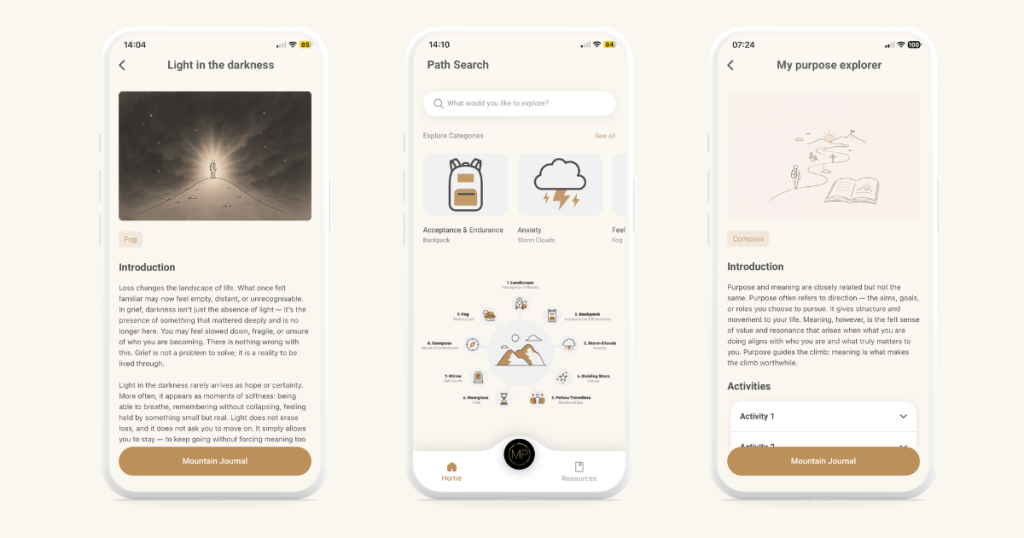
Path Search is our free reflective companion app inspired by Existential Analysis and the Mountain Framework.
Whether you are struggling with self-doubt, comparison, confidence, self-worth, relationships, or finding your direction in life, Path Search can help you explore meaningful questions through guided reflections and practical activities.
Popular self-love searches include:
- How do I love myself?
- Why am I so hard on myself?
- How do I trust myself?
- How do I stop comparing myself to others?
- How do I build self-worth?
- How can I be more confident?
- How do I become more authentic?
Each reflection includes practical exercises designed to support self-awareness, growth, and meaningful change.
Download Path Search and begin exploring the questions that matter most to you.
Download the Free Mountain Journal
The Mountain Journal is a free printable PDF designed to help you reflect on your experiences, values, emotions, goals, and personal growth.
Use it to:
- Deepen your self-love practice
- Reflect on journaling prompts
- Explore meaningful questions
- Clarify your values
- Track personal growth
- Strengthen self-awareness
Many readers find that combining journaling with reflection activities creates deeper insight and lasting change.
Download the Mountain Journal and continue your journey of self-discovery and self-acceptance.
Remember:
Self-love is not about becoming someone else.
It is about learning to relate to yourself with greater honesty, compassion, courage, and care.
Every small step matters.
Further Resources for Meaningful Reflection
If you would like to deepen your journaling practice, explore these related guides:
Self Discovery Journaling
Our guide to self-discovery journaling explores how reflective writing can help you better understand your values, identity, strengths, and personal growth.
Read: Self Discovery Journaling: A Reflective Guide to Meaning, Identity and Personal Growth
Gratitude Journal Prompts
Discover meaningful gratitude prompts designed to cultivate presence, appreciation, peace, and purpose.
Read: Prompts for Gratitude Journal: Meaningful Reflections for Presence, Peace and Purpose
Inspiring Words for Personal Growth
Explore a collection of positive and meaningful words that can support reflection, confidence, purpose, and self-development.
Read: Inspiring I Words: Positive and Meaningful Words for Growth, Confidence and Purpose