
Values Coaching
Sometimes the difficulty is not that you have no options.
It is that you are no longer sure which choices actually belong to you.
You may find yourself making decisions based on expectations, responsibilities, habit or what seems sensible, while feeling increasingly disconnected from what genuinely matters to you.
Perhaps you know something feels wrong but cannot explain why. You might struggle to make an important decision, feel conflicted between different priorities, or realise that the life you are living does not fully reflect the person you want to be.
Values coaching creates space to explore what matters deeply to you, understand where your values may be in conflict, and consider how they can provide greater direction in your everyday life.
The aim is not simply to create a list of values.
It is to explore what those values actually mean to you — and what it might look like to live them.
Our Framework
My Motivation. My Journey. My Decisions.
Rooted in the therapeutic tradition of Existential Analysis and Logotherapy, founded by Viktor Frankl and developed further by Alfried Längle. Our framework and digestible content, co-created by Meaningful Paths Founder David Chorlton and Therapist Sandy ElChaar, can be used for individual reflection and can also help practitioners support their own wellbeing and their clients.
Explore Our Framework →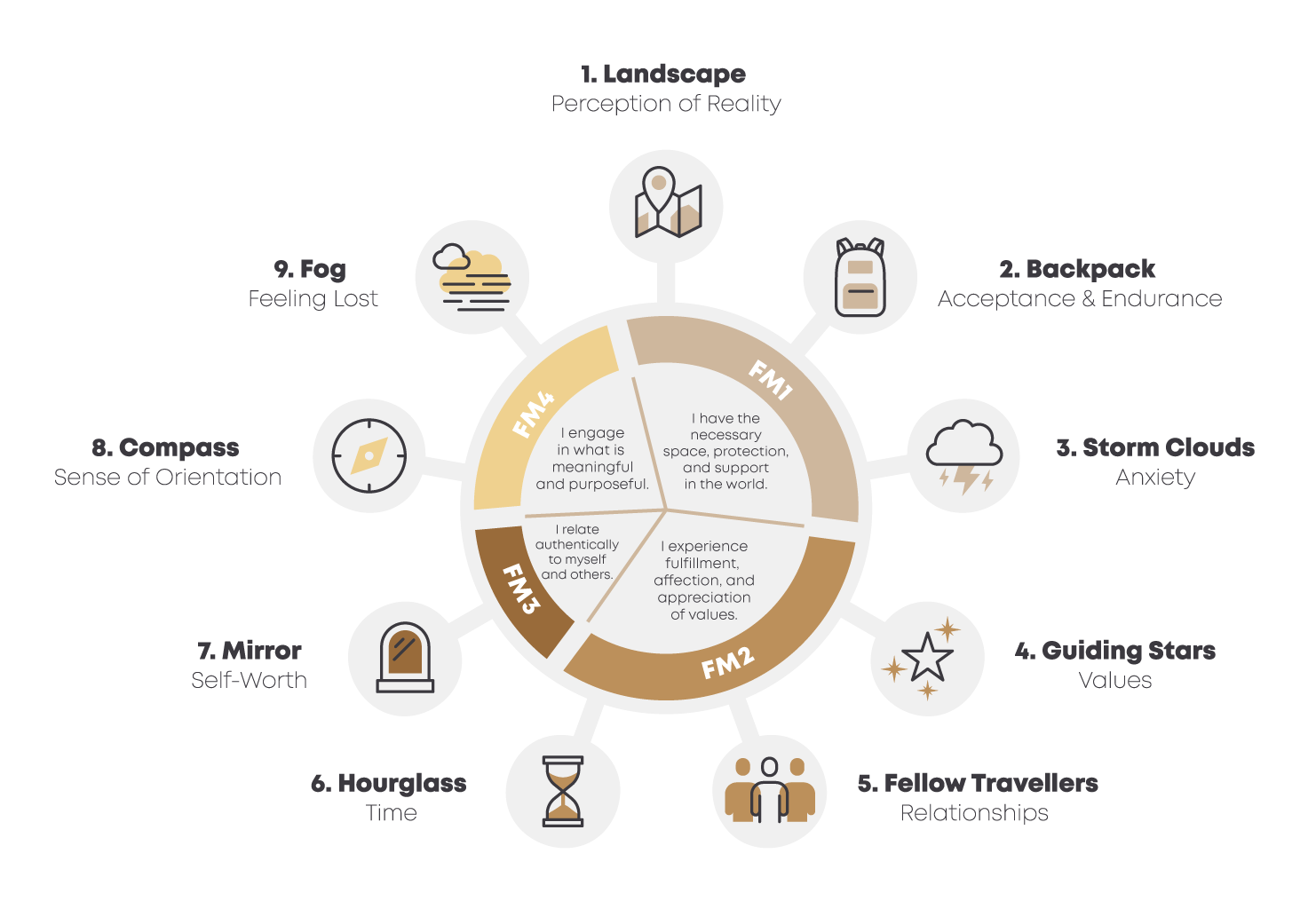

What are personal values?
Values are the things we experience as genuinely important and worth caring about.
They might include:
Connection.
Freedom.
Family.
Creativity.
Growth.
Adventure.
Stability.
Compassion.
Learning.
Authenticity.
Contribution.
Courage.
But two people can choose exactly the same value and mean very different things by it.
For one person, freedom might mean travelling and having few commitments.
For another, freedom might mean having enough financial security to make their own choices.
For one person, connection might mean having a wide social circle.
For another, it might mean a handful of deep relationships.
This is why values work needs to go further than simply asking:
“What are my values?”
The deeper question is:
“What does this value mean in the context of my life?”
Your Guiding Stars
Within the Meaningful Paths Mountain Framework, we represent values as Guiding Stars.
When you are walking through unfamiliar terrain, the stars do not tell you exactly where every turn in the path will be.
But they can help you maintain a sense of direction.
Values can work in a similar way.
You might not know exactly what job you want, where you want to live, whether you should make a particular change or what the next five years should look like.
But perhaps you know that connection matters.
Or creativity.
Contribution.
Family.
Growth.
Adventure.
That knowledge gives you something against which different possibilities can be explored.
Instead of asking only:
“Which option is correct?”
you can begin asking:
“Which possibility allows greater space for what genuinely matters to me?”
When your life and your values feel disconnected
Sometimes we know what matters to us but struggle to give it enough space.
You might value family deeply while spending almost all of your time working.
You might value creativity but have not created anything for years.
You might value friendship but repeatedly postpone seeing the people you care about.
You might value adventure while structuring your life almost entirely around avoiding uncertainty.
This does not necessarily mean you are living incorrectly.
Life contains responsibilities, limitations and competing needs.
But it can be useful to notice the gap between:
What I say matters
and
What receives my time, attention and energy.
That gap can tell us something.
Values coaching can help you explore where greater alignment might realistically be possible without expecting every moment of life to perfectly reflect every value you hold.
What happens when values conflict?
Sometimes the problem is not that we have forgotten our values.
It is that two things we value are pulling us in different directions.
You might value:
Freedom and security.
Career and family.
Adventure and stability.
Honesty and protecting someone you care about.
Belonging and authenticity.
These conflicts can make decisions particularly difficult because there may be something meaningful on both sides.
If you value both stability and growth, for example, deciding whether to make a major life change may not have an obvious answer.
Rather than trying to identify which value is the “correct” one, it can help to explore:
What is each value asking from me?
What would I gain through each possibility?
What might I have to give up?
Is there a way to honour both values, even if not equally?
Which choice can I genuinely stand behind?
Sometimes clarity comes not from eliminating the conflict, but from understanding it more deeply.
When one of your values has been crossed
Values can also help us understand our emotional reactions.
There may be times when somebody does something and your response feels surprisingly strong.
Perhaps you feel angry, disappointed, hurt or disrespected.
Before dismissing that response, it can be useful to ask:
Has something important to me been crossed?
If honesty is deeply important to you, discovering that somebody has lied may affect you particularly strongly.
If fairness matters, being treated unfairly may feel especially difficult.
If loyalty is important, a perceived betrayal may carry significant weight.
Our emotions do not always tell us exactly what happened or what we should do next.
But they can sometimes draw our attention towards something we value.
Understanding that can help us decide whether we need a conversation, a boundary, a change in expectations or simply a clearer understanding of our own needs.
Values and your Compass
Our Guiding Stars help us understand what matters.
Our Compass represents purpose and meaningful direction.
The two naturally work together.
If one of your values is contribution, your Compass might point towards finding more opportunities to help others.
If you value connection, it might point towards investing more intentionally in important relationships.
If you value creativity, perhaps your next step is creating regular space for something you have neglected.
If you value learning, your Compass might lead towards studying, reading, exploring or developing a new skill.
Purpose can therefore become less abstract.
Instead of trying to answer:
“What is the purpose of my life?”
you can begin with:
“How can I give more space to what matters?”
Turning values into everyday choices
Values become particularly useful when they leave the page and enter everyday life.
Choose one value that feels important to you right now.
Then ask:
Where does this value already exist in my life?
Where is it missing?
What is one small action that would give it more space this week?
If you value connection, perhaps you call someone.
If you value health, perhaps you protect time for rest or movement.
If you value creativity, perhaps you spend thirty minutes making something.
If you value learning, perhaps you finally begin the book or course you have been postponing.
The action does not need to be dramatic.
Small repeated choices can gradually change the direction of a life.
Values Coaching with Meaningful Paths
Our approach to values coaching combines reflective coaching with the Meaningful Paths Mountain Framework, helping you explore what genuinely matters to you and how those values relate to your choices, relationships and sense of direction.
Rather than giving you a predetermined list of values or telling you what should matter, we help you explore your own Guiding Stars.
Which values feel particularly important right now?
Where are they already present in your life?
Where might they be missing or compromised?
Are any of your values in conflict?
And how might they help your Compass find greater direction?
Knowing your values does not remove uncertainty from life.
But when the path becomes unclear, they can give you something important to navigate by.
Your Guiding Stars do not have to reveal the entire journey. Sometimes they simply help you recognise which direction feels more authentically yours.
Life Transition Articles –
What are Values – What Are Values? Meaning, Purpose and How to Find Yours
How to Find Purpose in your 50s- Living a Purposeful Life: Meaning, Values and Fulfillment