
Written and narrated by Dr. Samantha Brooks.

Dr Samantha Brooks
Cognitive Neuroscientist, Researcher and Meaningful Paths Partner
Dr Samantha Brooks is a Chartered member of the British Psychological Society and a Reader in Cognitive Neuroscience at Liverpool John Moores University, UK. Her research focuses on the neural mechanisms underlying impulse control, addiction and eating disorders, and she has published over 100 scientific papers.
Dr Brooks partners with Meaningful Paths on Cognitive Neuroscience, helping translate the latest brain science into accessible, evidence-based resources for personal growth and wellbeing. She is also the founder of Curb Your Addiction, a neuroscience-based app designed to help people better understand and overcome addictive behaviours.
Introduction
More than 2,700 years after it was first written, Homer’s The Odyssey continues to captivate readers because its challenges remain surprisingly familiar. Although the story follows Odysseus on his long journey home after the Trojan War, its deeper themes are timeless: temptation, self-control, identity, purpose and the struggle to stay true to what matters most.
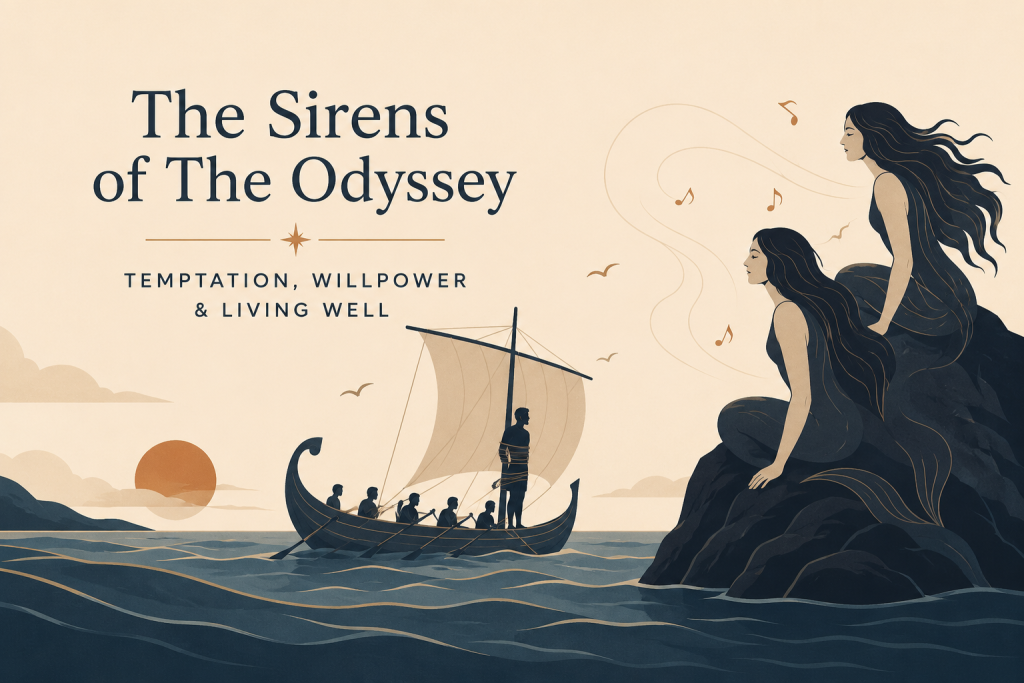
One of the most memorable moments in the epic is Odysseus’ encounter with the Sirens. Their irresistible song promises knowledge, pleasure and fulfilment, yet those who follow it lose sight of their destination. To protect himself and his crew, Odysseus famously has himself tied to the mast while his companions block their ears with beeswax, allowing them to continue their journey safely.
Today, our own “sirens” rarely appear as mythical creatures. Instead, they often take the form of distractions, unhealthy habits, social media, constant busyness, addiction, perfectionism or the pursuit of external approval. Like Odysseus, we can find ourselves pulled away from the life we genuinely want to live.
In this article, Dr Samantha Brooks explores the psychology of temptation and willpower, drawing on both ancient wisdom and modern psychological research. In the second half of the article, we’ll build on these ideas by exploring how the Meaningful Paths Mountain Framework can help us recognise our own sirens, reconnect with our values and continue our journey with greater clarity and purpose.
Before you continue…
Take a moment to consider this question:
What are the sirens in your own life?
What repeatedly distracts you from the person you want to become?
Keep this question in mind as you read.
Greek Sirens and willpower Dr. Samantha Brooks
The Sirens were first described in Homer’s The Odyssey as half-women, half bird, with upper bodies of the most beautiful women with enchanting singing voices, and their lower bodies were winged like birds. They lived on a rock island near Troy, enticing passing warriors on ships to their deaths who were unable to resist the beautiful songs and the sight of the beautiful women promising all sorts of pleasures.
The word siren derives from the Greek word, ‘rope’, or to ‘entangle’ – describing those who bind or entangle through beautiful songs and the anticipation of pleasure.
On his way back from the Troy, to rejoin his wife Penelope in his home of Ithaca, Odysseus, having heard the rumours about the enchanting songs the Sirens sang to sailors, wanted to hear what these songs were for himself. So, he plugged his men’s ears with wax, and ordered them to tie him tightly to the ship’s mast, and under no circumstances, no matter how much Odysseus begged, were the men to untie him.
Odysseus, on hearing the beautiful songs of the Sirens and their enchanting dancing, begged his men to untie him. But they only tied him tighter to the mast, unable to hear the songs themselves. As the Greek legend has it, if anybody heard the Siren’s songs but managed to pass them, the Sirens would kill themselves by drowning in the sea. This is what happened when Odysseus withstood their allure – with the help of his men.
Similarly, in another Greek story, when the Argonauts passed the Sirens, Orpheus was able to drown out their singing with his own music.
There are wonderful similarities between the willpower exerted by Odysseus – albeit superficial via actual physical restraint – Orpheus who used his own mental abilities to resist the Siren’s seductions, and modern-day need to exert willpower.
The Sirens in these stories could represent any manner of desires we experience as difficult to withstand today. The most common ones are high calorie, ultra-processed foods that give us short-term satisfaction and pleasure. Or the abundance of sexualised images in the media. Or advertising campaigns that persuade us to consume goods and services because we need them, or because it seems as though they satisfy our basic emotions.
We buy the latest gadgets, the biggest cars, the smartest televisions, fashionable, disposable clothes – all to feed corporate need to make profit – because we are seduced into believing that people will love us more, respect us more, will want to quell our over-worked loneliness by wanting to be in our company if we have the latest ‘it product’.
We drink too much alcohol and take drugs, both illicit and legal, to fill the empty spaces left in our minds when we don’t experience the promised satisfaction from these latest ‘it products’.
Like the Sirens who tried to entice the men in passing ships, the desirable commodities we see around us all the time, can only lead, in the end, to unhappiness and entanglement.
This could be why, when we are encouraged by corporations to find fulfilment in this way, that the lack of fulfilment in eating too much, buying too much, consuming too many synthetic substances, is related to increasingly higher rates of mental and physical ill-health.
We need to tie ourselves mentally to our own inner mast, to prevent us from jumping from our own ship as it charts its Meaningful Path to a better future, achieving the goals that are important to us. We need to listen to our own stronger song that can drown out the enticing distractions in our ever-busier world, so that we keep in mind our goals and stick to them.
The Greek stories of the enticing Sirens is a meaningful story, especially when we think that it seems impossible to resist all the seductions in society today. These stories are more meaningful when we consider the metaphors of Odysseus and Orpheus who resisted the temptations that others failed to.
Both physical restraint and mentally rehearsing one’s own songs – one’s own goals – is what a strengthened prefrontal cortex, with the daily use of CYa, will enable you to do. In neuroscience, these skills are referred to as response inhibition and working memory respectively. And without metaphorically ‘tying oneself to the mast of our own ship’ or ‘rehearsing our own favoured songs,’ we run the risk of succumbing to the seductions that can easily lead to our downfall and suffering.
So join the Meaningful Paths movement, and use CYa to help strengthen your willpower, that will ultimately keep your own beautiful ship on a meaningful course!
The Sirens Through the Mountain Framework
The Sirens didn’t simply tempt Odysseus with beautiful music—they tempted him to lose sight of where he was trying to go.
The Meaningful Paths Mountain Framework suggests that many of our modern struggles work in the same way. Rather than asking only “How can I resist temptation?”, it encourages us to explore why certain temptations feel so powerful in the first place.
Perhaps we’ve lost sight of our Guiding Stars—the values that give our lives direction. Maybe our Backpack is filled with fears, habits or past experiences that make certain distractions difficult to resist. Or perhaps difficult Weather, such as stress, loneliness or uncertainty, makes the easier path feel more appealing.
The goal isn’t simply to develop stronger willpower. It’s to better understand ourselves.
When we reconnect with what truly matters, recognise the influences shaping our choices and take one meaningful step at a time, the “song of the sirens” often becomes easier to hear without being pulled away from our journey.
Just as Odysseus needed more than determination alone to reach home, we too benefit from having a clear direction, supportive relationships and values that guide us through life’s distractions.
Reflection
Take a moment to ask yourself:
- What are the sirens in my own life?
- What values am I trying to protect?
- What keeps pulling me away from the life I want to build?
- What is one small step I could take today towards the person I want to become?

From Lost Hope to Found Purpose
What helps us keep moving when life feels uncertain, difficult or without direction?
In this reflective article, psychotherapist Sandy ElChaar explores how hope, meaning and purpose can help us reconnect with life, even during periods of struggle or disorientation.
Inside the Article
Explore the relationship between hope and purpose, why meaning can remain possible during difficult times, and how reconnecting with what matters may help you find your next step.
Written by psychotherapist Sandy ElChaar
Explore Your Own Sirens with Path Search
The Sirens in The Odyssey can remind us of the habits, distractions and pressures that repeatedly pull us away from the life we want to live.
Path Search is our free guided reflection app, built around the Meaningful Paths Mountain Framework. It can help you explore what is influencing your choices and reconnect with the values guiding your journey.
What Are the Sirens in My Life?
Identify the distractions, habits or temptations that repeatedly pull you away from what matters.
What Am I Trying to Escape?
Reflect on whether a distraction is helping you avoid stress, loneliness, uncertainty or a difficult feeling.
Which Values Do I Want to Protect?
Reconnect with your Guiding Stars and consider which choice brings you closer to the person you want to become.
Free on iOS and Android
Frequently Asked Questions
What do the Sirens symbolise in The Odyssey?
The Sirens symbolise temptation, distraction and the seductive pull of things that can lead us away from our true goals. Although they promise knowledge and fulfilment, following their song ultimately prevents sailors from reaching their destination. Today, the Sirens can be understood as anything that repeatedly distracts us from living according to our values.
Why did Odysseus tie himself to the mast?
Odysseus knew he wanted to hear the Sirens’ song but also understood that he would be unable to resist it. By having his crew tie him securely to the mast and block their own ears with beeswax, he created a way to experience temptation without acting on it. His strategy highlights the importance of preparation and self-awareness rather than relying on willpower alone.
What can the Sirens teach us about modern life?
The story reminds us that temptation often appears attractive because it promises immediate comfort, pleasure or certainty. In modern life, our own “sirens” may include social media, unhealthy habits, addiction, perfectionism, constant busyness or the pursuit of external approval. Recognising these distractions is the first step towards making more intentional choices.
What does psychology say about temptation and willpower?
Research suggests that willpower is only one part of behaviour change. Our environment, habits, emotions, stress levels and personal values all influence our decisions. Rather than simply trying harder, understanding why certain temptations are appealing can lead to more sustainable change.
How does the Mountain Framework help with temptation?
The Meaningful Paths Mountain Framework encourages you to explore the deeper influences behind your choices. Instead of asking only “How do I resist temptation?”, it invites questions such as:
- Have I lost sight of my values (Guiding Stars)?
- Am I carrying fears or habits from the past (Backpack)?
- Are difficult emotions or stress influencing my decisions (Weather)?
- Am I moving towards the life I want to build (Compass)?
By understanding the whole landscape rather than focusing on willpower alone, it becomes easier to make decisions that align with who you want to become.
What are the “sirens” in my own life?
Everyone’s sirens are different. They may include:
- Endless scrolling on social media
- Procrastination
- Addictive behaviours
- People-pleasing
- Constant comparison
- Overworking
- Seeking external validation
- Avoiding difficult emotions
Reflecting on what repeatedly pulls you away from your values can help you identify your own sirens.
Can the story of the Sirens still help us today?
Yes. Although The Odyssey was written thousands of years ago, its themes remain highly relevant. The story encourages us to think about purpose, self-control, relationships, identity and the choices that shape our lives. These timeless questions continue to resonate because the challenges of being human have changed far less than our technology.
Where can I explore these ideas further?
If you’d like to reflect on your own values, purpose and life’s challenges, you can explore the free Path Search app, discover the Meaningful Paths Mountain Framework, or continue your journey with our collection of articles and free courses.
Dr Samantha Brooks
Cognitive Neuroscientist, Researcher and Meaningful Paths Partner
Dr Samantha Brooks is a Chartered member of the British Psychological Society and a Reader in Cognitive Neuroscience at Liverpool John Moores University, UK. Her research focuses on the neural mechanisms underlying impulse control, addiction and eating disorders, and she has published over 100 scientific papers.
Dr Brooks partners with Meaningful Paths on Cognitive Neuroscience, helping translate the latest brain science into accessible, evidence-based resources for personal growth and wellbeing. She is also the founder of Curb Your Addiction, a neuroscience-based app designed to help people better understand and overcome addictive behaviours.