
Exploring Anxiety Through Existential Analysis
Introduction: When Worry Appears Without a Cause
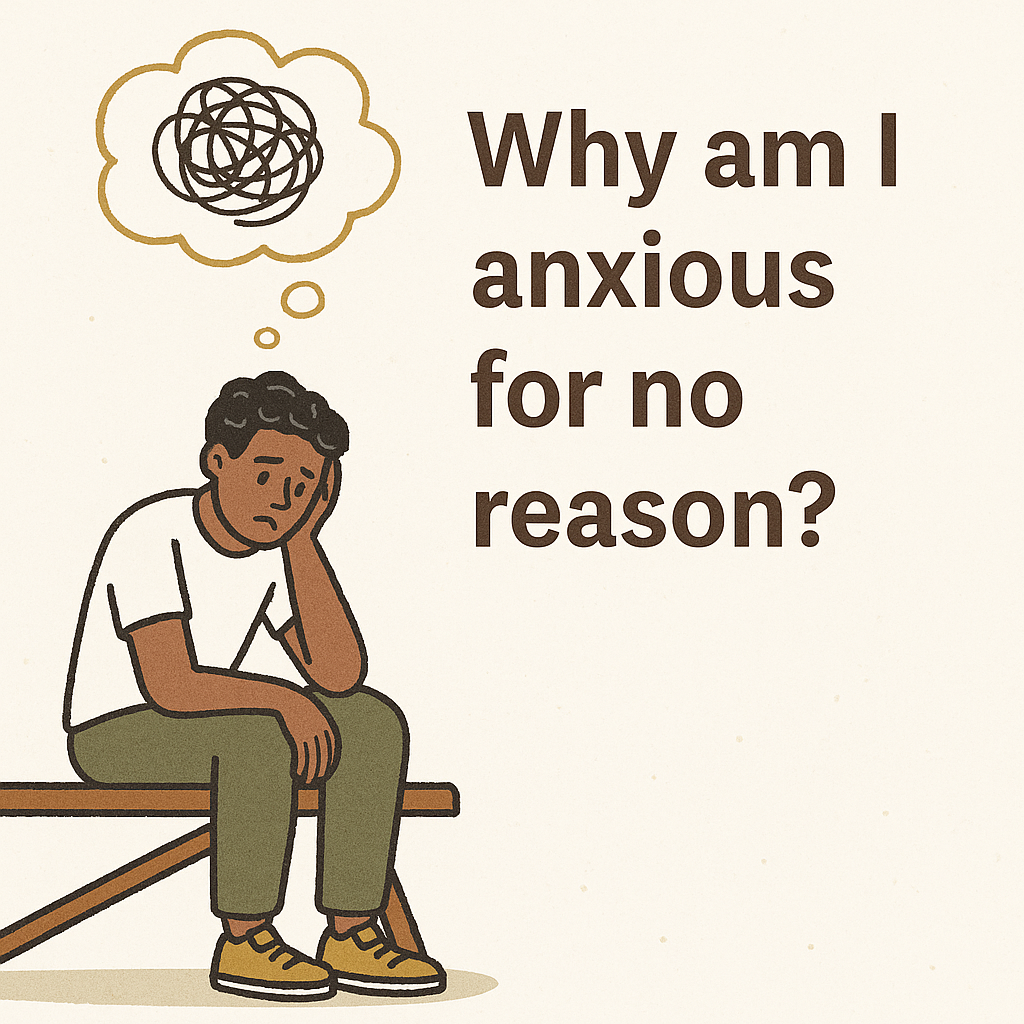
You wake up with your chest tight, your heart racing, and your thoughts spiraling. Someone asks, “What’s wrong?” and you can’t find an answer. The anxiety feels real—yet there’s no obvious reason for it. If you’ve ever asked yourself, “Why am I anxious for no reason?” you’re not alone. Millions of people experience unexplained anxiety, and while it may feel irrational, it usually has deeper roots.
From an existential perspective, anxiety is not meaningless noise—it is a signal. It often emerges when something important in our lives is out of alignment: when we feel disconnected from our values, uncertain about our future, or when our need for security or belonging is shaken. Rather than suppressing anxiety, Existential Analysis invites us to listen to it with curiosity and compassion.
In this article, we’ll explore:
- The science of anxiety and why it sometimes feels rootless.
- The perspective of Existential Analysis and Logotherapy—developed by Viktor Frankl and expanded by Alfried Längle.
- Practical, meaningful steps you can take to work with anxiety rather than against it.
- Resources for deepening your reflection, including our Quest for Meaning eBook and the Path Search free app.
Why Am I Anxious for No Reason?
Many people experience anxiety even when there is no obvious threat, problem, or crisis in front of them. This can feel confusing and frustrating, especially when life appears to be going relatively well. However, anxiety rarely appears completely “for no reason.” Often, it reflects underlying concerns, unmet needs, uncertainty, stress, unresolved emotions, or worries that may not yet be fully conscious.
According to existential psychologist and therapist Sandy ElChaar, anxiety is not always a sign that something is wrong. Sometimes it can be understood as a response to uncertainty, responsibility, change, loss, freedom, or questions about meaning and direction. Rather than immediately trying to eliminate anxiety, it can be helpful to explore what it may be attempting to communicate.
The Science of Anxiety: Why It Feels “Without Reason”
Anxiety is a natural human response to perceived threat. It primes our body through the fight-or-flight system: releasing adrenaline, increasing heart rate, sharpening our senses. But anxiety doesn’t always need an immediate external danger to activate.
Research shows that anxiety can be triggered by:
- Uncertainty – The brain dislikes the unknown and may create “false alarms” (Grupe & Nitschke, 2013).
- Stress accumulation – Small unresolved stresses build up until they spill over as anxiety.
- Attentional bias – Studies show anxious individuals notice threats faster than safety cues (Bar-Haim et al., 2007).
- Unmet psychological needs – Lack of belonging, autonomy, or purpose can quietly stir restlessness (Deci & Ryan, 2000).
This explains why anxiety sometimes feels disconnected from external events. On the surface, “nothing is wrong”—but under the surface, deeper human needs may be unacknowledged or unmet.
Existential Analysis: Anxiety as a Messenger
Viktor Frankl, psychiatrist and Holocaust survivor, believed that the deepest human drive is not pleasure or power, but meaning (Frankl, 2006). When our life feels empty or directionless, anxiety often fills the void.
Alfried Längle, who expanded Frankl’s work into Existential Analysis, describes anxiety as a signal of life imbalance. His model of the Four Fundamental Motivations identifies what every human needs to live fully:
- To have space and safety (a secure place in the world).
- To experience life and support (to feel nourished and sustained).
- To be oneself and of value (authenticity and self-worth).
- To have meaning and direction (a purpose to orient our actions).
When one of these is blocked, anxiety emerges—not as an enemy, but as a compass. For example:
- If you feel anxious about going to work, perhaps your value system conflicts with your role.
- If you feel anxious in relationships, perhaps your need for authentic connection isn’t met.
- If you feel anxious “for no reason,” perhaps it’s a whisper from within that life has drifted off course.
In this view, anxiety is not meaningless—it is an invitation to realign with what matters most.
Common Existential Roots of Anxiety
1. Fear of Losing Control
Even when life seems fine, uncertainty about the future can cause tension. This links to our need for space and security.
2. Feeling Disconnected
Loneliness doesn’t always mean being alone. Sometimes we’re surrounded by people yet feel unseen. This threatens our need for connection and belonging.
Related article: I Don’t Fit In Anywhere
3. A Crisis of Meaning
When daily routines lack purpose, we may feel restless or anxious. This touches the fourth motivation: the human need for meaning.
Related article: Why Meaning Matters
How to Work With Anxiety Using Existential Analysis
Instead of asking, “How do I get rid of anxiety?” EA encourages us to ask:
“What is my anxiety trying to tell me?”
Here are practical ways to begin:
🌱 Reflective Question
- What feels out of balance in my life right now—safety, support, authenticity, or meaning?
🪧 3 Practical Steps
- Pause and Name It – Anxiety lessens when we label it: “I notice tension in my chest.” This brings calm through mindful awareness (Kabat-Zinn, 2003).
- Connect to Values – Write down what matters most (kindness, courage, family, growth). Small acts aligned with values reduce anxiety by creating coherence (Martela & Steger, 2016).
- Anchor in Support – Share with a trusted friend, coach, or therapist. Anxiety shrinks in safe dialogue.
🧭 Next Step
Continue your journey with reflection tools like our FM Reflection Cards (based on the Four Fundamental Motivations) or our book Quest for Meaning: 10 Exercises on Purpose to explore meaning and purpose in daily life.
When Anxiety Becomes Overwhelming
Existential Analysis is powerful, but severe or persistent anxiety may need professional help. Psychotherapy, counseling, or medical support can provide relief. If anxiety impacts sleep, daily functioning, or relationships, reaching out is a sign of strength.
Purpose as an Antidote to Anxiety
Research shows that having a sense of purpose reduces risk of depression, anxiety, and even chronic disease (Hill & Turiano, 2014; Alimujiang et al., 2019). Purpose acts like a stabilizing anchor in stormy waters.
Learn more: Living a Purposeful Life
When we align with our guiding values, we cultivate eudaimonic well-being—a deeper form of happiness rooted in meaning rather than momentary pleasure.
Conclusion: Anxiety as a Guide, Not an Enemy
If you’ve ever wondered, “Why am I anxious for no reason?”, remember: anxiety is not senseless. It may be a messenger pointing toward unmet needs, unspoken fears, or unlived values.
Through Existential Analysis and Logotherapy, we learn not to silence anxiety but to listen—and in listening, we discover where life calls us to realign.
The next time you feel inexplicable anxiety, try pausing and asking:
- What does this feeling reveal about what I need most right now?
By approaching anxiety as a teacher, you can turn restlessness into reflection, and fear into purposeful steps forward.
Explore Further
- 📘 Quest for Meaning: 10 Exercises on Purpose — practical exercises rooted in Existential Analysis.
- 🌍 Related readings:
Frequently Asked Questions
Why do I feel anxious for no reason?
Although it may seem like anxiety appears without a cause, there is often an underlying explanation. Stress, uncertainty, unresolved emotions, life transitions, physical exhaustion, relationship concerns, health worries, or unconscious fears can all contribute to anxiety even when no immediate threat is obvious.
Can anxiety happen even when life is going well?
Yes. Anxiety is not always linked to external problems. Many people experience anxiety during positive life events, periods of growth, major decisions, or times of increased responsibility. Sometimes anxiety reflects uncertainty about the future rather than current circumstances.
Is it normal to feel anxious without knowing why?
Yes. Anxiety is a common human experience. It is not unusual to notice physical symptoms or feelings of unease before fully understanding what may be contributing to them.
What does existential psychology say about anxiety?
Existential psychology views anxiety as a natural response to important aspects of human life, including uncertainty, freedom, responsibility, relationships, change, meaning, and mortality. Rather than seeing anxiety purely as a symptom to remove, it can also be explored as a source of information about what matters to us.
Why do I wake up feeling anxious for no reason?
Morning anxiety can occur for several reasons, including elevated stress hormones, unresolved worries, poor sleep, life pressures, uncertainty, or emotional concerns that become more noticeable upon waking. Many people experience anxiety in the morning even when they cannot immediately identify a cause.
Can anxiety be caused by stress I am not aware of?
Yes. People often adapt to ongoing stress without fully recognising its impact. Work pressures, relationship difficulties, financial concerns, caregiving responsibilities, or emotional burdens may contribute to anxiety even when they are not consciously at the forefront of attention.
How can I calm anxiety when I don’t know the cause?
Grounding exercises, breathing practices, journaling, reflection, physical activity, meaningful connection, and self-compassion can all be helpful. Rather than fighting anxiety, it may also be useful to approach it with curiosity and ask what it might be trying to communicate.
Is anxiety always a bad thing?
Not necessarily. Anxiety can sometimes act as a signal that something important requires attention. While excessive anxiety can be distressing, moderate anxiety may encourage preparation, reflection, growth, or meaningful action.
Can questions about purpose or meaning create anxiety?
Yes. Periods of uncertainty about direction, identity, values, relationships, or purpose can contribute to anxiety. Existential psychology recognises that questions about meaning and the future are often closely connected to experiences of anxiety.
When should I seek support for anxiety?
If anxiety is persistent, overwhelming, significantly affecting daily life, relationships, sleep, work, or wellbeing, it may be helpful to seek support from a qualified mental health professional who can help you explore and understand your experience.
References
- Alimujiang, A., Wiensch, A., Boss, J., Fleischer, N. L., Mondul, A. M., McLean, K., & Pearce, C. L. (2019). Association between life purpose and mortality among US adults older than 50 years. JAMA Network Open, 2(5), e194270. https://doi.org/10.1001/jamanetworkopen.2019.4270
- Bar-Haim, Y., Lamy, D., Pergamin, L., Bakermans-Kranenburg, M. J., & Van Ijzendoorn, M. H. (2007). Threat-related attentional bias in anxious and nonanxious individuals: A meta-analytic study. Psychological Bulletin, 133(1), 1–24.
- Deci, E. L., & Ryan, R. M. (2000). Self-determination theory and the facilitation of intrinsic motivation, social development, and well-being. American Psychologist, 55(1), 68–78.
- Frankl, V. E. (2006). Man’s Search for Meaning. Beacon Press. (Original work published 1946).
- Grupe, D. W., & Nitschke, J. B. (2013). Uncertainty and anticipation in anxiety: An integrated neurobiological and psychological perspective. Nature Reviews Neuroscience, 14(7), 488–501.
- Hill, P. L., & Turiano, N. A. (2014). Purpose in life as a predictor of mortality across adulthood. Psychological Science, 25(7), 1482–1486.
- Kabat-Zinn, J. (2003). Mindfulness-based interventions in context: Past, present, and future. Clinical Psychology: Science and Practice, 10(2), 144–156.
- Längle, A. (2011). The search for meaning in life and the existential fundamental motivations. Existential Analysis, 22(1), 25–40.
- Martela, F., & Steger, M. F. (2016). The three meanings of meaning in life: Distinguishing coherence, purpose, and significance. Journal of Positive Psychology, 11(5), 531–545.