
Updated October 2025 with new insights.
Motivation can be elusive. Sometimes you wake up knowing exactly what you “should” do, and yet your energy feels flat. You ask yourself: Why can’t I just find motivation? What is wrong with me? Whether it’s about your health, career, relationships, or personal growth, loss of motivation can feel like being stuck in a grey fog.
In this article, we’ll explore why motivation is not just about willpower, and how you can reconnect with long-lasting drive using Existential Analysis and the Four Fundamental Motivations. We’ll also dive into intrinsic vs extrinsic motivation (and why external rewards sometimes backfire), and offer practical, reflective steps to help you move from inertia to meaningful action.
You might also find value in our article: From Lost Hope to Found Purpose — it addresses deeper meaning when motivation seems absent.
The Four Fundamental Motivations & Motivation Loss
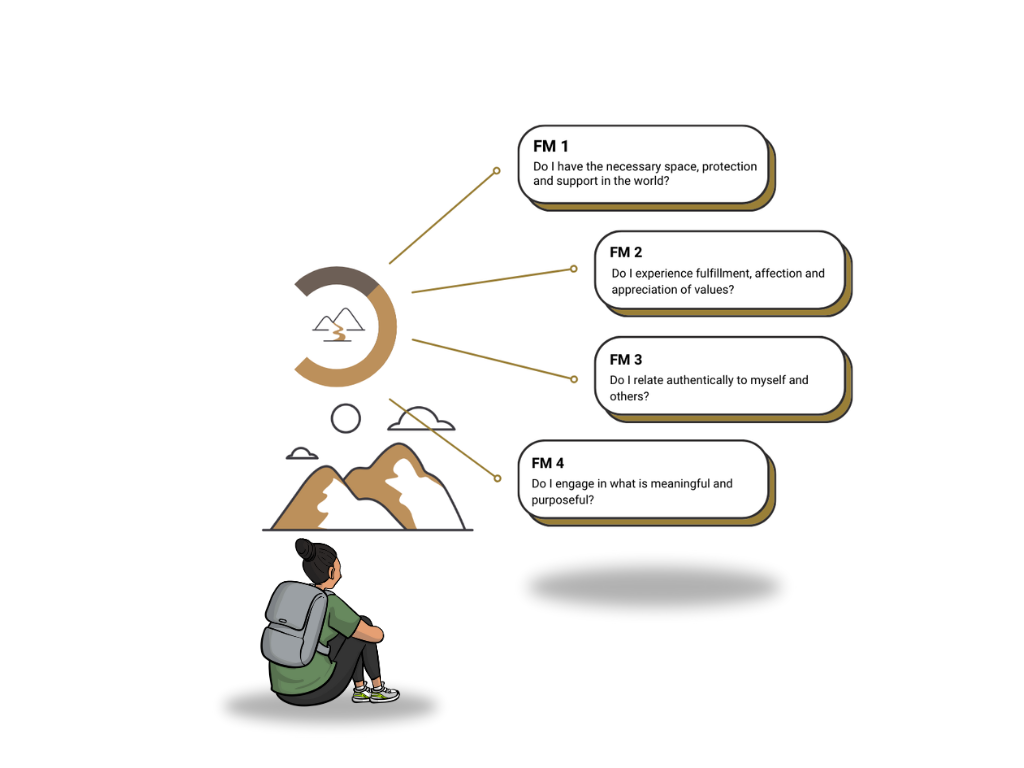
According to Existential Analysis, human well-being is rooted in satisfying four core motivational domains. When motivation fades, often one or more of these areas is being starved of attention:
- Space, Protection & Support
- When we feel insecure, overwhelmed, or unsupported, our internal resources get tied up in surviving instead of thriving.
- You might resist starting a new project because a part of you fears failure or judgment.
- Fulfillment, Affection & Appreciation of Values
- Motivation wanes when your daily actions do not reflect what you value — when life feels hollow or misaligned.
- If your tasks don’t feel meaningful, it’s harder to muster drive.
- Authentic Relation to Self & Others
- If you feel disconnected from who you truly are or from people around you, the inner resonance of purpose weakens.
- You might feel you’re performing roles rather than living your truth.
- Engagement with Meaning & Purpose
- When you lose sight of why you’re doing something, the “what” becomes a burden instead of a path.
- Motivation doesn’t survive long in a vacuum of purpose.
To restore motivation, it helps to reflect on which of these motivations feels dry or missing right now. Motivation is not simply a matter of pushing yourself harder — it’s about reconnecting with your inner landscape.
Intrinsic vs Extrinsic Motivation — What’s the Difference?
To understand motivation better, it helps to distinguish between intrinsic and extrinsic forms:
- Intrinsic motivation is when you engage in an activity because it is inherently satisfying, meaningful, or aligned with who you are. You do it for its own sake — the joy, growth, curiosity, or fulfillment. Verywell Mind describes intrinsic motivation as when the task itself is the reward. Verywell Mind
- Extrinsic motivation is when you do something for external rewards or pressures (e.g. praise, money, approval, avoiding guilt). Simply Psychology+1
Research shows that while extrinsic rewards can motivate behavior in the short term, they can sometimes crowd out intrinsic motivation — a phenomenon called the overjustification effect (offering rewards for something you already enjoy can reduce your internal drive). Wikipedia+2Self Determination Theory+2
However, the distinction is not black-and-white. Self-Determination Theory (Ryan & Deci) describes a continuum: extrinsic motivation that’s been internalized (you accept the value) becomes more sustainable. PMC+2Self Determination Theory+2
In practice:
- Use extrinsic motivators carefully (e.g. rewards, accountability) when starting something new.
- But aim to shift toward intrinsic motivation by connecting tasks to personal values, autonomy, and meaning.
Why Motivation Disappears (From Internal & External Angles)
Here are common reasons motivation fades — and how they relate to existential and psychological dynamics:
- Misaligned Goals: You’re pursuing what others expect or what “seems right,” not what you deeply care about.
- Lack of Autonomy or Overcontrol: If external rules or pressure dominate, you lose internal ownership.
- Fear of Failure or Judgment: The risk of vulnerability blocks the first step.
- Burnout / Overwhelm: You’ve stretched your margin too thin; the system shuts down.
- Disconnection from Meaning: Tasks that lack significance feel hollow.
- Competing Motivations: You may have opposing goals (e.g. desire for comfort vs growth).
Existential reflection helps uncover these hidden tensions.
What Does Unmotivated Mean — Clear Definition and Context
When you’re feeling stuck, one of the first questions people ask is: what does unmotivated mean? In everyday language, unmotivated meaning describes a state where someone lacks the desire or drive to initiate or complete tasks, even ones they know are important or meaningful. According to standard dictionary definitions, unmotivated meaning is essentially not wanting to do something, or not wanting to do something well, reflecting an absence of internal push toward action.
It can feel like you simply don’t have the “oomph” to start something — even if deep down you logically know you should. This state of being unmotivated does not necessarily mean you are lazy, incompetent, or incapable. In fact, psychologists point out that a person isn’t universally unmotivated — rather, there may be unmotivated meaning only in relation to specific tasks, contexts, or emotional states.
For example, someone might feel deeply motivated and engaged in creative work they love, yet unmotivated when faced with routine tasks like laundry or administrative emails. In that sense, the unmotivated meaning isn’t a judgment on your character — it’s a description of how your motivational energy is being distributed in that moment.
Understanding what unmotivated meaning really refers to — a lack of internal drive toward a specific activity — can be a useful first step in moving from inertia toward action.
Reflective Practice — Reignite Motivation
🔍 Reflective Questions to Start
- Which of the Four Fundamental Motivations feels most distant right now?
- If resources (time, energy, support) were guaranteed, what would I choose to do first?
- What feeling or value would action fulfill — not what outcome, but what experience?
🧭 Decision Framework (Personal Existential Analysis)
- Perception / Facts
- Clarify the situation: What’s keeping you from acting? What constraints are real, which are imagined?
- Emotions / Values
- Name what you fear, resist, long for. Reconnect with values you wish to live.
- Value-Based Decision
- Choose one action that best aligns with your deepest values (not necessarily the “easiest”).
- Act
- Commit to doing it, however small, to generate momentum.
5 Practical Tips to Boost Motivation
- Start Very Small
- Choose one micro-step you can do today (e.g. 5 minutes).
- This builds sense of competence and momentum.
- Frame Tasks as Experiments
- Instead of “I must,” try “I’m curious to see what happens.”
- Experimentation lowers pressure and opens possibility.
- Anchor to Meaning
- Remind yourself regularly why you are doing this — not for status or reward, but for contribution, growth, connection.
- Revisit meaningful stories or purpose anchors (see From Lost Hope to Found Purpose).
- Create Gentle Accountability
- Partner with someone or commit publicly to small goals.
- Use the accountability to support autonomy, not shame.
- Celebrate Movement, Not Perfection
- Every step counts, even imperfect ones.
- Acknowledge small wins, even if outcome is incomplete.
Application: How Do I Motivate Myself to Eat Healthy / Run / Lose Weight
- Eat Healthy: connect nutrition to your values (energy, presence, vitality). Use choice over rules.
- Run: start with short intervals; link running with mental clarity, solitude, or exploration.
- Weight Loss: emphasize health, self-care, and long-term flourishing instead of just appearance.
Remember: How do I motivate myself to lose weight? often hides deeper questions: What life will this enable me to live?
When Motivation Remains Elusive
- Reflect on whether external pressures are dominating your drive.
- Be patient; motivation ebbs and flows.
- Consider coaching or therapy (especially existential) when stuck patterns persist.
Use tools like our FM Reflection, Mountain, and Decisions Cards inside the Meaningful Paths App to help you map motivation and act with clarity.
Final Thoughts & Next Steps
Motivation is not a fixed state you either have or don’t. It’s a living interplay between your inner world and outer life. By reconnecting with your fundamental motivations, shifting from extrinsic to intrinsic drive, and making small value-led decisions, you can move from stagnation to meaningful momentum.
If you want guided prompts and exercises to reignite motivation, explore our book: Quest for Meaning: 10 Exercises on Purpose.
When motivation feels flat, it’s common for a deeper question to surface — how can I find my passion when nothing seems to spark interest or energy right now?
References
- Ryan, R. M., & Deci, E. L. (2000). Intrinsic and Extrinsic Motivations: Classic Definitions and New Directions. Contemporary Educational Psychology. Self Determination Theory
- Deci, E. L., & Ryan, R. M. (2013). Intrinsic Motivation and Self-Determination in Human Behavior.
- Rhodes, R. E., & Yao, C. A. (2015). Models, correlates, and interventions in healthy eating and physical activity: a review and comparison of three approaches. Psychology & Health.
- Work on physical activity motivation: internal regulation, autonomy and competence as predictors of habitual exercise. PMC