
Life Transition Coaching
Life changes can leave us standing somewhere between what was familiar and what comes next.
Sometimes the transition is something we chose: moving somewhere new, changing direction, beginning a relationship, becoming a parent, retiring, or deciding that an old way of living no longer feels right.
Other transitions arrive without invitation.
A relationship ends. A role changes. Children become more independent. Something we relied upon disappears. Or life simply moves into a different chapter before we feel ready for it.
Even positive changes can bring uncertainty.
Life transition coaching creates space to understand what is changing, what matters to you now, and how you want to move into the next part of your life.
The aim is not to rush through the uncertainty or immediately construct a new version of yourself. It is to help you understand where you are, what you are carrying with you and which direction feels meaningful from here.
Our Framework
My Motivation. My Journey. My Decisions.
Rooted in the therapeutic tradition of Existential Analysis and Logotherapy, founded by Viktor Frankl and developed further by Alfried Längle. Our framework and digestible content, co-created by Meaningful Paths Founder David Chorlton and Therapist Sandy ElChaar, can be used for individual reflection and can also help practitioners support their own wellbeing and their clients.
Explore Our Framework →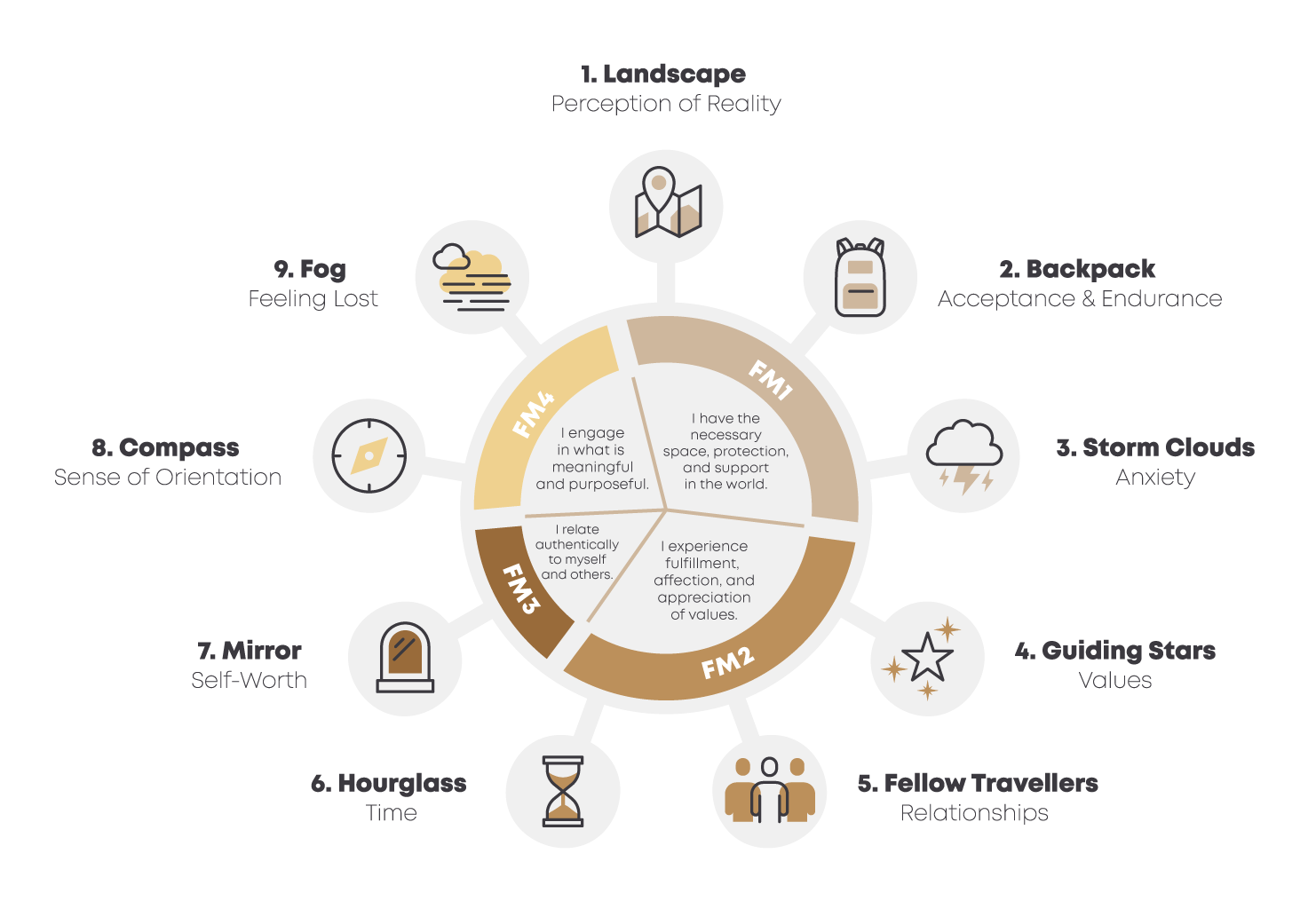

Why can life transitions feel so difficult?
Change affects more than our circumstances.
It can affect our routines, relationships, identity, expectations and sense of direction.
You might find yourself asking:
Who am I now that this part of my life has changed?
What do I want from this next chapter?
Am I making the right decisions?
What should I hold onto — and what am I ready to leave behind?
Why do I feel unsettled even though this change is supposed to be positive?
There can be a period during transition when the old landscape no longer fits but the new one has not yet become clear.
Within the Meaningful Paths Mountain Framework, we might think of this as encountering Fog on the Mountain.
You do not necessarily need to clear all of the Fog before moving.
Sometimes you need enough clarity to recognise the next meaningful step.
Understanding the landscape you are entering
Our Landscape represents the wider circumstances in which our lives unfold.
When life changes, the Landscape can change too.
Your relationships may be different. Your responsibilities might have shifted. Your environment may have changed. Something that previously structured your days may no longer be there.
Before deciding what comes next, it can help to notice what your new Landscape actually contains.
Ask yourself:
What has genuinely changed?
What remains stable?
What possibilities exist now that did not exist before?
What feels difficult about this new Landscape?
What support do I need while I learn how to move within it?
Not every transition needs to become an immediate opportunity for transformation.
Sometimes we first need time to understand where we have arrived.
Looking inside your Backpack
On the Mountain, our Backpack represents the experiences we carry with us.
A new chapter does not erase the chapters that came before it.
We carry memories, relationships, disappointments, achievements, expectations, lessons and experiences into whatever comes next.
During a transition, it can therefore be helpful to look inside the Backpack.
What from the previous chapter do I want to carry forward?
What has this experience taught me?
What currently feels particularly heavy?
Am I carrying an expectation about how my life was supposed to look?
Is there anything I am ready to begin carrying differently?
Leaving something behind does not necessarily mean rejecting or forgetting it.
Sometimes it means acknowledging that something mattered while accepting that its place in our life has changed.
Returning to your Guiding Stars
When the Landscape changes, our Guiding Stars — our values — can help provide orientation.
You may not know exactly what you want your next chapter to look like.
But you can begin by asking what you want it to contain.
Perhaps connection matters deeply.
Or freedom.
Family.
Creativity.
Adventure.
Stability.
Learning.
Contribution.
Authenticity.
Growth.
Values do not tell us precisely which decision to make.
They help us recognise what deserves consideration when we make it.
A useful question during transition can therefore be:
What matters enough that I want it represented in the next part of my life?
Finding your Compass again
Our Compass represents purpose and meaningful direction.
During a transition, the Compass can temporarily feel difficult to read.
Perhaps an old goal no longer makes sense.
Perhaps you achieved something you had been working towards and are now wondering what comes next.
Or perhaps circumstances have changed so significantly that plans you once made no longer feel possible or relevant.
You do not necessarily need another enormous goal.
Purpose can begin much closer to where you are.
What feels worth moving towards now?
That might mean rebuilding connection.
Creating greater stability.
Exploring something new.
Giving more time to people who matter.
Learning.
Contributing.
Taking care of yourself.
Or beginning something you have postponed for years.
A Compass provides direction rather than a complete map.
Sometimes that is enough.
You don’t need to have the next chapter figured out
Transitions can create pressure to make decisions quickly.
What’s next?
What are you going to do?
What’s the plan?
But there can be value in allowing a period of uncertainty to exist.
You may need time to understand what has changed before deciding what should replace it.
That does not mean becoming permanently stuck.
It means recognising that reflection can also be part of movement.
You can explore.
Try something.
Have conversations.
Reconnect with people.
Notice what gives you energy.
Notice what repeatedly feels important.
Take one small step and see what becomes visible from there.
The whole path does not need to appear at once.
Life Transition Coaching with Meaningful Paths
Our approach to life transition coaching combines reflective coaching with the Meaningful Paths Mountain Framework, helping you explore where you are, what you are carrying, what matters to you and where you might want to go next.
Rather than assuming that every transition needs a dramatic reinvention, we begin with your actual experience.
What does your Landscape look like now?
What are you carrying in your Backpack?
Which Guiding Stars still matter?
Where is your Compass beginning to point?
And what is one step you can realistically take from here?
A life transition can contain loss, uncertainty and disruption.
But it can also create space to reconsider how you want to live.
You do not need to know exactly where the next chapter leads before you begin writing it.
Life Transition Articles –
How to Find Purpose in your 40s – How to Find Purpose in Your 40s: Meaning, Growth, Direction
How to Find Purpose in your 50s- How to Find Purpose in Your 50s: Meaning, Fulfilment, Growth
Midlife Crisis in Women – Midlife Crisis in Women: A Turning Point With Purpose
Midlife Crisis in Men – Midlife Crisis in Men: Meaning, Struggle & Renewal