

Good mental health rarely comes from one dramatic breakthrough.
More often, it is built quietly — through daily habits that support clarity, emotional regulation, self-worth, and meaning.
But what actually helps?
In this guide, we explore practical, therapist-informed habits for good mental health — grounded not just in surface-level tips, but in deeper existential psychology.
We’ll also draw from the Meaningful Paths Mountain Framework and its foundation in the Four Fundamental Motivations — a structured way of understanding what human beings truly need in order to thrive.
What Do We Really Mean by “Good Mental Health”?
Good mental health does not mean:
- Never feeling anxious
- Never doubting yourself
- Always being productive
- Always being positive
Instead, it means:
- Having space to process emotions
- Being able to regulate difficult thoughts
- Feeling grounded in your values
- Living with direction and authenticity
From an existential perspective, mental health is not just symptom reduction — it is the experience of living meaningfully.
You can explore our deeper framework here:
https://www.meaningfulpaths.com/our-framework/
The Four Foundations of Mental Health
At Meaningful Paths, we explore mental wellbeing through the Four Fundamental Motivations:
FM1. Do I have the necessary space, protection, and support in the world?
FM2. Do I experience fulfillment, affection, and appreciation of values?
FM3. Do I relate authentically to myself and others?
FM4. Do I engage in what is meaningful and purposeful?
Healthy habits should support these four areas — not just productivity.
Let’s explore habits that align with each one.
1. Create Daily Psychological “Space”
Mental health begins with safety.
Without a sense of internal and external safety, the nervous system remains in survival mode.
Habits that support FM1:
- Taking short pauses between tasks
- Limiting news or social media intake
- Creating a predictable morning routine
- Saying no when overwhelmed
If you struggle with racing thoughts, this article may help:
https://www.meaningfulpaths.com/define-racing-thoughts-what-they-are-and-why-they-happen/
Mental clarity requires space. Without space, the mind spins.
2. Build Emotional Regulation Rituals
Emotional health improves when we:
- Name emotions
- Allow emotions
- Process emotions
Daily habits:
- 5-minute journaling
- Breath-based grounding
- Short reflective walks
- Asking: “What am I feeling right now?”
Good mental health isn’t about suppressing feelings — it’s about relating to them safely.
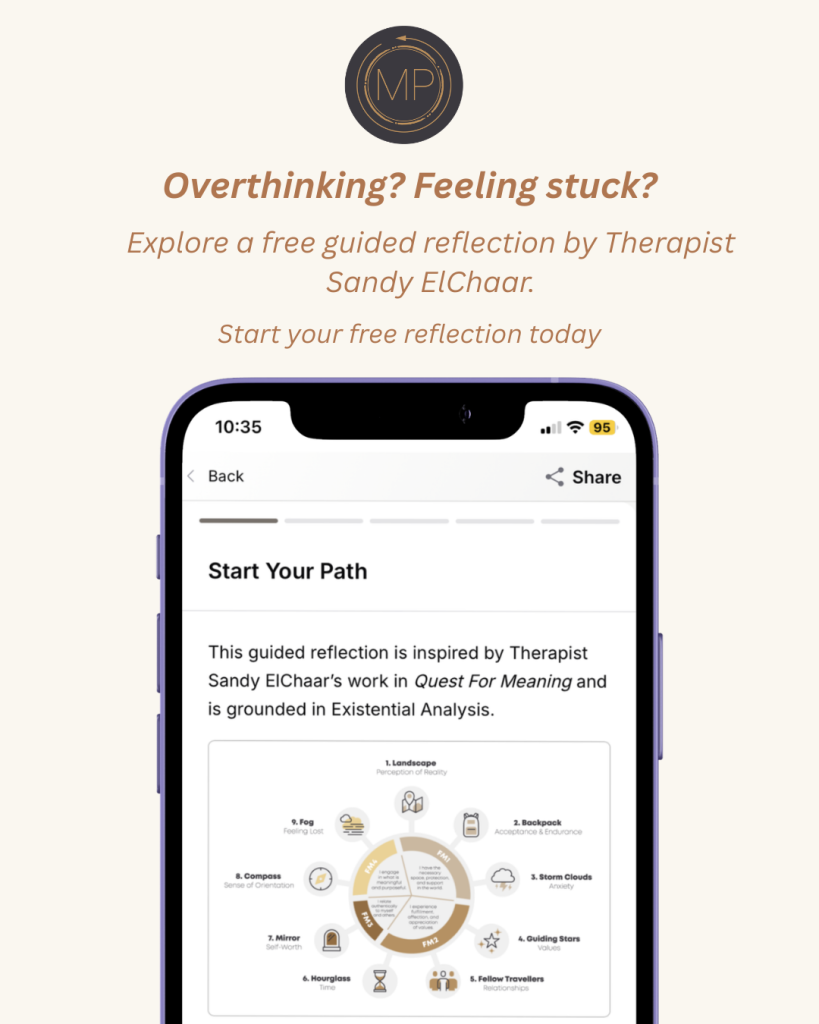
Explore Free Activity – Created by Therapist Sandy ElChaar >>
3. Practice Self-Confidence Through Action
Confidence doesn’t appear magically. It builds through repeated self-trust.
Healthy mental habits include:
- Completing small promises to yourself
- Tracking micro-wins
- Reflecting on strengths weekly
If self-doubt frequently shows up, read:
https://www.meaningfulpaths.com/how-to-build-my-self-confidence-when-doubt-keeps-showing-up/
Confidence is not the absence of doubt. It’s the ability to act despite it.
4. Reduce Overthinking with Structured Reflection
Unstructured rumination fuels anxiety.
Structured reflection reduces it.
Try:
- Writing down one core question
- Setting a 10-minute timer
- Reflecting intentionally
If overthinking dominates your mind, explore:
https://www.meaningfulpaths.com/overthinking-quotes/
Sometimes even short reframing prompts can interrupt cognitive loops.
5. Strengthen Self-Acceptance
Many mental health struggles are amplified by self-criticism.
Healthy habits include:
- Speaking to yourself as you would a friend
- Identifying unrealistic expectations
- Replacing “I should” with “I choose”
For deeper reflection, explore:
https://www.meaningfulpaths.com/self-acceptance-quotes/
Self-acceptance does not mean stagnation.
It means growth without hostility.
6. Create a Personal Growth Plan
Purpose reduces anxiety.
Direction reduces chaos.
A practical mental health habit is designing a simple personal growth structure.
Start here:
https://www.meaningfulpaths.com/sample-personal-growth-plan-with-a-simple-template/
You don’t need a five-year life plan.
You need:
- One area of focus
- One meaningful habit
- One measurable step
Mental wellbeing increases when action aligns with values.
7. Explore Passion Through Meaning
Many people search for passion as excitement.
But passion is often the byproduct of meaning.
If you feel disconnected from direction, read:
https://www.meaningfulpaths.com/how-can-i-find-my-passion-a-meaning-centered-way-to-discover-what-truly-matters/
Mental health improves when:
- Your daily actions reflect your values
- You feel needed
- You feel connected to something larger
8. Prioritise Relational Authenticity
Good mental health is relational.
Habits that strengthen relational wellbeing:
- Honest conversations
- Setting boundaries
- Expressing needs clearly
- Asking for help
Isolation amplifies mental strain.
Authentic connection stabilises it.
9. Protect Your Cognitive Environment
Your mental diet matters.
Reduce:
- Doom-scrolling
- Constant notifications
- Comparison-based content
Increase:
- Reflective reading
- Meaningful conversations
- Focused creative time
Mental clarity is rarely accidental — it is designed.
10. Engage in Meaningful Action Weekly
One of the strongest protective factors in mental health research is meaning.
Ask yourself weekly:
- What did I do that mattered?
- Who did I support?
- What value did I live?
Even small meaningful actions buffer anxiety and low mood.
Why Habits Alone Are Not Enough
Lists of habits can become overwhelming.
Without structure, even healthy practices feel like pressure.
This is why we developed the Mountain Framework — a structured way to explore:
- Your internal landscape
- Your emotional weather
- Your direction
- Your guiding values
You can explore it in more depth here:
https://www.meaningfulpaths.com/our-framework/
A Structured Tool to Support These Habits
If you want a guided, therapist-designed way to build mental health habits around meaning and values, you may find our Existential Workbook & Audio Course helpful:
It includes:
- 10 structured existential exercises
- Audio reflections via the Mountain Framework
- Lifetime access inside the free Meaningful Paths app
- Downloadable PDF workbook
Sometimes mental health habits become sustainable when they are structured.
Mental health grows in the direction of intentional living.
Conclusion: Developing Habits for Good Mental Health
Developing habits for good mental health is not about striving for perfection — it is about building steady, repeatable practices that support emotional clarity, self-trust, and meaningful direction. When daily routines are grounded in space (FM1), values (FM2), authenticity (FM3), and purpose (FM4), habits for good mental health become sustainable rather than overwhelming.
Over time, these habits for health strengthen not only your mood, but your resilience, relationships, and sense of direction. Small actions — taken consistently — create lasting stability. If you would like to explore how physical routines and lifestyle choices support mental wellbeing, you may also find this guide helpful:
https://www.meaningfulpaths.com/daily-habits-for-better-health-physically-mentally/
Start with one habit. Anchor it in meaning. Repeat gently. Good mental health grows through intention, not pressure.
Explore Free Activity – Created by Therapist Sandy ElChaar >>
When to Seek Additional Support
While building healthy daily habits can strengthen your mental wellbeing, there are times when additional support is important.
If you are experiencing:
- Persistent low mood
- Intense anxiety or panic
- Ongoing sleep disruption
- Thoughts of harming yourself
- Feeling unable to cope
Please consider reaching out for professional help.
In the UK, you can contact:
NHS 111 (Press 2 for the urgent mental health line)
Available 24/7 for immediate support.
Samaritans – 116 123
Free, confidential emotional support 24 hours a day.
Mind (mental health charity)
Information and support: https://www.mind.org.uk
Infoline: 0300 123 3393
If you are outside the UK, check your local health services for crisis or emergency mental health support.
Seeking help is not a failure of resilience.
It is often a courageous step toward safety and care.