

Updated August 2026 with new insights via Existential Analysis and the Meaningful Paths Mountain Framework.
Feeling trapped in life: what does it mean?
Feeling trapped in life can happen when you know that something needs to change, but you cannot yet see a realistic or meaningful way forward. You might feel stuck in a relationship, career, routine or life situation — or you may simply have a persistent sense that the life you are living no longer feels right for you.
Sometimes feeling trapped is connected to circumstances that are genuinely difficult to change. At other times, you may technically have choices but feel unable to make them because of fear, uncertainty, responsibilities, expectations or the consequences that change could bring.
This can create an uncomfortable tension between wanting something to be different and not knowing what to do next. You may find yourself overthinking, feeling restless, withdrawing from other people, questioning your decisions or repeatedly searching for a way out without finding one that feels right.
From an existential perspective, feeling trapped can also raise deeper questions about how you are living:
Does my life still reflect what matters to me? Am I able to be myself within it? What am I holding onto? What would I be afraid to lose if something changed?
At Meaningful Paths, we don’t believe that becoming “unstuck” means controlling your thoughts or forcing yourself to think positively. Sometimes the first step is simply understanding what is happening — what belongs to your circumstances, what belongs to fear or uncertainty, and what your experience might be telling you about your needs, values and direction.
In this article, we’ll explore why you may feel trapped in life, the signs of feeling stuck, how Existential Analysis can help us understand the experience, and practical ways to begin finding movement and direction again.
Feeling Trapped Through the Lens of Existential Analysis
Feeling trapped can sometimes be understood as more than simply wanting to escape a particular situation. We may experience a sense of restriction when something fundamental in our relationship with ourselves, our lives, or the world around us feels difficult.
The Four Fundamental Motivations offer four different places from which we can gently explore that feeling. Rather than immediately asking “How do I get out of this?”, we can first ask what may be lacking in space, value, authenticity or meaning.
Space, protection & support
Do I have the necessary space, protection, and support in the world?
Feeling trapped may intensify when we experience too little physical or emotional space, when circumstances feel unstable, or when we cannot see where there is room to move.Fulfilment, affection & values
Do I experience fulfillment, affection, and appreciation of values?
Life can begin to feel constricted when there is little that feels nourishing, valuable or emotionally connecting — even when everything appears fine from the outside.Authenticity & relationship
Do I relate authentically to myself and others?
Sometimes the feeling of being trapped emerges when there is a growing distance between how we are living and who we experience ourselves to be.Meaning & purposeful engagement
Do I engage in what is meaningful and purposeful?
When we struggle to see what our situation is for, where we are going, or what is asking something of us, life can begin to feel directionless or closed.Feeling trapped does not necessarily tell us what needs to change. It may first invite us to understand where we are experiencing too little space, value, authenticity or meaning.
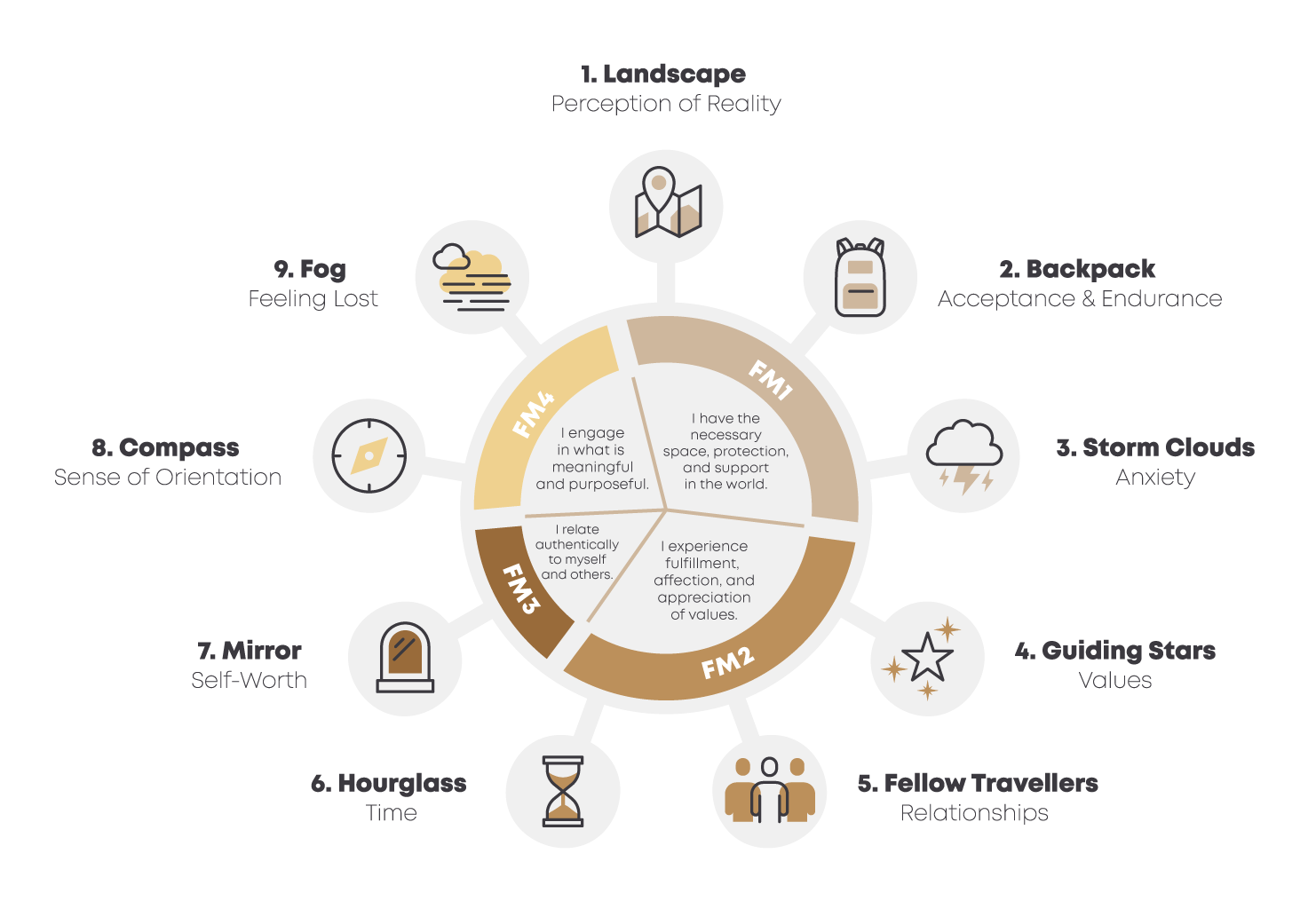
Different Ways Feeling Trapped Can Show Up
Feeling trapped does not always mean that you literally have no choices. The experience can arise when the choices available to you feel limited, costly, uncertain or in conflict with something else that matters.
Sometimes there are also very real external constraints — financial circumstances, caring responsibilities, health, work, housing or relationship circumstances — that cannot simply be changed through a different mindset.
At other times, feeling trapped may emerge from several pressures accumulating at once. Understanding where the feeling of being trapped is coming from can be more helpful than immediately trying to make it disappear.
Feeling trapped by your thoughts
When we are under prolonged stress or anxiety, our attention can become increasingly focused on threats, problems and possible negative outcomes. It can become harder to imagine alternatives, particularly when we are exhausted or overwhelmed.
You might notice yourself repeatedly thinking:
There is no way out.
Nothing I do will make a difference.
Every option feels wrong.
I don’t know what to do.
Rather than trying to force these thoughts away, it can be useful to become curious about them. What is the thought responding to? What are you afraid might happen? What part of the situation can you influence, and what is genuinely outside your control?
Sometimes creating a little distance from a thought allows possibilities that were difficult to see before to become more visible.
Feeling trapped by several areas of life at once
Sometimes there isn’t one obvious problem.
Financial pressure, work, caring responsibilities, relationships, uncertainty about the future and exhaustion can accumulate until life itself begins to feel constricted.
In these situations, asking “How do I fix my life?” can make the problem feel even larger.
A gentler starting point might be:
Which part of my life feels most difficult to carry right now?
Your entire life may not need to change. One part of it may simply need your attention first.
Feeling trapped in a relationship
Feeling trapped in a relationship can mean very different things to different people. It does not automatically mean that the relationship is unhealthy or that it should end.
You may love someone deeply while also feeling that you have lost space for yourself. You may be struggling with recurring conflict, changing needs, responsibilities, intimacy, communication or uncertainty about the future. Sometimes the relationship itself is not the only source of the feeling — pressures elsewhere in life can also affect how much freedom or connection we experience within it.
Instead of immediately asking “Should I stay or leave?”, it may help to explore:
What specifically feels restrictive?
What do I miss within the relationship or within myself?
What would I like there to be more space for?
What still feels valuable about this relationship?
These questions do not determine what you should do. They can simply help make the experience more understandable.

Feeling trapped does not always mean you need an immediate escape. Sometimes the first movement comes from understanding what feels restricted, what you are carrying, and what matters enough to move towards.
Explore Sandy’s reflections and resources on meaning, identity, relationships, uncertainty and finding direction when life feels stuck.
Explore Sandy’s ResourcesFeeling trapped in a marriage
Marriage can hold love, commitment and belonging while also bringing responsibilities, compromises and periods of change.
People themselves change over time too. The needs, values and aspirations you had at one stage of life may not remain exactly the same years later. Feeling trapped within a marriage therefore does not necessarily tell you what the marriage means or what should happen to it.
Sometimes it may point towards something that needs to be understood: a need that has gone unspoken, a loss of individuality, a recurring difficulty between partners, pressures surrounding family or finances, or simply a sense that life has become narrower than it once felt.
A useful question can be:
What am I actually longing for when I imagine feeling less trapped?
The answer might be more independence, closeness, novelty, recognition, rest, purpose, communication or something entirely different.
Understanding that longing can be more informative than judging yourself — or your relationship — for the feeling itself.
Feeling trapped as a parent
It is possible to deeply love your child and still sometimes feel overwhelmed, restricted or disconnected from other parts of yourself.
Those experiences are not mutually exclusive.
Parenthood can involve significant changes to time, identity, relationships, work, sleep, finances and personal freedom. For some parents, particularly during demanding periods, there may be very little time or practical support available for their own needs.
Rather than interpreting the feeling as evidence of how you feel about your child or your ability as a parent, it may be helpful to ask:
Which part of myself feels as though it has had very little space recently?
Perhaps you miss creativity, friendships, work, solitude, movement, spontaneity or simply having time in which nobody needs anything from you.
The answer will be different for every parent. The aim is not to prescribe what self-care should look like, but to recognise that the person you were before becoming a parent still deserves a place within the life you have now.
Feeling trapped in your own body
The phrase “I feel trapped in my body” can describe many different experiences, so it is important not to assume that it means the same thing for everyone.
For some people it may relate to appearance or body image. For others it might relate to illness, disability, pain, physical limitations, anxiety or simply feeling disconnected from bodily experience.
If appearance is part of the struggle, comparison — particularly through social media and idealised images — can make the body feel like something that needs to meet an external standard.
One possible shift is from asking only “How does my body look?” towards also noticing “How do I experience living in my body?”
Movement, rest, comfort, strength, pleasure and physical capability can all become ways of relating to the body that are not centred exclusively on appearance. What feels supportive will differ from person to person.
Feeling trapped living with your parents
Living with parents as an adult can bring both benefits and difficulties.
Housing costs, education, employment, cultural expectations, caring responsibilities and personal circumstances mean there is no single age at which someone should leave home.
At the same time, wanting greater independence, privacy or control over your environment is understandable. You can appreciate having somewhere to live while simultaneously finding aspects of the arrangement difficult.
It may help to separate two questions:
What cannot realistically change about my circumstances right now?
and
Where could I create a little more independence within the circumstances I currently have?
That might involve boundaries, finances, privacy, responsibilities, future planning or simply having an honest conversation about what living together needs to look like as the relationship between parent and adult child changes.
From Feeling Trapped to Feeling More Motivated, Energised & Alive
When life feels trapped or closed in, the goal is not to force yourself into positivity. It can be more helpful to create enough clarity and space for movement to become possible again.
The Mountain Framework offers a simple way to think about this journey: notice the fog, understand what you are carrying, reconnect with what matters, and choose a direction you can begin moving toward.
Make room for uncertainty
Feeling trapped can resemble standing in thick fog. When you cannot clearly see the path ahead, every direction can feel uncertain and the safest response may be to stop moving altogether.
You do not need to see the whole route before taking the next step. Sometimes clarity develops through movement rather than before it.
Notice what you are carrying
Past experiences, responsibilities, disappointments and expectations can add weight to the backpack we carry through life.
The aim is not to throw the backpack away. Some things we carry are important, meaningful or unavoidable. But becoming aware of the weight can help us distinguish between what still belongs with us and what may no longer need to determine our next step.
Reconnect with what matters
Values can act like guiding stars when the path itself is unclear. You may not know exactly what job, relationship decision or life change comes next, but you may still know what qualities you want more of in your life.
Freedom, connection, creativity, stability, contribution, adventure, learning or family may all offer clues about the direction that feels more alive and meaningful to you.
Choose a direction, not a perfect destination
Purpose does not always arrive as one dramatic life mission. It can begin as a direction — a sense of what you want to move closer to and what you want your actions to serve.
A compass does not tell you every step of the journey. It simply helps you orient yourself.
Turn direction into one clear action
Motivation often grows after we begin moving, not before. A very small action can restore a sense of agency and create evidence that change is possible.
Instead of asking “How do I completely change my life?”, try making the next step specific enough that you could actually do it.
Choose one action that is clear, realistic and connected to one of your guiding values.
What is one thing you could do in the next seven days that would move you 1% closer to the life you want?Sometimes energy and joy begin to return when we experience a little more agency, a little more alignment with our values, and one small piece of evidence that movement is possible.
A Final Reflection
Feeling trapped in life often isn’t about laziness or lack of effort. It can feel like being stuck in place, unsure of direction, and worn down by constantly trying to fix things that don’t seem to move. Over time, this kind of stuckness creates exhaustion — not because nothing has been tried, but because too much has been carried without clarity.
Sometimes what helps most is not pushing harder, but pausing long enough to understand what is being carried, what no longer fits, and what still quietly matters. Movement often begins with recognition, not action.
Additional resources
- From Lost Hope to Found Purpose
https://www.meaningfulpaths.com/from-lost-hope-to-found-purpose/
Explores how hope and meaning can return when life feels stalled or directionless. - Reconnecting With Purpose After a Major Life Change
https://www.meaningfulpaths.com/reconnecting-with-purpose-after-a-major-life-change/
A reflection on rebuilding direction and meaning after life shifts, disruptions, or endings.
If you’d like support beyond reading
Articles can help you feel understood. Some people also benefit from gentle structure or personalised guidance as they sit with feelings of stuckness and uncertainty.
You can explore our self-guided tools if you want quiet prompts, reflective exercises, and space to work through things at your own pace:
https://www.meaningfulpaths.com/
If you feel caught in repeated mental loops or unsure how to move forward, our coaching options offer guided conversations to help you reconnect with clarity, direction, and what feels meaningful to you.
At times like these, the question isn’t how to fix everything, but how to begin finding direction again. Direction doesn’t always arrive as a clear plan — it often emerges slowly through reflection, small choices, and noticing what feels more aligned than before.
FAQs for “Feeling Trapped in Life”
Why do I feel trapped in my life?
Feeling trapped in life can happen when you experience a gap between how your life currently is and how you would like it to be, while struggling to see a realistic way forward. Work, relationships, finances, responsibilities, past experiences, uncertainty and a lack of meaning or direction can all contribute. Sometimes several pressures accumulate at once, making your available choices feel much smaller than they actually are.
Is it normal to feel trapped in life?
Yes, feeling trapped can occur during periods of uncertainty, transition, prolonged stress or dissatisfaction. It does not necessarily mean that your entire life needs to change. The feeling can be an invitation to explore what currently feels restrictive and whether you need more space, support, fulfilment, authenticity or meaningful direction.
How do I get mentally unstuck?
Getting mentally unstuck often begins by making the problem smaller and more specific. Instead of asking, “How do I fix my life?”, ask what feels most restrictive right now, what is within your influence, and what one realistic action could create movement. Small actions can help restore a sense of agency when the bigger picture feels overwhelming.
Why do I feel trapped even though my life seems good?
A life can look good externally while still feeling unfulfilling internally. You may have stability, relationships, work or achievements while experiencing little connection with your values, identity or sense of purpose. From an Existential Analysis perspective, fulfilment involves more than circumstances alone; it also concerns whether we can authentically say “yes” to the life we are living.
Can feeling trapped make you lose motivation?
Feeling trapped can be accompanied by lower motivation, withdrawal or a sense that taking action will not make much difference. When the way forward feels unclear, it can become harder to invest energy in movement. Rather than waiting to suddenly feel motivated, identifying one meaningful and achievable next step may help rebuild a sense of possibility.
How can I find purpose when I feel stuck?
Purpose does not necessarily require discovering one major calling. Start by identifying what you value, what you care about, what feels worth contributing to and what you would like more of in your life. These can act as guiding stars: even when you cannot see the entire path, they can help you choose a meaningful direction.
What does the Mountain Framework say about feeling trapped?
The Meaningful Paths Mountain Framework uses different elements of a mountain journey to explore experiences such as feeling stuck. Fog represents uncertainty, the Backpack represents experiences and influences we carry, Guiding Stars represent our values, and the Compass represents purpose and direction. Together, they help shift the question from “How do I escape?” toward “What am I experiencing, what matters to me, and where might I move next?”
What is one thing I can do today if I feel trapped?
Choose one area of your life that currently feels restrictive and write down one small action that is genuinely within your control. It might be having a conversation, researching an option, returning to something you value, asking for support or setting aside time to think. The aim is not to solve everything today; it is to create one experience of movement.
References
https://www.bluezones.com/2012/04/friends-nourish-the-body-and-soul/
https://www.ncbi.nlm.nih.gov/pmc/articles/PMC2908186/
https://www.sciencedaily.com/releases/2013/12/131205220031.htm