
In recent years, there’s been a reawakening to our being part of nature. The main widespread message is: we need to be spending more time in nature. While there’s nothing wrong with this idea, I personally prefer and find it more accurate to think that “being cut from the living world is harming us”. Because “more time in nature” implies that our baseline is already fine and that we would just add some extra moments. And because it puts the emphasis on duration rather than relationship, cycles, processes.
In a way, it’s the different side of the same coin that I’m interested in. And there is another aspect about this that I feel deserves closer attention, particularly when we think about social and psychological distress: the fact that human life is actually more and more akin to the machine realm. This isn’t new, but it has accelerated in the more recent era.
As human beings, we evolved alongside the rest of the living world. Our physiology is intimately linked to the trees, the seas, the seasons cycles, the other animals… to the solar system. We are great apes and belong to the mammalian family, not to the mechanical or digital one. Yet the way we talk and think about the human experience is slowly distancing us from this reality. And this belief is so pervasive in our culture that none of us is entirely immune from it, not even those of us who feel deeply connected to nature.
The first obvious sign is found in the vocabulary that we use to describe ourselves and our experiences. It is becoming more and more colonised by the machine world: “I feel rusty”, “I don’t have enough bandwidth for this”, “he was running out of steam”, “we need to boost their energy”, “She’s not wired like me”, “What is your target?”, “They just switched off”, and so on and so forth.
Of course, language is meant to be creative, and there is nothing wrong with using metaphors drawn from the mechanical world. But when this way of speaking becomes habitual and involuntary, it can begin to shape our understanding of ourselves, others and the world around us. And without necessarily realising it, we start seeing human experiences through a mechanical lens, which can then influence how we relate to ourselves and others.
A machine is made of parts which can be changed and fixed
When we consider the human experience in a mechanistic way, it can lead to thinking about it in a simplistic and reductive way. We focus on one part rather than appreciating the complexity of the whole, overlooking the intricate relationship between our bodies, minds and environments.
When something feels wrong, we look for one element to address and one solution to put it right. Bookshops are full of books promising The solution to That problem, while pharmacies offer vitamins and supplements for almost every conceivable condition. In my work, I often meet people who are anxiously searching for that one missing piece, that one method or explanation that will finally make sense of their difficulties and resolve them. We all long for such a possibility, that’s understandable. When we are struggling, the promise of a clear and simple answer can be incredibly reassuring.
The paradox though is that when we start seeing our emotions and difficulties as faults in the system, it can set the ground for shame, self-criticism and emotional suppression. We may end up feeling that we have failed because we haven’t managed to resolve an issue that we have repeatedly been made to believe should be easy to identify and fix.
A machine has a user’s manual with a troubleshooting chapter
We’ve gradually come to believe that we can predict and control events, behaviours, outcomes. This has contributed to the development of standardised methods, measuring systems or diagnosis tools. These can be useful and helpful at times, but they also suggest to us that uncertainty, unpredictability, the unknown are signs that something has gone wrong rather than being inherent elements of human life. We can then grow less and less able to accept and bear those uncertain or unknown factors and this leaves us naturally feeling more and more anxious, stressed and fearful. Ironically, the very ideas that promised certainty and clarity end up creating more anxiety and stress.
A machine is expected to follow a set of instructions within a few predetermined functions
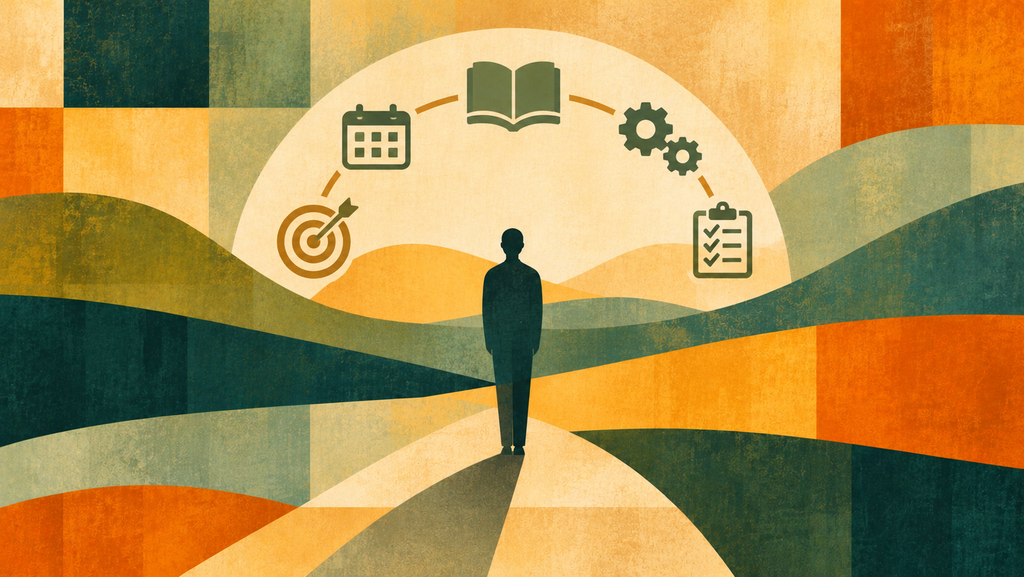
To have a good life, we are told to spend 20 minutes in nature every day, eat five portions of fruit and vegetables, walk 10,000 steps and, more recently, follow the 3-2-1 concept for friendships.
These recommendations can be undoubtedly beneficial. But the way they are presented misses something fundamental: we are not all the same, and what supports one person’s wellbeing may not necessarily work for another. Nor can our wellbeing be reduced to a collection of set prescriptions. How can we not feel inadequate or the pressure of perfectionism when we are constantly bombarded by rigid prescriptions like these?
I find it more helpful to think of balance and wellbeing as something like walking on a tightrope. To remain in equilibrium, we need to be continually sensing and responding to the subtle and not-so-subtle movements within and around us, adjusting our bodies and movements accordingly. If there is wind, we will change how we walk. If another person is on the rope with us, we will adjust to that as well. Balance is an ongoing, dynamic process, not a static one, and it requires us to be attuned to our own body sensations, thoughts and feelings. It requires us to connect to our animal side.
But in fact, anything that might precisely remind us of our animal side tends also to be dismissed, repressed or ridiculed. We have come to think of our bodies as things to be controlled and formatted. Think, for example, of the shame or embarrassment many of us experience when using our voices freely or moving our bodies spontaneously, particularly in front of others. We have learned to suppress our natural expressiveness.
We have also become somewhat disconnected from some of our greatest gifts: our senses, our intuition and our capacity for imagination. We increasingly rely on apps telling us if we slept well, when to stop looking at our phones or if it’s going to rain rather than tuning into our bodily sensations, looking at the sky and feeling the wind on our skin. And I find it incredibly sad and frustrating that, in our growing reliance on external devices, we are beginning to lose sight of our own skills and knowledge. We slowly adopt the belief that machines know better than we do and that our own senses and instincts are somehow less reliable or valuable.
A machine is expected to operate continuously, efficiently and without interruption
A good machine is one that functions smoothly, quickly and constantly. And this brings me to another important theme: productivity.
It is something that comes up frequently in my conversations with people. Sometimes it appears as guilt at the thought of resting or relaxing. Sometimes as a constant need for linear progress and growth in order to feel satisfied. And sometimes through comparing ourselves competitively with others, to avoid feeling that we are falling behind.
Yet the more we try to live according to this relentless productivity and linearity ideal, the more dissatisfied and frustrated we can become, not to mention the growing risk of exhaustion and burnout.
We need rest, periods of stillness, play, spontaneity, times when nothing particularly useful seems to be happening. These are fully part of life itself, not a waste of time. Trees would not bear fruits if they were not going dormant in Winter. Unlike the productivity of a machine, nature productivity is a dynamic process, it needs times of rest and slowness and times of activity and acceleration. And rather than a linear, straight motion, it works in a circular, spiralling one.
A machine is expected to work unassisted
In our culture, we associate a successful life with being able to manage everything ourselves, without depending on others or needing help. We’ve adopted self-reliance and independence as our golden rule.
And yet human life and the living world that we are part of are interconnected. There’s no escaping it. Even the person who appears to be entirely self-sufficient relies on other beings or elements. The simple fact that we need to eat means that we depend on farmers and growers, and the plants or animals we actually eat. We breathe oxygen released by trees and oceans. We access NHS medical care or state education thanks to others contributing also to their funding. We learn from others either directly or by being inspired by them.
I wonder what difference it would make if we were to acknowledge more this interdependence in our lives? I suspect it would bring a greater sense of connection to others, and possibly some feelings of gratitude and more desire to care back.
We need other beings and we cannot thrive without connection and belonging. The current growing loneliness epidemic is perhaps one of the saddest reminders of that truth.
There would be obviously much more to say about this wide topic. And in writing this piece, I don’t want to appear to simplify, in my turn, the difficulties we are facing and add more guilt, inadequacy or despair to our lives. There are, of course, a mix of factors contributing to our human struggles. But I do believe this mechanical view of our world is an important one and deserves our attention.
My actual wish is to bring some awareness about it and therefore new possibilities. For when we take things for granted, they become invisible and this invisibility is what grants them power over us.
I hope that we can all feel encourage to be curious and start noticing when we are treating ourselves or others as machines: when we talk in mechanistic ways, when we look for a quick fix to something complex, when we judge ourselves for needing rest or help, or when we try to control every aspect of our lives.
As with so many things, awareness is an essential first step. It allows us to understand what is happening, where certain beliefs and expectations might come from, and how they might be shaping our lives. And in turns, it will create the possibility for us to choose whether, and to what extent, we want these mechanical ways of thinking to influence us.