

Featured Image – https://www.pexels.com/@energepic-com-27411
Relationships are meant to be a source of connection, warmth, and mutual support. And yet, for many people, the experience can feel like an emotional rollercoaster— repetitive thoughts, second-guessing, replaying conversations, scanning for meaning. You may find yourself asking questions like, “Why do I overthink so much in my relationship?”, or wondering whether something about you or your partner is broken. You might be late at night staring at the ceiling, asking: “Why do I overthink in my relationship?” Or more generally, you may feel weighed down by your own mind, thinking too much, too often — which brings up the question: Why do I always overthink things?
In this article, we’ll explore these questions not as problems to be fixed with willpower or quick tips, but as deeper invitations to understand what your mind is trying to do, why it gets caught in loops, and how you can move toward connection and clarity using the Meaningful Paths framework.
Why Do I Overthink So Much in My Relationship?
Overthinking in relationships is often an attempt to create certainty in situations that feel emotionally important. When we care deeply about someone, our minds naturally pay attention to signs of connection, distance, rejection, or uncertainty. As a result, small events can sometimes trigger large amounts of reflection, worry, or self-questioning.
According to existential psychologist and therapist Sandy ElChaar, overthinking is rarely random. It often reflects underlying needs related to security, belonging, trust, self-worth, connection, or fear of loss. Rather than viewing overthinking as a personal flaw, it can be helpful to explore what your thoughts may be trying to protect or understand.
Within the Meaningful Paths framework, overthinking often emerges in My Journey — the inner narrative through which we make sense of uncertainty, relationships, emotions, and our place in the world.
Overthinking Isn’t Random — It Has Meaning
Overthinking is not an arbitrary flaw, nor is it a sign of failing in a relationship. From the Meaningful Paths framework, life experience is shaped by three domains:
- My Motivation — the inner “why”
- My Journey — the narrative and patterns
- My Decisions — how I act and respond
Overthinking sits primarily in what we might call My Journey — the stream of internal experience that tries to make sense of uncertainty, threat, and emotional pain. When you ask, “Why do I overthink so much in my relationship?”, you’re really pointing to an emotional experience that is trying to solve a felt problem — What’s happening here? What does it mean? What should I do?
Your mind uses thinking to try to reduce uncertainty. But when the situation feels important, ambiguous, or emotionally charged, the thinking doesn’t settle. Instead it loops. Understanding this is the first step toward a different relationship with your thoughts — not trying to stop them forcefully, but learning what they are responding to.
Emotional Self-Awareness: The Lens That Changes Everything
Before we talk about relationships specifically, it helps to understand the role of emotional self-awareness in how thoughts arise and persist.
When your emotions are strong — whether fear, insecurity, longing, pain, or uncertainty — your body and mind naturally try to make sense of the experience. This is healthy and adaptive. But if you don’t have words or clarity for what you’re feeling, your mind will generate stories to fill that gap. This can feel like overthinking.
This is where emotional awareness becomes crucial. If you want to start unpacking questions like “Why do I overthink in my relationship?”, it helps to notice what your mind is responding to before you try to quiet it. For example:
- What emotions come up when you think about a past conversation with your partner?
- What sensations arise in your body when you wait for a text reply?
- What is the felt experience behind the thoughts?
For a deeper exploration of this dynamic — and how emotional self-awareness leads to more purposeful decisions — see How Emotional Self-Awareness Fosters Purpose.
Overthinking often feels like thinking without resolution because the emotional signal beneath it has not been consciously distinguished.

Feeling caught in rumination, seeking clarity or purpose?
If you’ve been reflecting on overthinking, direction, or the search for meaning, you may find deeper structure and guidance in our → Quest For Meaning EBook by Therapist Sandy ElChaar.
Written from an existential perspective, this ebook explores rumination, identity, purpose, and uncertainty through the Meaningful Paths framework. Rather than offering quick fixes, it helps you understand why certain thoughts repeat, what they may be pointing toward, and how to move from mental loops toward clarity and meaningful direction.
If you’re looking for something you can work through at your own pace — thoughtfully and without pressure — the → Quest For Meaning EBook offers a deeper companion to the ideas explored here.
Relationships Trigger Deep Parts of Us
Now let’s bring this into the relational context.
You may be wondering, “Why do I overthink so much in my relationship?” Romantic relationships activate deep patterns in us — patterns shaped by early attachment experiences, self-worth, fear of rejection, fear of being misunderstood, and the deep human need for connection.
When you overthink a text message, a tone of voice, or your partner’s silence, your mind is responding to risk — emotional risk. Even if the situation is small, your nervous system may be activating a protective pattern that comes from long before your current partner.
This is not a flaw; this is meaningful. The mind is trying to protect you, to anticipate threat, to prepare you. But it can overshoot and get stuck in loops of what-ifs and worst-case scenarios.
This is an important part of a broader question: “Why do I always overthink things?” Especially in relationships, overthinking is not just about the present moment. It’s about how your nervous system learned to respond when connection feels uncertain. Recognising this opens up a path for compassion and curiosity — not judgement.
From the Mountain Framework: What’s the Underlying Motivation?
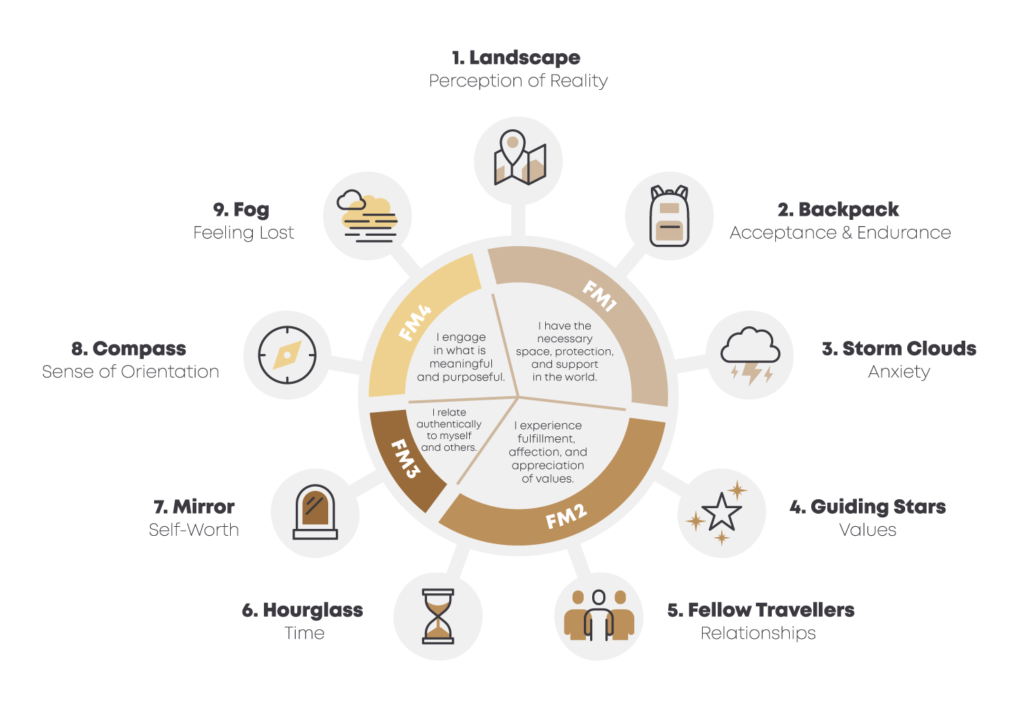
Meaningful Paths uses the Mountain Framework — My Motivation, My Journey, My Decisions — to help people deepen their understanding of internal experience and make more meaningful decisions.
Ask yourself:
- What is my mind trying to accomplish with these thoughts?
- What need is being activated — clarity, safety, reassurance, control, connection?
- How does my thinking serve me — and when does it interfere?
When you ask “Why do I overthink in my relationship?”, beneath the surface is often a deeper emotional question like:
- “Am I safe here?”
- “Do I matter to this person?”
- “Will I be rejected?”
- “What does their behaviour mean about us?”
These questions matter. But the way your mind tries to answer them — by looping through scenarios — doesn’t always bring you closer to understanding them. Instead, it can feel like being stuck at the same viewpoint again and again.
Overthinking and Emotional Loneliness
Relationships can be confusing because they put you in close proximity to someone, but your internal experience can feel silent and isolated. This leads many people to ask:
“Why do I overthink so much in my relationship?” or “Why do I overthink in my relationship?” especially when you feel emotionally alone even while being with someone.
Overthinking often fills the gap between what you experience inside and what you feel you can say out loud. This internal dialogue can feel like a companion — but it’s a companion that argues with uncertainty and loops instead of listens with empathy.
For a deeper look at how emotional loneliness arises in relationships — and what it feels like — see Why Do I Feel Lonely in My Relationship?.
Part of quieting overthinking is not shutting down thought, but learning how to bring emotional experience into awareness so thinking can become reflective rather than reactive.
Navigating Overthinking: A Path Forward
Understanding the why is only the beginning. The Meaningful Paths journey is less about defeating your thoughts and more about shifting your relationship with them. Here are the kinds of shifts that help:
1. Notice Intent Before Content
Instead of getting lost in the details of “Did they mean X?” start by noticing what felt need the thought is responding to. Are you seeking safety? Connection? Acceptance?
Thoughts often feel like facts, but they are attempts to respond to emotion.
2. Pause and Name What’s Arising
When you catch yourself in a loop, try naming the experience before you unpack the content:
- “There’s fear here.”
- “I’m longing to feel understood.”
- “I’m worried about rejection.”
Naming the emotion interrupts the autopilot of rumination and invites reflective awareness.
3. Create Space Before You Act
When emotions are high, decisions can be driven by the loop — not by your values or your true intentions. Create a habit of saying:
“I notice I’m feeling X and thinking Y. I’m going to give this some space before I respond.”
This is a decision that respects both your mind and your relationship.
4. Use Reflective Questions, Not Fuel for the Loop
Questions like “What does this feeling want me to understand?” can be grounding. Avoid “What does this mean about us?” which often feeds rumination.
5. Return to Your Motivation
Your deeper motivation — to be loved, safe, understood, and connected — is not served by overthinking. Once you recognise the need behind the thought, you can act in ways that align with your values.
This shift from thinking about problems to feeling into experience then choosing your response is a profound move toward clarity and purpose.
Closing the Loop: What You’ve Learned
So when you find yourself thinking:
- “Why do I overthink so much in my relationship?”
- “Why do I overthink in my relationship?”
- “Why do I always overthink things?”
Remember:
- Overthinking is not random — it’s a response to emotional uncertainty.
- You don’t have to force your mind to stop — you can understand what it’s responding to.
- The Meaningful Paths framework helps you move from reactive thinking to reflective awareness, which is what truly shifts experience.
- Emotional self-awareness — the ability to notice what you are feeling before you act — is essential.
If you’re curious to explore more about how reflections and tools can support this process, you might find comfort and insight in our Overthinking Quotes page — a gentle companion for minds that loop.
If you’re looking for a clear explanation, you may find our article on the definitions of intimacy helpful in understanding what intimacy really means in psychology and relationships.
🧭 Explore Your Relationship Questions with Path Search
Relationships often bring questions that don’t have simple answers:
- Why do I overthink everything in my relationship?
- Why am I afraid of being abandoned?
- How do I trust myself and my partner more?
- Why do I need constant reassurance?
- What is my anxiety trying to tell me?
🧭 Path Search is our free reflective tool designed to help you explore questions about relationships, attachment, self-worth, trust, belonging, anxiety, meaning, and personal growth.
Simply type your question in your own words and discover relevant reflections, activities, articles, and resources grounded in Existential Analysis and the Meaningful Paths framework.
Many people discover that greater clarity begins not by fighting their thoughts, but by understanding them.
🧭 Try Path Search for Free → Path Search – Meaningful Paths
Where to Go Next
- Clarify emotional experience: Read Why Emotional Self-Awareness Fosters Purpose to deepen awareness of your inner life.
- Understand relational loneliness: Visit Why Do I Feel Lonely in My Relationship? to explore that experience compassionately.
- Find gentle reflection in language: Explore Overthinking Quotes and see how others have made sense of similar experiences.
- If you’re looking to go deeper, our collection of relationship journaling prompts offers structured questions designed to strengthen communication, clarify emotions, and rebuild connection with intention
Reflect on Your Relationship Goals
If you are thinking about how to strengthen your connection with your partner, you may find it helpful to explore our guide on relationship goals for couples. In this article, we explore healthy relationship goals, practical relationship goals examples, and ways couples can grow emotionally and communicate more openly.
Read the full guide:
https://www.meaningfulpaths.com/relationship-goals/
Frequently Asked Questions
Why do I overthink so much in my relationship?
Overthinking often occurs when a relationship feels emotionally significant. Your mind may be trying to understand uncertainty, prevent rejection, maintain connection, or make sense of situations that feel important to you.
Is overthinking a sign that something is wrong with my relationship?
Not necessarily. Overthinking can happen in healthy and unhealthy relationships alike. Sometimes it reflects uncertainty, anxiety, past experiences, or a strong desire for reassurance rather than an actual problem within the relationship itself.
Why do I constantly analyse my partner’s behaviour?
When relationships matter deeply, people often look for clues about connection, safety, trust, or commitment. This can lead to analysing messages, conversations, tone of voice, or behaviour in an attempt to gain certainty.
Can anxiety cause relationship overthinking?
Yes. Anxiety can increase uncertainty, amplify worries, and encourage repetitive thinking. When anxiety is present, the mind may become more focused on identifying potential problems or threats within the relationship.
What does existential psychology say about overthinking?
Existential psychology views overthinking as an attempt to understand uncertainty, relationships, identity, belonging, and emotional needs. Rather than seeing it as a flaw, it can sometimes be understood as a response to important aspects of being human.
Why do I overthink even when my partner reassures me?
Reassurance can be helpful, but if deeper concerns about trust, self-worth, attachment, or security remain unresolved, the mind may continue searching for certainty despite receiving reassurance.
Is overthinking linked to self-worth?
Often, yes. People who struggle with self-worth may be more likely to question whether they are valued, loved, accepted, or enough within relationships. This can contribute to repeated self-doubt and overanalysis.
How can I stop overthinking in my relationship?
Many people benefit from focusing on the present moment, communicating openly, challenging assumptions, strengthening self-awareness, and exploring the emotional needs beneath the thoughts. Understanding the cause of overthinking is often more effective than simply trying to suppress it.
Why do I imagine worst-case scenarios in relationships?
The mind sometimes creates worst-case scenarios as a way of preparing for potential pain or disappointment. Although intended to protect us, this habit often increases anxiety rather than reducing it.
Can overthinking affect a relationship?
Yes. Persistent overthinking can create stress, misunderstanding, and emotional exhaustion. Learning to balance reflection with trust, communication, and self-awareness can help support healthier relationships.